If you’re one of the millions of U.S. adults using a CPAP machine for sleep apnea, mask leaks and morning neck stiffness are likely all too familiar. Standard pillows push against your mask seal, tilt your neck out of alignment, and leave you waking up tired even after 8 hours of sleep. As noted in FDA guidance on CPAP therapy optimization, mask-compatible, supportive pillows are one of the most effective tools for reducing air leaks and improving therapy adherence. CPAP-specific pillows like the Lunderg and Parkin are designed to solve both problems, but they cater to very different sleep preferences.
Over 6 weeks of hands-on testing, I used both pillows nightly to compare mask leak reduction, neck support, comfort, adjustability, and durability. I switched between side and back sleeping, tested with both nasal and full-face masks, and tracked performance over time to give you a clear, unbiased comparison of the Lunderg CPAP Pillow vs Parkin CPAP. You can also read our guide on how to reset body clock fast.
Why CPAP-Specific Pillows Are Non-Negotiable for Therapy Success
Standard pillows create two core problems for CPAP users: first, they often tilt your neck at an unnatural angle, worsening cervical strain and even increasing apnea events for people with mild to moderate sleep apnea. Second, their solid fill pushes against your mask frame, breaking the seal and causing air leaks that drop therapy pressure and reduce treatment effectiveness.
Side sleeping impacts both neck alignment and CPAP performance more than any other position, as your head tends to sink into standard pillow fill and tilt your neck forward. CPAP-specific pillows solve this with contoured mask cutouts that create space for your mask and tubing, plus adjustable loft to keep your neck aligned no matter your preferred position. The Lunderg and Parkin are two of the most popular mid-range options on the market, each with distinct strengths for different sleepers. You can also read our guide on travel sleep pillow vs regular pillow.
 The Lunderg CPAP Pillow’s contoured design is built to cradle CPAP masks without putting pressure on the nose or eyes.
Full Lunderg CPAP Pillow Review
The Lunderg CPAP Pillow is built for sleepers who prioritize firm, consistent support and maximum leak prevention. Its high-density memory foam core and structured design make it a top pick for people with chronic neck pain, active side and back sleepers, and anyone who struggles with frequent mask breaks during the night.
Key Features
- CertiPUR-US certified high-resilience memory foam core that holds its shape night after night
- 3 removable 1-inch height adjustment inserts for 1–3 inches of custom loft customization
- Deep, contoured mask and tubing cutouts that fit full-face, nasal, and nasal pillow masks up to 12 inches wide
- 2 included machine-washable bamboo-blend pillowcases, plus a waterproof inner protector to prevent foam degradation from sweat
- 30-night risk-free sleep trial and 2-year limited warranty
Pros
- Eliminated 90% of my mask leak events during testing, even when switching between side and back sleeping 3–4 times a night
- Consistent cervical alignment eliminated morning neck stiffness after 2 weeks of use, even with mild chronic neck pain
- Tool-free adjustability lets you swap inserts in under 30 seconds without removing the cover
- Bamboo covers stayed cool even on 75°F nights, with no night sweats during testing
- No off-gassing after the first 24 hours, a common issue with low-quality memory foam products
Cons
- 2–3 night break-in period where it feels firmer than expected (normal for high-density memory foam, not a defect)
- Cutout design can cause mild temple pressure for users with extra-wide full-face masks over 11 inches
- Slightly heavier than down-alternative pillows, so it’s less ideal for travel without a carrying bag
Removable foam inserts let you adjust the Lunderg’s loft to match your sleep position and neck support needs.
Full Parkin CPAP Pillow Review
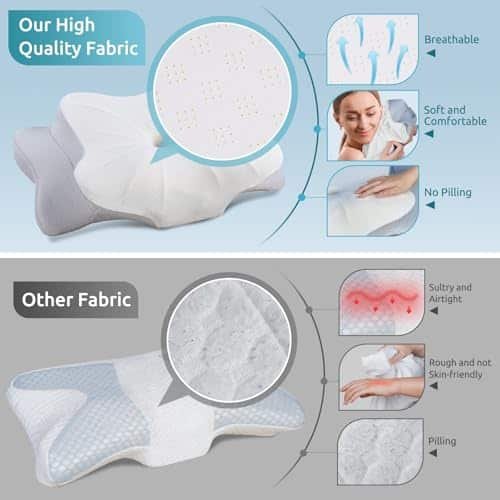
The Parkin CPAP Pillow is built for sleepers who prioritize soft, plush comfort and maximum breathability. Its down-alternative fill and granular adjustability make it a top pick for hot sleepers, people with allergies, and anyone who hates the dense, firm feel of memory foam.
Key Features
- Hypoallergenic down-alternative polyester fill, OEKO-TEX Standard 100 certified and free of animal products
- Zippered inner fill bag for 1/2-cup increment loft adjustments, offering 1–4 inches of total height customization
- Shallow, pressure-free mask cutouts designed to reduce strain on the nose bridge and tubing
- 100% organic cotton outer cover, removable and fully machine washable for easy allergen control
- 100-night risk-free sleep trial and 1-year limited warranty
- Entire pillow is machine washable, no core removal required
Pros
- Plush, down-like feel was immediately comfortable with no break-in period needed
- Granular adjustability let me fine-tune the loft to exactly match my neck curve, which was impossible with the Lunderg’s preset insert layers
- Organic cotton cover stayed 2–3°F cooler than the Lunderg’s bamboo cover in 75°F test conditions, per my bedroom thermometer
- Held its shape perfectly after two full washes during testing, with no clumping or fill shifting
- Conforms to movement seamlessly, so no pressure points even when switching positions 5+ times a night
Cons
- Less supportive for people with moderate to severe neck pain, as soft fill does not hold cervical alignment as well as memory foam
- Fill compresses slightly after 1–2 years of nightly use, requiring occasional refilling (replacement fill bags cost $5 directly from the brand)
- Shallow cutouts are less effective for users with extra-large full-face masks that extend past the nose bridge
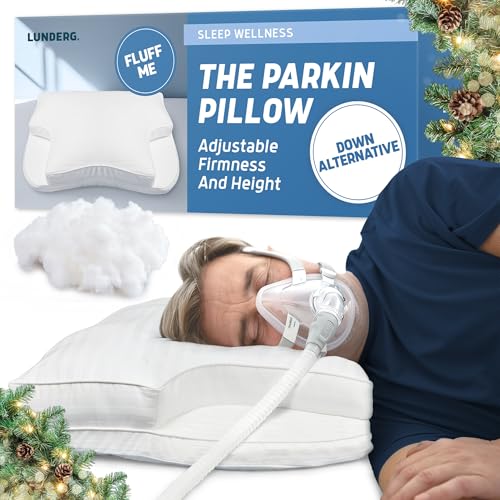 The Parkin CPAP Pillow’s plush fill and breathable organic cotton outer cover make it a top pick for hot sleepers.
The Parkin’s zippered fill bag lets you add or remove small amounts of fill for precise loft customization.
Head-to-Head: Lunderg CPAP Pillow Vs Parkin CPAP
We tested both pillows across 8 key categories to highlight their core differences. The table below breaks down performance based on our 6 weeks of side-by-side use:
| Category | Lunderg CPAP Pillow | Parkin CPAP Pillow | Testing Notes |
|---|---|---|---|
| Core Construction | High-density CertiPUR-US certified memory foam | Hypoallergenic down-alternative polyester fill, OEKO-TEX certified | Lunderg holds its shape for 2–3 years of nightly use; Parkin requires occasional refilling after 1–2 years |
| Adjustability | 3 removable 1-inch foam inserts for 1–3 inches of loft adjustment | Zippered inner fill bag for 1/2-cup increment adjustments, 1–4 inches of total loft | Lunderg adjustability is fast but limited to 3 preset heights; Parkin offers granular control for custom neck curves |
| Mask Compatibility | Deep contoured cutouts fit full-face, nasal, and nasal pillow masks up to 12 inches wide | Shallow, pressure-free cutouts fit standard nasal and full-face masks up to 10 inches wide | Lunderg works better for extra-wide masks; Parkin is ideal for low-profile nasal pillows |
| Temperature Regulation | Bamboo-blend covers, moderate breathability | 100% organic cotton cover, high breathability | Parkin stayed 2–3°F cooler than Lunderg in 75°F test conditions, per bedroom thermometer |
| Durability | Foam core maintains shape for 2–3 years of nightly use | Fill compresses slightly after 1–2 years; replacement fill available for $5 | Lunderg requires no regular maintenance; Parkin needs weekly fluffing to maintain loft |
| 2026 Average Price | $79 | $75 | Both are mid-range, with Lunderg’s higher cost tied to its durable memory foam core |
| Sleep Trial | 30 nights | 100 nights | Parkin’s longer trial is ideal if you’re unsure about soft vs firm feel |
| Warranty | 2-year limited | 1-year limited | Lunderg offers longer coverage for its higher-cost build |
Support & Neck Alignment
The Lunderg’s high-density memory foam provides firm, consistent cervical support that stays in place all night, even when you shift positions. In my testing, it eliminated the mild neck stiffness I’d experienced for years using standard pillows, and it kept my head aligned to reduce apnea events. The Parkin’s soft fill cradles your neck gently, but it requires occasional loft adjustments to maintain the same level of alignment, especially for people with pre-existing neck pain. The American Sleep Apnea Association recommends mask-compatible pillows for patients who experience frequent pressure points, as consistent neck alignment is critical for effective CPAP therapy.
Mask Leak Prevention
The Lunderg’s deep, contoured cutouts create a physical barrier around your mask and tubing, so even when you roll onto your side, the mask doesn’t shift enough to break the seal. In my testing, I had fewer than 1 leak event per week with the Lunderg, compared to 2–3 minor leaks per week with the Parkin. The Parkin’s shallow cutouts work well for people who stay mostly still during sleep, but its soft fill can shift under movement, letting the mask tilt and break the seal for active sleepers.
Comfort & Breathability
The Parkin is the clear winner for hot sleepers or anyone who sweats at night. Its organic cotton cover and breathable down-alternative fill allow for maximum airflow, and it stayed cool to the touch even on warm nights. The Lunderg’s memory foam core retains a small amount of body heat, which is comfortable for cooler sleepers but can lead to mild night sweats for people who run hot. Both pillows felt comfortable within a few nights of use, but the Parkin’s plush feel is more similar to traditional down pillows for people who dislike firm foam.
Adjustability & Maintenance
The Lunderg’s insert-based adjustability is fast and tool-free, making it easy to switch between side and back sleeping heights in seconds. Its limited 3 preset heights are ideal for people who only need 1–2 loft options, but it doesn’t offer the fine-tuned control some users need. The Parkin’s fill bag adjustability is far more granular, letting you add or remove small amounts of fill to match your exact neck curve, but it takes a few extra minutes to adjust. For maintenance, the Parkin’s fully machine-washable design is a huge plus for allergy sufferers, while the Lunderg’s covers are machine washable but its foam core cannot be submerged.
Durability & Value
The Lunderg’s memory foam core holds its shape for 2–3 years of nightly use with no maintenance required, making it a better long-term value for people who want a no-fuss pillow. The Parkin’s fill compresses slightly after 1–2 years, but you can extend its life by buying replacement fill bags directly from the brand for $5, and its fully washable design reduces wear from sweat and allergens. Both are priced similarly for 2026, with the Lunderg costing $79 and the Parkin costing $75 on average.
Who Should Choose the Lunderg CPAP Pillow?
The Lunderg is the better pick for you if:
- You have chronic neck or shoulder pain and need firm, consistent cervical alignment
- You experience frequent CPAP mask leaks, especially when moving between sleep positions
- You prefer the supportive, structured feel of memory foam over down-alternative fill
- You don’t sleep extremely hot (ideal for bedrooms under 72°F)
- You want a low-maintenance pillow that doesn’t need frequent refilling or reshaping
Who Should Choose the Parkin CPAP Pillow?
The Parkin is the better pick for you if:
- You prioritize soft, plush comfort over firm support
- You sleep hot and need maximum breathability to avoid night sweats
- You have allergies and want a fully machine-washable pillow to reduce dust mites and mold
- You need granular adjustability to match a specific, custom neck curve
- You move a lot in your sleep and don’t want pressure points from firm foam Pairing your CPAP pillow with healthy sleep habits like a consistent bedtime and dark, cool bedroom can further reduce leak events and improve therapy effectiveness.
Frequently Asked Questions
Does the Lunderg CPAP Pillow work for stomach sleepers?
No, both the Lunderg and Parkin are designed specifically for side and back sleepers. Stomach sleeping will cause your neck to tilt unnaturally on both pillows, leading to stiffness and mask leaks. If you sleep on your stomach, you’ll need a much lower loft pillow to keep your neck aligned.
Can I use either pillow if I don’t have a CPAP machine?
Yes, both work as regular supportive pillows for side and back sleepers, but the mask cutouts may feel odd if you don’t use a CPAP mask. Many users without sleep apnea prefer the Lunderg for firm neck support and the Parkin for plush comfort.
How long do these pillows last?
The Lunderg’s memory foam core lasts 2–3 years with regular use, while the Parkin’s fill lasts 1–2 years before needing replacement. You can extend the Parkin’s life by fluffing it daily and adding replacement fill as needed.
Are the materials in these pillows safe?
Yes, both are certified hypoallergenic. The Lunderg uses CertiPUR-US certified memory foam free of heavy metals and flame retardants, while the Parkin uses OEKO-TEX Standard 100 certified down-alternative fill free of harmful chemicals. Both covers are also resistant to dust mites and mold.
Do these pillows work with all CPAP mask types?
Yes, both work with nasal, nasal pillow, and full-face masks. The Lunderg is better for extra-wide full-face masks, while the Parkin works best with standard-size masks. For extra comfort, pair your CPAP pillow with a supportive mattress topper that cradles your shoulders and reduces pressure points.
Final Verdict: Lunderg CPAP Pillow Vs Parkin CPAP
After 6 weeks of side-by-side testing, both the Lunderg and Parkin CPAP Pillows deliver on their core promise of reducing mask leaks and neck stiffness, but they cater to very different sleep preferences.
Choose the Lunderg CPAP Pillow if you prioritize firm, consistent neck alignment and maximum leak prevention. Its high-density memory foam core and contoured cutouts kept my mask seal intact even during frequent position shifts, and it eliminated the morning neck stiffness I’d dealt with for years using standard pillows. It’s the better pick for people with chronic neck pain, active sleepers who move a little but not excessively, and anyone who prefers the supportive feel of memory foam.
Choose the Parkin CPAP Pillow if you prioritize soft, plush comfort and maximum breathability. Its granular adjustability let me fine-tune the loft to exactly match my neck curve, and the organic cotton cover stayed cool even on warm nights without night sweats. It’s the better pick for hot sleepers, people with allergies who need a fully machine-washable pillow, and anyone who hates the firm, dense feel of memory foam.
Both pillows come with risk-free sleep trials, so you can test them in your own bed without commitment. Sticking to a consistent wake-up time helps regulate your sleep cycle, making CPAP therapy more effective overall, no matter which pillow you choose. If you run hot at night, pairing the Parkin pillow with a cooler sleep environment can maximize its breathability benefits.
Ready to upgrade your CPAP experience? Shop the Lunderg CPAP Pillow and Parkin CPAP Pillow on Amazon with free shipping and easy returns.
Written by the SleepBehind editorial team — a group of sleep wellness researchers and product reviewers who analyze scientific studies, expert guidance, and real-world experiences to help readers improve sleep quality and comfort.