
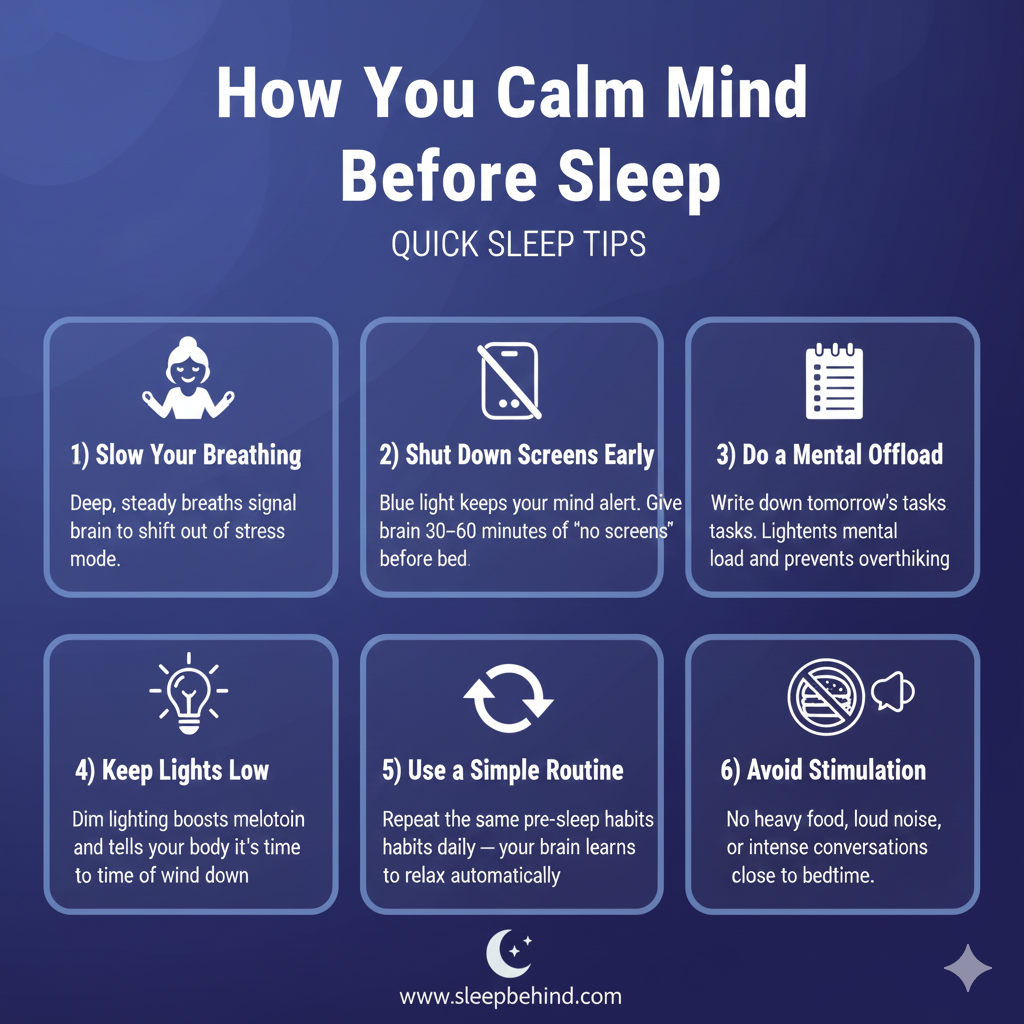
Lying awake at 2 a.m. replaying an awkward work conversation, scrolling through tomorrow’s to-do list, or cycling through worst-case scenarios is an extremely common experience—you’re not alone, and it’s not a personal failing. Racing thoughts at bedtime happen when your brain’s default mode network (the part responsible for self-referential thinking) kicks into overdrive without the distractions of the day to keep it occupied, often paired with elevated stress hormones and suppressed melatonin production from late-day screen use or unfinished stress.
The good news is you don’t need expensive gadgets or hours of free time to learn how to calm mind before sleep at night. This guide shares evidence-based, actionable quick sleep tips you can try tonight, from 2-minute breathing exercises to small environmental tweaks that train your brain to wind down automatically. We’ll cover the science behind why your mind races, step-by-step techniques to quiet rumination, common mistakes to avoid, and when to reach out to a professional for extra support.
 Common triggers for racing thoughts at night include stress, unfinished tasks, and screen exposure
Source: ringconn
Common triggers for racing thoughts at night include stress, unfinished tasks, and screen exposure
Source: ringconn
Why Your Mind Races At Bedtime (And Why "Just Stop Thinking" Never Works)
Racing thoughts at bedtime are not a sign of a "busy brain" or poor willpower—they’re a physiological response to unprocessed stress and environmental cues. When you’re awake during the day, work, social interaction, and physical activity keep your default mode network occupied, so worries and unfinished tasks stay on the back burner. At bedtime, when those distractions fade, your brain tries to "process" unfinished business, leading to rumination.
Additional triggers include elevated cortisol from late-day caffeine, stressful work messages sent after hours, and blue light from phones, laptops, and TVs that mimics sunlight and suppresses melatonin production, the hormone that signals your body it’s time to sleep. Physical discomfort from an unsupportive mattress topper, flat pillow, or tangled hair can also distract your brain from winding down. The key to calming your mind at bedtime is not to force yourself to stop thinking (which almost always backfires) but to redirect your attention to low-stimulation, rest-focused cues.
Evidence-Based Breathing & Body Techniques To Quiet Racing Thoughts In 2 Minutes Or Less
Breathwork and body-focused practices work fast because they directly interrupt your body’s fight-or-flight stress response and activate the parasympathetic nervous system, which triggers rest-and-digest mode. These techniques require no gear and can be done in bed in 2-5 minutes, making them ideal for quick sleep tips when you’re short on time.
Core Techniques To Try Tonight
- 4-7-8 breathing: A pranayama yoga technique that lowers heart rate and alertness. Breathe in quietly through your nose for 4 seconds, hold for 7 seconds, then exhale slowly through pursed lips for 8 seconds. Repeat 4-6 cycles. If holding your breath for 7 seconds feels uncomfortable, start with 4-4-6 breathing and build up gradually.
- Box breathing: Used by military personnel and first responders to reduce acute stress. Inhale through your nose for 4 seconds, hold for 4 seconds, exhale slowly for 4 seconds, hold for 4 seconds. Repeat 5 rounds. This steady rhythm anchors your attention away from racing thoughts.
- Progressive muscle relaxation (PMR): Tense each muscle group for 5 seconds, then release for 10 seconds, working from your toes up to your scalp. Most people hold hidden tension in their jaw, shoulders, and forehead, so spend extra time on these areas. A 5-10 minute session is enough to release physical stress that keeps your mind alert.
- Body scan: Lie flat and slowly bring your attention to each part of your body, from your toes to the top of your head, noticing sensations without judgment. If your mind wanders to a worry, gently redirect your focus back to the body part you were scanning. This trains your brain to shift away from mental rumination and into physical awareness.
In practice, most people see the best results when they practice these techniques 1-2 times during the day first, so they feel familiar and low-effort when you need them at bedtime. A common mistake is trying a new technique for the first time when you’re already stressed and frustrated you can’t fall asleep, which makes the exercise feel like a chore instead of a relief.
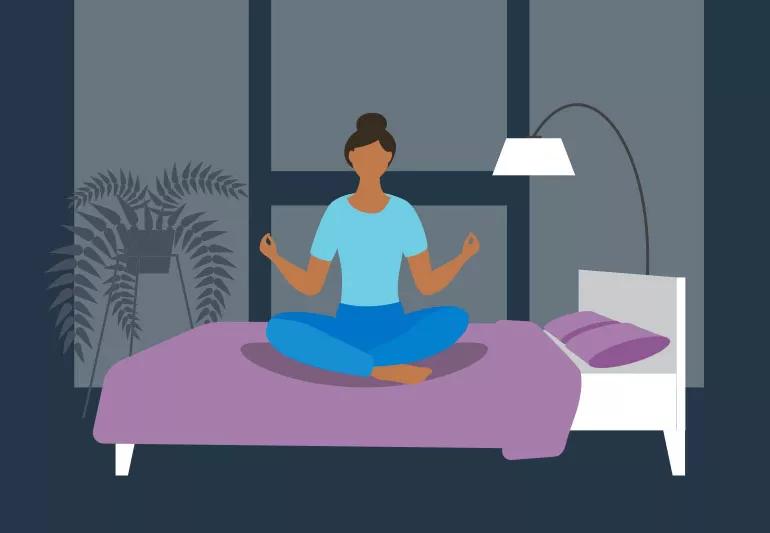
Simple Mental Habits To Stop Bedtime Rumination For Good
Mental habits work by offloading unfinished thoughts from your working memory, so your brain doesn’t feel the need to replay them when you’re trying to sleep. Unlike breathing techniques, these require a small amount of advance planning, but they take 5-10 minutes or less to complete.
Effective Low-Effort Mental Habits
- Evening brain dump journaling: Spend 5 minutes writing down 2-3 tasks for the next day, followed by one small win from the current day and one thing you’re looking forward to tomorrow. This signals to your brain that tasks are recorded and don’t need to be replayed. You don’t need a fancy journal—a notes app on your phone works fine, as long as you keep the screen brightness low and use night mode.
- Designated worry time: Schedule 15-20 minutes of worry time 2-3 hours before bed, not right before sleep. During this window, write down every worry that comes to mind, plus one small actionable step for each (even if the step is just "think about this more tomorrow"). If a worry pops up at bedtime, tell yourself "I’ll address that during tomorrow’s worry time" and gently redirect your attention.
- Guided visualization: Instead of vaguely "imagining a calm place", use the 5-4-3-2-1 grounding method paired with a calming scene: name 5 things you see in your scene (e.g. a sandy beach, a blue sky), 4 things you feel (warm sun on your skin, soft sand under your feet), 3 things you hear (waves, seagulls), 2 things you smell (saltwater, coconut sunscreen), and 1 thing you taste (cold lemonade). This anchors your brain in sensory detail, making it harder to ruminate on stressors.
- Micro-mindfulness: You don’t need 20-minute meditation sessions to see results. Start with 1-2 minutes of focused breathing, or simply notice the sounds around you without labeling them as good or bad. The goal is not to clear your mind completely, but to notice thoughts without engaging with them.
If you can’t fall asleep after 20 minutes of lying in bed, get up and do a low-light, boring activity (fold laundry, dust a shelf, organize a drawer) until you feel sleepy. Lying in bed awake creates a negative association between bed and stress, which makes racing thoughts worse over time.
 Evening journaling helps offload unfinished tasks so you don't ruminate on them at bedtime
Source: ringconn
Evening journaling helps offload unfinished tasks so you don't ruminate on them at bedtime
Source: ringconn
Common Mistakes That Make Racing Thoughts Worse At Bedtime
Even with the best techniques, small unexamined habits can sabotage your efforts to calm your mind before bed. These are the most common, evidence-backed mistakes to avoid:
- Scrolling social media to "wind down": Social media algorithms are explicitly designed to keep you engaged, and short-form video content spikes cortisol and dopamine levels, making it harder for your brain to shift into rest mode. Even 10 minutes of scrolling can delay sleep onset by 30 minutes or more.
- Lying in bed awake for hours: As mentioned earlier, this creates a conditioned response where your brain associates bed with stress and alertness, rather than rest. If you can’t fall asleep after 20 minutes, get out of bed until you feel sleepy.
- Stressing about not falling asleep fast: The pressure to sleep triggers your body’s fight-or-flight response, raising your heart rate and cortisol levels and creating a vicious cycle of alertness. If you’re still awake after 20 minutes, remind yourself that rest is still beneficial even if you don’t fall asleep immediately.
- Using sleep aids long-term without addressing root causes: Over-the-counter sleep aids, melatonin, and herbal supplements can be helpful short-term, but they lose effectiveness over time and some carry risks of dependency or next-day grogginess. They work best when paired with consistent sleep habits, not as a replacement for them.
- Trying to overhaul your entire routine at once: Picking 5-6 new techniques to implement on the same night is overwhelming and unsustainable. Start with 1-2 small changes, build consistency over 2-4 weeks, then add new habits gradually.
Optimize Your Sleep Environment To Send Clear Rest Signals To Your Brain
Your bedroom environment is one of the most powerful cues for your brain to shift into rest mode. Small tweaks can reduce racing thoughts by eliminating physical distractions and reinforcing the association between bed and sleep. The CDC’s sleep hygiene guidelines confirm that a cool, dark, distraction-free bedroom is one of the most reliable non-pharmaceutical ways to reduce nighttime restlessness.
Key Environmental Adjustments
- Temperature: Keep your bedroom between 60-67°F (15-19°C). A cool core body temperature is required for sleep onset, and a room that’s too warm can cause restlessness and night sweats that keep your mind active.
- Light: Use blackout curtains or a sleep mask to block outside light, and avoid overhead bright lights in the hour before bed. If you need a nightlight, use a red bulb, as red light does not suppress melatonin production.
- Noise: Use a white noise machine or earplugs to block disruptive background noise from traffic, roommates, or pets.
- Clutter and work items: Keep your bed reserved only for sleep and intimacy. Remove work laptops, work bags, and clutter from your bedroom to eliminate visual cues that trigger stress or task-related rumination.
- Comfortable bedding: An unsupportive mattress topper, flat pillow, or tangled hair can cause subtle physical discomfort that distracts your brain from winding down. If your bamboo pillow has lost its shape and causes neck strain at bedtime, follow proper care guidelines to restore its support. If your feather mattress topper is lumpy or split, learn how to revive it to eliminate physical discomfort that keeps you tossing and turning. If you often go to bed with wet hair and find it sticks to your face or causes itching that distracts you from winding down, healthier wet hair sleep habits can eliminate that nighttime annoyance. For people with straight or wavy hair, using a loose silk scrunchie or sleep bonnet keeps hair off your face so you don’t have to adjust it while trying to calm your mind.
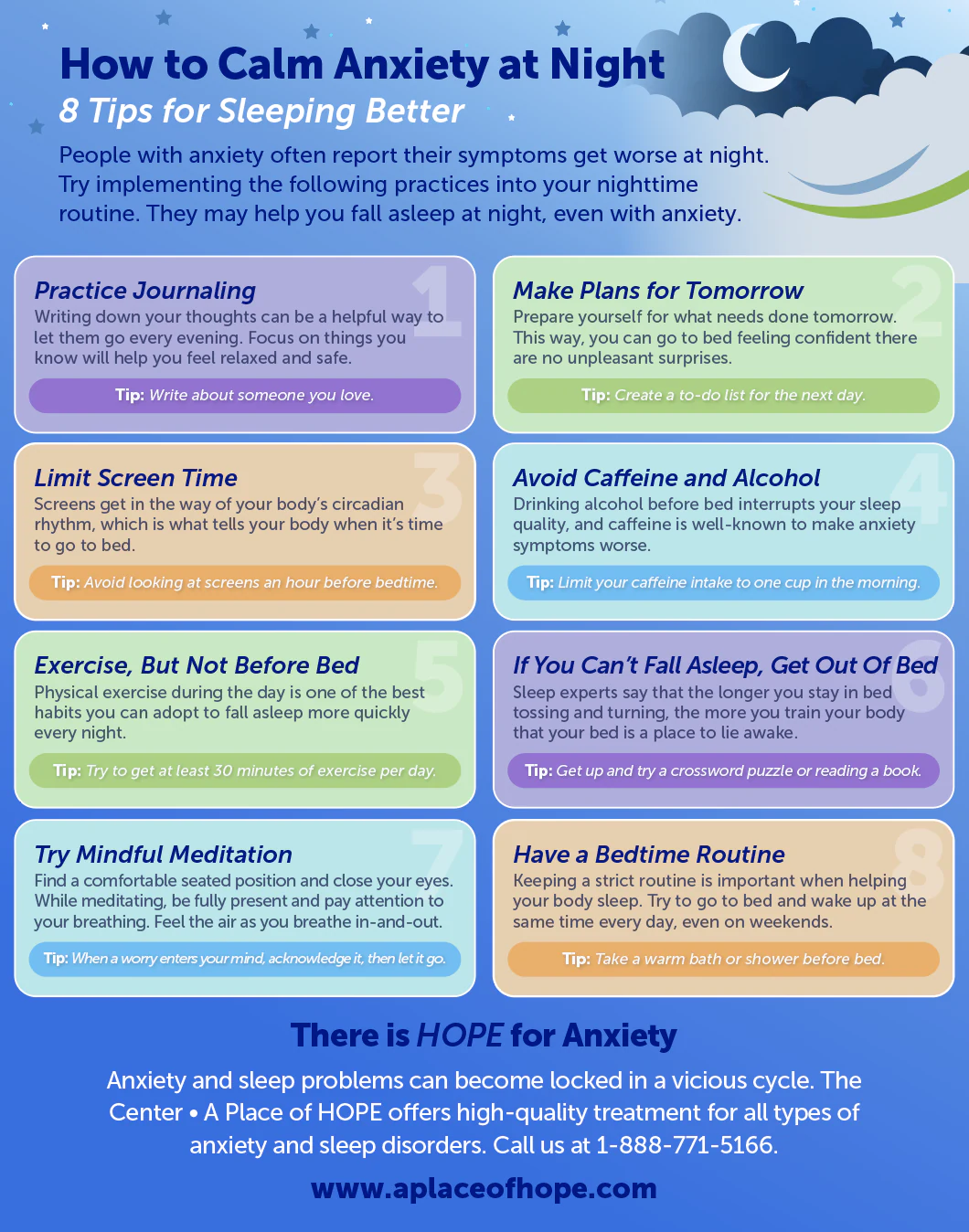 A cool, dark, clutter-free bedroom is a key cue for restful sleep
Source: aplaceofhope
A cool, dark, clutter-free bedroom is a key cue for restful sleep
Source: aplaceofhope
A 15-Minute Step-By-Step Pre-Sleep Routine You Can Start Tonight
Consistency is far more important than perfection when it comes to calming your mind before bed. A short, repeatable routine trains your brain to recognize that bedtime is a wind-down cue, reducing the need to "try" to calm your mind because it becomes automatic over time. This 15-minute routine is customizable to fit any schedule:
- T-15 minutes: Dim all overhead lights, turn off all screens (phone, laptop, TV), and put your phone on do-not-disturb in another room. If you need to use your phone before bed, turn on night mode and blue light filters to reduce melatonin disruption.
- T-12 minutes: Do 2 minutes of light stretching, focusing on your neck, shoulders, jaw, and hips—areas where most people hold unnoticed tension from sitting at a desk or scrolling during the day.
- T-10 minutes: Complete your chosen mental or body habit: 5 minutes of journaling, 5 minutes of 4-7-8 breathing, or a quick full-body scan.
- T-5 minutes: Get into bed, adjust your pillows and blankets for comfort, and do 3 minutes of slow, deep breathing or your chosen visualization.
- If you’re still awake after the 15 minutes, get out of bed and do a low-light, boring activity (folding laundry, organizing a drawer) until you feel sleepy.
Pairing these mental and physical techniques with structured pre-sleep habits trains your brain to recognize bedtime as a wind-down cue. For a more customizable wind-down plan, explore our step-by-step bedtime routine guide to build a routine that fits your lifestyle.
 A consistent 15-minute pre-sleep routine trains your brain to wind down automatically
Source: mormindful
A consistent 15-minute pre-sleep routine trains your brain to wind down automatically
Source: mormindful
 Establishing a consistent wind-down routine is one of the most effective ways to reduce racing thoughts at bedtime
Source: harvard
Establishing a consistent wind-down routine is one of the most effective ways to reduce racing thoughts at bedtime
Source: harvard
Natural Aids, Supplements & When To Consult A Sleep Professional
For some people, small natural additions to their routine can make calming the mind before bed easier, but they work best when paired with the habits outlined above, not as a replacement for them.
Low-Risk Natural Aids To Consider
- Weighted blankets: Gentle deep pressure stimulation from a weighted blanket (10% of your body weight) can reduce restlessness and lower cortisol levels for many people, especially those with anxiety.
- White noise machines: Mask disruptive background noise from traffic, roommates, or pets that can trigger alertness.
- Herbal teas: Chamomile, valerian root, and lemon balm teas have mild sedative effects for some people. Avoid teas with added caffeine, sugar, or artificial ingredients.
- Supplements: Low-dose melatonin (0.5-1mg) can help reset your sleep schedule if you’re dealing with jet lag or shifted work hours, but avoid high doses (3mg+) which can cause next-day grogginess. Magnesium glycinate may help with muscle relaxation, but avoid magnesium oxide which often causes digestive issues. Always consult a healthcare provider before starting any new supplement, especially if you take other medications or have underlying health conditions.
When To See A Professional
If racing thoughts occur 3+ nights a week for 3 or more consecutive months, cause daytime fatigue, difficulty concentrating, or mood changes, or are paired with panic attacks or intrusive thoughts, it’s time to reach out for support. For persistent racing thoughts, cognitive behavioral therapy for insomnia (CBT-I) is the first-line treatment recommended by the American Academy of Sleep Medicine, and it is more effective long-term than over-the-counter sleep aids. A sleep specialist can also rule out underlying conditions like sleep apnea or anxiety that may be contributing to your symptoms.
 Natural supplements may help some people, but they work best paired with healthy sleep habits
Source: youtube
Natural supplements may help some people, but they work best paired with healthy sleep habits
Source: youtube
Troubleshooting Common Sleep Mind Racing Setbacks
Even with a solid routine, you’ll have off nights. These fixes address the most common setbacks:
- Still wired after breathing exercises: Add 5 minutes of progressive muscle relaxation to release hidden tension in your shoulders and jaw, areas where most people hold stress without noticing.
- Worries keep popping back up: Move your designated worry time earlier in the evening, and write down one small action step for each worry to give your brain a sense of closure.
- Nighttime energy spikes: Check for late-day caffeine (avoid after 2 p.m.), heavy evening meals, or inconsistent wake times even on weekends, all of which can disrupt your circadian rhythm.
- Difficulty staying asleep: Avoid large amounts of fluids 2 hours before bed, and keep your room at a consistent cool temperature to avoid night sweats.
- Meditation feels impossible: Start with 1-2 minute sessions, and remember that the goal isn’t to clear your mind completely—just to notice thoughts without engaging with them. There’s no "wrong" way to practice.
 Addressing worries earlier in the evening reduces bedtime rumination
Source: youtube
Addressing worries earlier in the evening reduces bedtime rumination
Source: youtube
Frequently Asked Questions
How long does it take to see results from techniques to calm your mind before bed?
Most people notice small improvements in sleep onset time within 1 week of consistent practice, with more significant changes appearing after 2-4 weeks of regular use. The key is consistency, not perfection—even using one technique 3-4 nights a week will build momentum.
Is it normal to still have thoughts after trying breathing exercises?
Absolutely. The goal of breathing techniques is not to stop thoughts entirely (that’s impossible for most people) but to shift your nervous system out of fight-or-flight mode so thoughts feel less urgent and easier to let pass. Over time, this reduces the frequency of racing thoughts at bedtime.
Can supplements make it easier to calm your mind before sleep?
Some supplements may provide short-term relief for people with shifted sleep schedules or mild muscle tension, but they are not a substitute for healthy sleep habits. Always consult a healthcare provider before starting any new supplement, especially if you take other medications or have underlying health conditions.
Will avoiding screens completely cure my racing mind at bedtime?
Screen reduction is a critical first step, as blue light suppresses melatonin production and social media content is designed to stimulate your brain. However, it works best when paired with other habits like journaling, breathing exercises, and a consistent sleep schedule.
When should I see a sleep specialist about my nighttime racing thoughts?
Seek professional help if racing thoughts occur 3+ nights a week for 3 or more consecutive months, cause daytime fatigue, difficulty concentrating, or mood changes, or are paired with panic attacks or intrusive thoughts. A sleep specialist can rule out underlying conditions like insomnia or anxiety, and CBT-I is a highly effective first-line treatment.
Can exercise during the day help calm my mind before bed?
Yes, regular moderate exercise (30 minutes most days) improves sleep quality and reduces stress hormones that contribute to nighttime rumination. Avoid intense workouts 2-3 hours before bed, as they can increase alertness and raise your core body temperature, making it harder to fall asleep.
Why do I only get racing thoughts right before bed, not during the day?
This is extremely common, and it’s usually because your brain doesn’t have distractions at bedtime to keep it occupied. During the day, work, tasks, and social interaction keep your default mode network occupied. At bedtime, when those distractions fade, unfinished tasks and worries can surface. The techniques in this guide help redirect that mental energy productively.
Can meditation make my racing thoughts worse?
If you approach meditation with the goal of "stopping all thoughts", it can feel frustrating and increase stress. Instead, approach it with the goal of noticing thoughts without engaging with them—if your mind wanders, gently bring your focus back to your breath or body sensations without judgment. Starting with 1-2 minute sessions can help you build the habit without feeling overwhelmed.

Conclusion
Racing thoughts at bedtime are a common, manageable experience, not a personal failure. The key to learning how to calm mind before sleep at night is not a single quick fix, but consistent, small habits that train your brain to associate bedtime with rest, not stress. Start with 1-2 techniques that fit your lifestyle—whether that’s 4-7-8 breathing, a 5-minute journaling session, or adjusting your bedroom temperature—and practice them consistently for 2-4 weeks to build momentum.
If racing thoughts persist for months and interfere with your daily life, reach out to a sleep specialist or mental health provider—CBT-I is a highly effective, evidence-based treatment that works for most people with chronic nighttime rumination.
Have you found a go-to technique to calm your mind before bed? Share your favorite tip in the comments below, and browse our full collection of sleep guides for more practical ways to improve your rest.

Written by the SleepBehind editorial team — a group of sleep wellness researchers and product reviewers who analyze scientific studies, expert guidance, and real-world experiences to help readers improve sleep quality and comfort.