
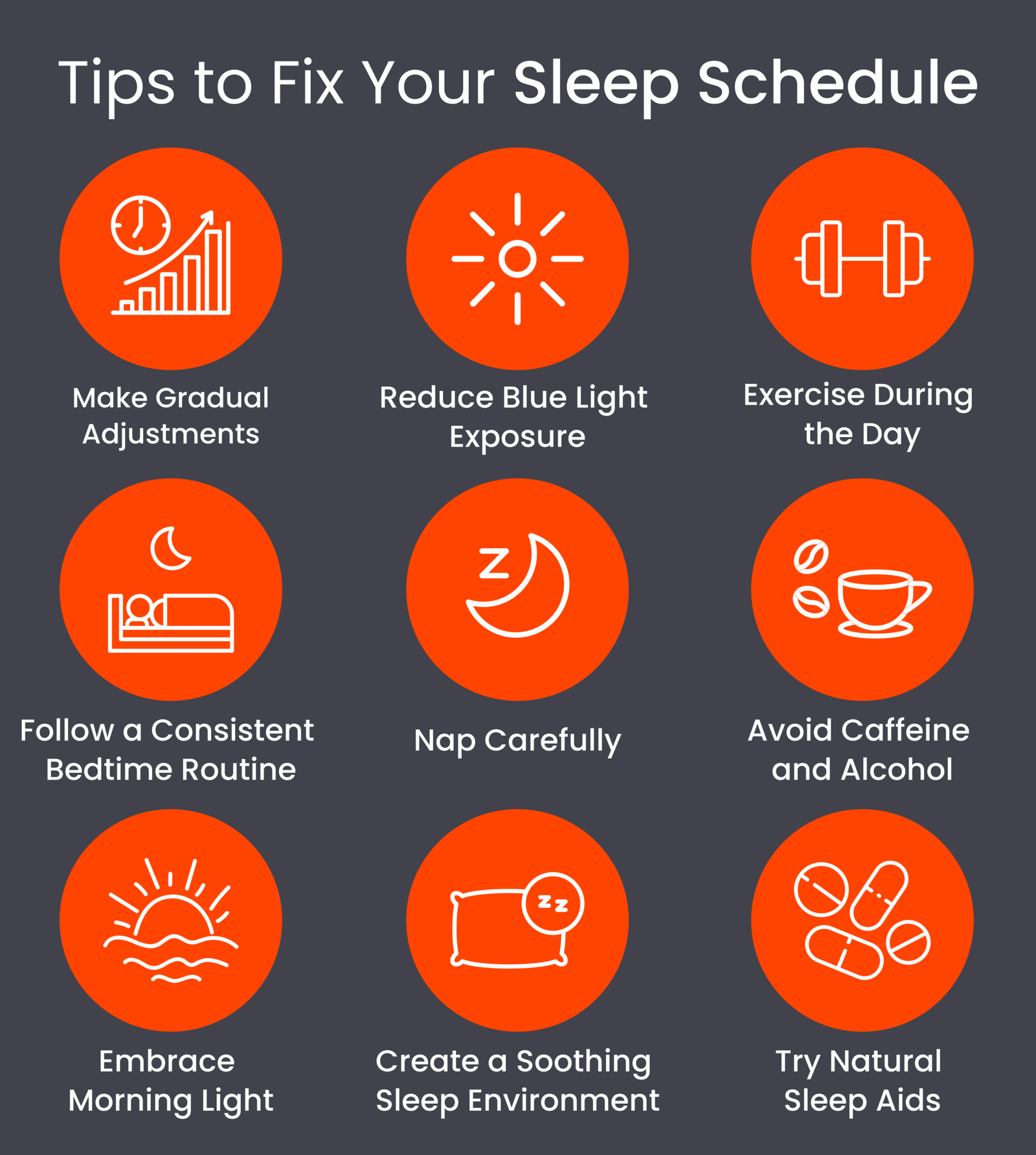
If you’re hitting snooze three times before dragging yourself out of bed, chugging an extra coffee by 9 a.m. to shake off grogginess, and scrolling until 1 a.m. even on nights you need to be up early, your internal body clock is out of sync. A disrupted sleep schedule doesn’t just leave you tired—it impacts focus, mood, immune function, and long-term metabolic health, per guidance from sleep medicine experts. The good news is you don’t need to overhaul your entire routine overnight to fix sleep schedule. This evidence-based 7-day plan uses gradual, sustainable shifts aligned with your circadian rhythm to reset your clock, eliminate midnight energy crashes, and help you wake up feeling alert without an alarm dependency. We’ll cover common pitfalls, science-backed light and timing tricks, and small environment tweaks that make the process stick, even if you work non-traditional hours or deal with occasional travel jet lag. If you want a customized plan, use our free personalized sleep schedule blueprint to calculate your ideal bedtime and wake time based on your current schedule.
Why Your Sleep Schedule Gets Derailed
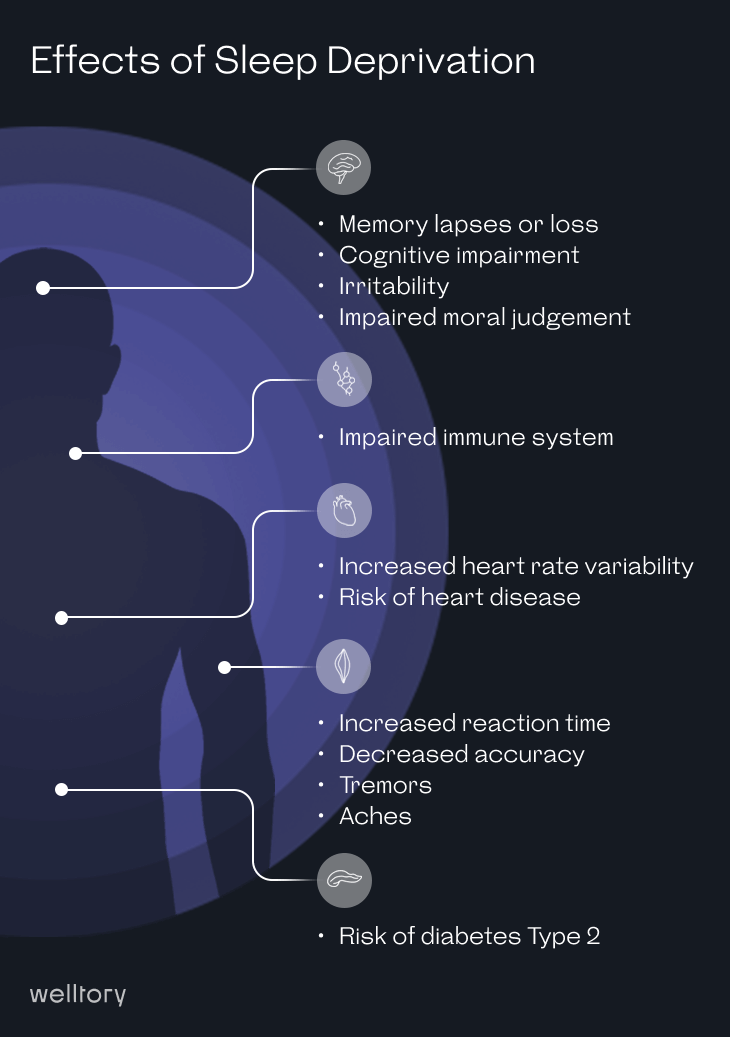
Your circadian rhythm is a 24-hour internal clock regulated by light, meal timing, and consistent daily routines. When these cues are inconsistent, your clock drifts out of sync with your desired schedule. Common triggers include late-night social media use (both the blue light and arousing content suppress melatonin production), irregular wake times even on weekends, caffeine consumed after 2 p.m. (caffeine has a 6-hour half-life, so a 4 p.m. coffee still has 25% of its caffeine in your system at 10 p.m.), heavy meals close to bed that raise core body temperature, and shift work or frequent travel across time zones. Social jet lag—when your weekend sleep schedule is 2+ hours different from your weekday one—is as disruptive to your circadian rhythm as crossing one time zone, per sleep research from the American Academy of Sleep Medicine. Many people mistake their "night owl" tendencies for a fixed trait, but 90% of people can shift their schedule by 1-2 hours with consistent cues over 2 weeks. In practice, the biggest driver of a disrupted schedule is inconsistent wake times: your brain learns to expect arousal at a specific time, so even small weekend sleep-ins can undo a week of progress. If you frequently struggle with trouble drifting off even when you're tired, your pre-sleep environment or routine may be the culprit. You can also read our guide on sleep calculator.

Step 1: Assess Your Current Sleep Baseline
Before you start shifting your schedule, you need to know exactly where you’re starting. Track your sleep for 7 days (not just 3—7 days accounts for weekend variations) and note:
- Your natural bedtime and wake time each day, no forced adjustments
- How long it takes you to fall asleep once you get in bed
- How many times you wake up during the night, and total sleep time
- Your energy levels at 10 a.m., 2 p.m., and 4 p.m. to spot crashes
- Caffeine intake timing and screen use within 1 hour of bed
You can use a simple paper diary or a reputable sleep tracking app for this. Avoid obsessing over perfect sleep scores from wearables, as they often overestimate or underestimate sleep stages and can increase sleep anxiety, which makes falling asleep harder. Your baseline will tell you exactly how big of a shift you need: if you’re going to bed at 1 a.m. and waking at 7 a.m. with 30 minutes of sleep latency, your target bedtime is 2 hours earlier, not 30 minutes. If you need to adjust shifting your wake time as part of your reset, start with just 15 minutes earlier than your current wake time, rather than jumping straight to your target.
 A 7-day sleep diary is the most accurate way to measure your starting point.
Source: amerisleep
A 7-day sleep diary is the most accurate way to measure your starting point.
Source: amerisleep
7-Day Sleep Schedule Reset Plan
This plan uses gradual 15-30 minute daily shifts to avoid overwhelming your circadian rhythm, which resists sudden changes of more than 30 minutes in a single day. Stick to the fixed wake time every single day, even on weekends—this is the most critical rule for success.
Day 1: Lock in your wake time Set your alarm for your target wake time (e.g., 7 a.m.) and get up immediately when it goes off, no snoozing. Within 30 minutes of waking, get 20 minutes of outdoor light (even on cloudy days—outdoor light provides 10-100 times more lux than indoor lighting, which is enough to signal your body to start producing melatonin earlier in the evening). Do not adjust your bedtime yet—just track when you naturally fall asleep to establish your baseline. If you normally go to bed at 1 a.m., don’t force yourself to sleep earlier tonight.
Day 2: First small bedtime shift Move your bedtime 15 minutes earlier than your baseline (e.g., 12:45 a.m. if your baseline is 1 a.m.). Start a 60-minute wind-down routine: dim indoor lights, put away all screens, and do a calming activity like reading, gentle stretching, or listening to soft music. Avoid caffeine after 2 p.m. today.
Day 3: Build the wind-down habit Move your bedtime another 15 minutes earlier (total 30-minute shift from baseline). Add 10 minutes of deep breathing or progressive muscle relaxation to your wind-down routine to reduce pre-sleep anxiety. If you can’t fall asleep after 20 minutes in bed, get up and do a quiet, non-stimulating activity (like folding laundry or reading a physical book) until you feel sleepy. This trains your brain to associate your bed only with sleep, not with frustration.
Day 4: Block blue light Move your bedtime another 15 minutes earlier (total 45-minute shift). Enable night mode on all devices 1 hour before bed, or wear blue-blocking glasses if you need to use screens for work or school. Keep your bedroom temperature between 60-68°F (15-20°C), as a cooler core body temperature is required for sleep onset.
Day 5: Eliminate late-night disruptors Move your bedtime another 15 minutes earlier (total 1-hour shift). Avoid heavy meals, spicy foods, and alcohol within 2 hours of bed, as these raise core body temperature and disrupt deep sleep. Limit liquid intake 1 hour before bed to reduce night wakings for bathroom trips.
Day 6: Strengthen the bed-sleep association Move your bedtime another 15 minutes earlier (total 1 hour 15-minute shift). Only use your bed for sleep and intimacy—don’t work, scroll, or watch TV in bed, so your brain associates the bed only with rest. If you still struggle to fall asleep after 20 minutes, repeat the "get out of bed" rule from Day 3.
Day 7: Hit your target bedtime Move your bedtime to your full target (e.g., 11 p.m. if your baseline was 1 a.m.). Review your sleep diary from the past week: note what worked, what felt difficult, and adjust your routine as needed. Plan for the coming week by scheduling your wind-down time and morning light exposure in your calendar like any other appointment.
 Small 15-30 minute daily shifts avoid overwhelming your circadian rhythm.
Source: amazon
Small 15-30 minute daily shifts avoid overwhelming your circadian rhythm.
Source: amazon
Bedroom & Lifestyle Tweaks To Speed Up Your Reset
Small environment changes reduce friction and make it easier to stick to your new routine. Focus on these high-impact tweaks first:
- Light control: Use blackout curtains or a sleep mask to block streetlights and early morning sun, and use low, warm (2700K) bulbs in your bedroom and bathroom in the evening.
- Temperature: Keep your bedroom between 60-68°F (15-20°C). A cooler room helps lower your core body temperature, which is required to fall asleep.
- Sound: Use a white noise machine, earplugs, or a fan to block sudden noises like traffic or roommates that can cause micro-wakings.
- Sleep surface comfort: If your mattress topper is lumpy or your pillows are flat, you’ll wake up more often during light sleep stages. A supportive topper can reduce pressure points, and washing your pillows regularly keeps them free of dust mites that can trigger allergies and disrupt sleep. For bamboo pillows, follow specific keeping your pillows fresh guidelines to avoid damaging the material. If you have a feather topper that’s lost its loft, our guide to a supportive topper can help you restore its comfort without replacing it entirely. A washable mattress protector also shields your mattress from spills, sweat, and allergens, making maintaining your mattress protector a quick monthly task that extends the life of your sleep surface. Also, if you sleep with wet hair often, learning sleeping with wet hair comfortably can prevent scalp irritation and reduce tossing and turning that delays sleep onset.
- Pre-sleep routine: Include 10-15 minutes of gentle stretching, reading a physical book, or guided breathing exercises in your 60-minute wind-down window. Avoid strenuous exercise, work emails, or stressful conversations during this time.
- Limit evening liquids: Reduce intake of water, soda, or alcohol 1-2 hours before bed to minimize bathroom trips during the night.
These tweaks work with your behavioral changes to reduce the effort required to fall asleep, so your new schedule feels natural instead of like a constant struggle.
 Cool temperatures, blackout curtains, and white noise reduce sleep disruptors.
Source: welltory
Cool temperatures, blackout curtains, and white noise reduce sleep disruptors.
Source: welltory
How Light, Melatonin, and Routine Anchor Your Circadian Rhythm
Light is the most powerful regulator of your circadian rhythm, per the Centers for Disease Control and Prevention (CDC). Your body uses light cues to distinguish between day and night: morning light advances (shifts earlier) your internal clock, while evening light delays it. This is why consistent light exposure is the backbone of any successful sleep schedule reset. Practical light tips:
- Get 20-30 minutes of outdoor light within 30 minutes of waking, even on cloudy days. If you can’t go outside, sit near a sunny window or use a 10,000-lux sunrise lamp.
- Dim indoor lights 2 hours before your target bedtime, and avoid overhead bright lights in the evening. Use table lamps with warm bulbs instead.
- Block blue light from phones, laptops, and TVs 1 hour before bed, as blue light in the 460-480 nm range suppresses melatonin production, the hormone that signals sleepiness. Consistent morning light exposure is one of the most effective ways to advance your circadian rhythm without supplements.
Melatonin supplements can help accelerate your reset if used correctly, but they are not a long-term solution. Start with a low dose (0.25-1 mg) taken 1-2 hours before your target bedtime for 1-2 weeks only. Long-term use can suppress your body’s natural melatonin production, and supplements are not FDA-regulated, so purity and dosage vary widely between brands. Consult your healthcare provider before using melatonin if you have underlying health conditions, are pregnant, or take other medications. For most people, consistent light exposure and fixed timing are more effective and sustainable long-term.
 Morning light advances your clock, while evening light delays it.
Source: dhgate
Morning light advances your clock, while evening light delays it.
Source: dhgate
Adjusting Your Schedule for Naps, Travel, and Shift Work
A 7-day reset works for most people with 9-5 schedules, but you can still fix your sleep schedule even if you deal with napping needs, frequent travel, or non-traditional shift work:
- Naps: Short, early-afternoon naps (20-30 minutes, before 1 p.m.) are unlikely to disrupt your nighttime sleep, and can even help you stay alert during the day without building up excessive sleep pressure. Longer naps (over 30 minutes) or naps after 3 p.m. can delay your circadian rhythm, making it harder to fall asleep at your target bedtime.
- Travel: For eastward travel (e.g., New York to London), start shifting your schedule 3 days before you leave, moving your bedtime and wake time 15 minutes earlier each day. Seek bright morning light at your destination, and avoid bright light in the afternoon to help your clock adjust faster. For westward travel (e.g., New York to California), shift your schedule 15 minutes later each day before you leave, seek evening light at your destination, and avoid bright morning light to avoid advancing your clock too early.
- Shift work: If you work night shifts, treat your daytime sleep with the same priority as nighttime sleep. Use blackout curtains, a white noise machine, and a consistent pre-sleep routine to signal to your body that it’s time to rest. Get 10-15 minutes of bright light at the start of your shift to stay alert, and wear sunglasses on your commute home to avoid bright light suppressing your daytime melatonin production. Keep your wake time consistent even on your days off to avoid disrupting your rhythm further.
 Strategic light exposure and naps make schedule resets possible for non-traditional schedules.
Source: realsimple
Strategic light exposure and naps make schedule resets possible for non-traditional schedules.
Source: realsimple
Common Mistakes That Derail Your Progress
Even with the best plan, small missteps can throw off your progress. Avoid these common pitfalls:
- Changing your wake time on weekends: Sleeping in even 1 hour on weekends increases social jet lag, making Monday mornings far harder. Stick to your fixed wake time within 30 minutes even on days off.
- Using screens during your wind-down: Blue light from phones and TVs suppresses melatonin, and arousing content (social media, work emails) increases alertness, making it harder to fall asleep.
- Relying on alcohol to fall asleep: Alcohol reduces deep sleep by 20-30% and causes frequent night wakings as your body metabolizes it, leaving you groggy the next day even if you slept through the night.
- Trying to shift your schedule too fast: Forcing a 2-hour bedtime shift in one night will almost always lead to lying in bed awake for hours, frustrated, and giving up on the reset entirely. Gradual shifts are far more sustainable.
- Obsessing over sleep tracker data: Wearables often provide inaccurate sleep stage data, and fixating on "perfect" sleep increases anxiety, which makes it harder to fall asleep. Use trackers to spot trends, not to judge your sleep quality.
- Giving up after one bad night: Occasional poor sleep is normal, especially in the first few days of your reset. Return to your fixed wake time the next day, and you’ll get back on track faster than sleeping in to "catch up."
A common mistake I see people make is trying to power through sleep deprivation with caffeine: while caffeine masks grogginess, it also builds up in your system and delays your circadian rhythm further, creating a vicious cycle. If you’re struggling with daytime sleepiness during your reset, take a 20-minute early-afternoon nap instead of reaching for a 4 p.m. coffee.
Tools, Apps, and Tracking to Support Your Reset
Simple tools reduce guesswork and improve adherence to your new routine:
- Sleep diary app: Track bed and wake times, sleep latency, and energy levels to spot trends in your progress.
- Light alarm or sunrise lamp: Wake gently with increasing light that simulates sunrise, reducing sleep inertia.
- Blue-light filter app: Automatically dim screens and block blue light after sunset to protect your melatonin production.
- Wearable tracker: Use trend data, not nightly scores, to see long-term progress and adjust your routine as needed.
- Timer or reminder app: Set alerts for your wind-down routine, caffeine cutoff time, and morning light exposure to build consistency.
I used a sunrise lamp and a simple paper sleep diary when I first reset my schedule after a period of frequent travel. Seeing steady progress over 7 days kept me motivated even when I had off nights.

Frequently Asked Questions
How long does it take to fix sleep schedule?
Most people see a noticeable improvement in sleep onset and morning alertness within 3-5 days of following the plan, with full schedule stabilization in 7-14 days. If you have a severely offset schedule (e.g., going to bed at 4 a.m. and waking at 12 p.m.), it may take 2-3 weeks to fully adjust. Consistency is the biggest factor in speeding up the process.
Can I use melatonin every night to fix sleep schedule?
Short-term melatonin use (1-2 weeks) at low doses (0.25-1 mg) taken 1-2 hours before your target bedtime can help accelerate your schedule shift, but it is not recommended for long-term daily use. Regular use can suppress your body’s natural melatonin production, and the supplement is not FDA-regulated, so purity and dosage vary widely between brands. Consult your healthcare provider before using melatonin if you have underlying health conditions or take other medications.
What if I work night shifts—can I ever fix sleep schedule?
Yes, shift workers can establish a stable, consistent sleep schedule by treating daytime sleep with the same priority as nighttime sleep. Use blackout curtains, a white noise machine, and a consistent pre-sleep routine to signal to your body that it’s time to rest, even if it’s daytime. Avoid sunlight on your commute home by wearing sunglasses, and keep your wake time consistent even on your days off to avoid disrupting your rhythm further. If you struggle with shift work sleep disorder long-term, a sleep specialist can help with tailored light therapy and behavioral adjustments.
Are naps bad when trying to fix sleep schedule?
Short, early-afternoon naps (20-30 minutes, before 1 p.m.) are unlikely to disrupt your nighttime sleep, and can even help you stay alert during the day without building up excessive sleep pressure. Longer naps (over 30 minutes) or naps after 3 p.m. can delay your circadian rhythm, making it harder to fall asleep at your target bedtime.
How important is morning light to fix sleep schedule?
Morning light is the single most powerful cue to advance (shift earlier) your circadian rhythm. Aim for 20-30 minutes of outdoor light within 30 minutes of waking, even on overcast days—outdoor light provides 10-100 times more lux than indoor lighting, which is enough to signal your body to start producing melatonin earlier in the evening. If you can’t go outside, a 10,000-lux sunrise lamp is a effective substitute.
What if I have insomnia while trying to fix sleep schedule?
If you have trouble falling or staying asleep for 3 or more nights a week for 3 months or longer, you may have chronic insomnia, which requires targeted treatment beyond schedule adjustments. Cognitive behavioral therapy for insomnia (CBT-I) is the gold-standard treatment, with a 75% success rate per the American Academy of Sleep Medicine. Consult a sleep specialist to rule out underlying conditions like sleep apnea or restless legs syndrome.
Can I drink coffee before bed if I have a high caffeine tolerance?
Caffeine has a 6-hour half-life, so even if you don’t feel jittery, it still blocks adenosine (the chemical that builds sleep pressure) in your brain, delaying sleep onset and reducing deep sleep. It’s best to avoid caffeine after 2 p.m. regardless of tolerance.
Will this plan work if I’m a natural night owl?
Yes, most people’s natural circadian rhythm can be shifted by 1-2 hours with consistent cues. If you still struggle to fall asleep at your target bedtime after 4 weeks of consistent effort, consult a sleep specialist to rule out delayed sleep phase syndrome, a condition that requires targeted light therapy to treat.
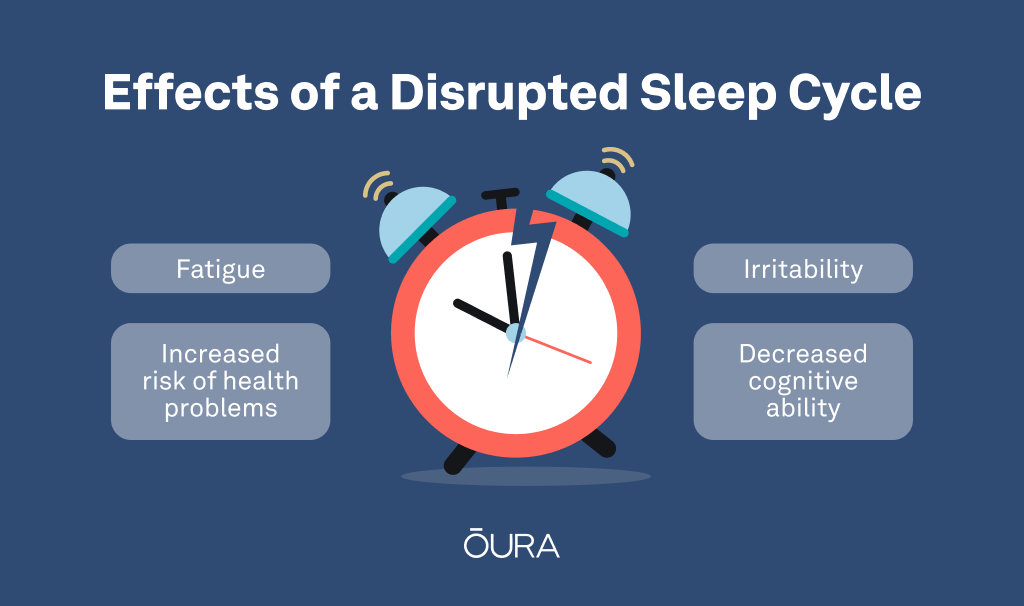 Quick answers to the most common questions about sleep schedule resets.
Source: ouraring
Quick answers to the most common questions about sleep schedule resets.
Source: ouraring
Long-Term Maintenance Tips
The first 2 weeks of your reset are the hardest, but after that, your new routine will start to feel automatic. To keep your sleep schedule stable long-term:
- Keep your wake time consistent even on weekends: varying by more than 30 minutes increases social jet lag and can undo your progress.
- Protect your 60-minute wind-down routine every night, even if you’re busy or stressed. Even 30 minutes of screen-free time before bed will make a big difference.
- Get 10-15 minutes of morning light every day, even on weekends: a quick walk outside after waking will anchor your circadian rhythm.
- Avoid all-nighters or late nights when possible: if you do stay up late, shift your wake time back by 15-30 minutes the next day instead of sleeping in for 3 hours to avoid jet lag-like symptoms.
- Reassess your schedule every 3 months: as seasons change, your light exposure changes, so you may need to adjust your wake time slightly (e.g., waking 15 minutes earlier in the summer when the sun rises earlier).
If you struggle with bedhead or messy hair after sleeping, protecting straight hair overnight with a silk bonnet or loose braid can reduce morning styling time and prevent hair damage, while also keeping hair off your face to reduce tossing and turning.
Conclusion
Fixing your sleep schedule is a marathon, not a sprint—small, consistent changes add up far faster than extreme overnight overhauls. The 7-day plan above works because it aligns with your body’s natural circadian rhythm, rather than fighting against it. Start with one small change today, like locking in your wake time or getting 10 minutes of morning light, and build from there. If you’re ready to start your reset today, use our free personalized sleep schedule blueprint to get a customized 7-day shift plan. Have you tried resetting your sleep schedule before? Share your biggest challenge in the comments below, and we’ll help you troubleshoot.

Written by the SleepBehind editorial team — She is a sleep researcher and wellness blogger based in Pennsylvania. Passionate about helping people optimize their sleep.