It’s 2:17 a.m. You just jolted awake, your mind already racing through tomorrow’s to-do list, and the clock glows: you have 5 hours left until your alarm. If you’ve ever found yourself staring at the ceiling willing sleep to come, you’re not alone. Most adults wake up at least once a night, and learning how to fall asleep again after waking up quickly can cut down on lost rest and prevent next-day fatigue. This guide shares evidence-based, no-gimmick quick sleep fixes tested by sleep coaches, so you can get back to rest without lying awake for hours.
Why Nighttime Awakenings Happen (and Why They’re Usually Normal)
Waking up in the middle of the night is not a sign of poor sleep on its own. The human sleep cycle runs in 90-minute rounds of light, deep, and REM sleep, and we experience 10–15 brief, unconscious arousals per night that we rarely remember. Full, conscious wakes happen when a disruptor pushes you past your arousal threshold: common triggers include stress-induced cortisol spikes, a full bladder, sudden environmental noise or light, physical pain, a drop in blood sugar from a heavy evening meal, or a too-warm bedroom. As we age, we naturally spend more time in light sleep, so brief nighttime wakes become even more common, and are not inherently a sign of a sleep disorder. You can also read our guide on why cant i fall asleep fast.
 Visualization of normal sleep architecture, including light sleep phases where brief, unconscious awakenings are common
Source: sleepfoundation
Visualization of normal sleep architecture, including light sleep phases where brief, unconscious awakenings are common
Source: sleepfoundation
Immediate First Steps To Take The Second You Wake Up
In practice, the first 60 seconds after you wake up determine how long it will take to fall back asleep. The goal is to avoid signaling to your brain that it’s time to be awake. Follow these steps immediately:
- Stay in bed: Getting up right away reinforces an association between your bed and wakefulness, which can lead to chronic insomnia over time. Only get up if you’re still alert after 20 minutes.
- Keep lights off: Even small amounts of light from a hallway, phone screen, or alarm clock suppress melatonin production, the hormone that signals your body it’s time to sleep. If you need to navigate to the bathroom, use a low-wattage red nightlight, which does not disrupt melatonin.
- Avoid screens: The blue light from phones, tablets, and e-readers suppresses melatonin by up to 50% in as little as 10 minutes, and the content (social media, work emails) increases cortical arousal, making it take 2–3 times longer to fall back asleep. Keep your phone outside the bedroom if possible.
- Don’t check the clock: Clock-watching triggers “sleep effort anxiety” — every time you calculate how much sleep you’re losing, your nervous system ramps up, making it harder to drift off. Turn your alarm clock away from view.
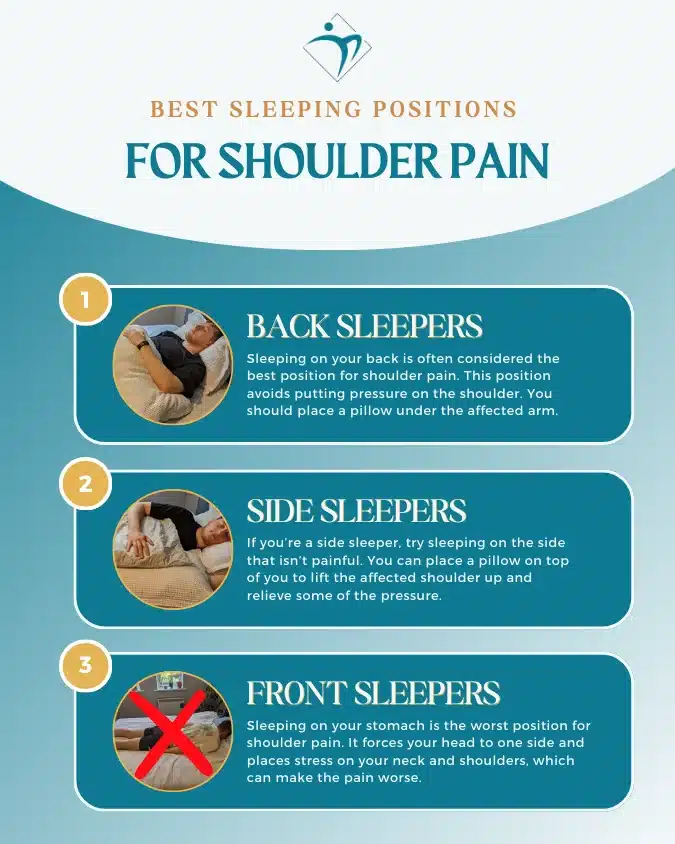
- Use a neutral distraction for racing thoughts: Count backwards from 100 by 3s, or repeat a single neutral word like “calm” to shift your focus away from anxious thoughts without stimulating your brain. If you regularly wake from shoulder discomfort, adjusting your sleep position first can reduce nighttime awakenings long-term.
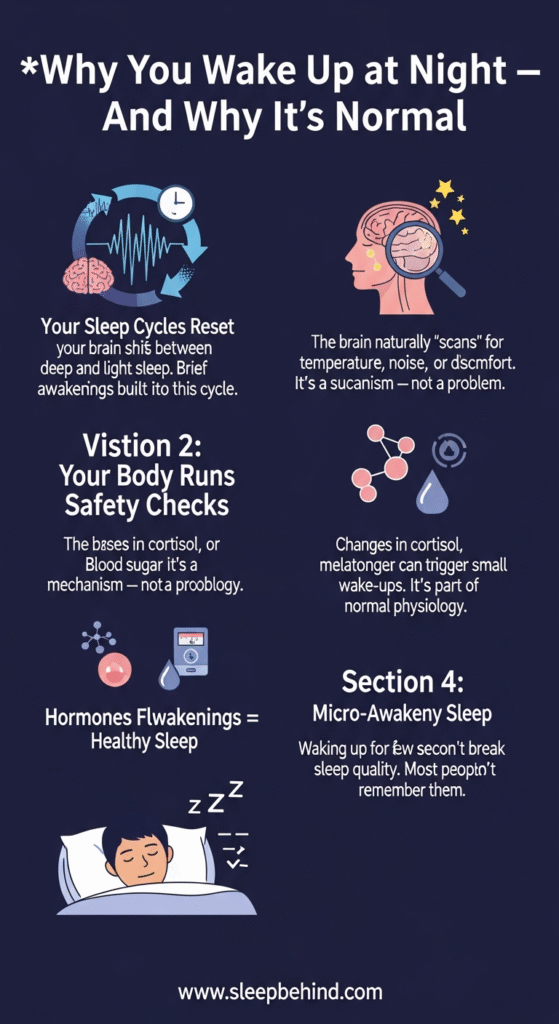 Common triggers for full nighttime awakenings, from stress to environmental disruptions
Image: Why you wake up at night
Common triggers for full nighttime awakenings, from stress to environmental disruptions
Image: Why you wake up at night
Evidence-Based Breathing and Relaxation Techniques That Work Fast
Slow, controlled breathing activates the parasympathetic nervous system, which counteracts the fight-or-flight response triggered by sudden waking. These techniques take 2–5 minutes to work, and require no special equipment:
- 4-4-8 breathing: Inhale quietly through your nose for 4 seconds, hold your breath for 4 seconds, then exhale slowly through pursed lips for 8 seconds. This pattern lowers your heart rate by 5–10 beats per minute within 2 minutes of consistent practice.
- Progressive muscle relaxation (PMR): Starting at your toes, tense each muscle group for 5 seconds, then release for 10 seconds, working your way up to your jaw and scalp. This releases built-up tension you may not notice you’re holding, especially in the shoulders and lower back.
- Diaphragmatic (belly) breathing: Place one hand on your chest and one on your belly. Breathe slowly so only your belly hand rises, which reduces shallow chest breathing that often accompanies anxiety.
- Body scan: Starting at your toes, bring your attention to each body part in turn, noticing any tension and consciously releasing it as you move up to the top of your head. This grounds you in the present moment and quiets racing thoughts. A common mistake is trying to perform these techniques perfectly — even a sloppy, half-hearted version is more effective than stressing about getting the timing exactly right. These methods also help you fall asleep faster at bedtime, making them a valuable addition to your overall sleep hygiene routine. You can also read our guide on how to sleep with shoulder pain.
 Diaphragmatic breathing activates the parasympathetic nervous system to reduce stress within minutes
Source: rorykinsellameditation
Diaphragmatic breathing activates the parasympathetic nervous system to reduce stress within minutes
Source: rorykinsellameditation
Mindset Shifts To Quiet Racing Thoughts
For many people, the biggest barrier to falling back asleep after waking is sleep performance anxiety: the pressure to fall asleep quickly, which only makes your brain more alert. These cognitive tricks rewire your brain’s association with the bed, shifting it from a place of stress to a place of rest:
- Guided mental imagery: Instead of ruminating on problems, picture a calm, familiar place (a favorite vacation spot, a quiet park) and add small, specific details: the sound of waves, the smell of pine, the feeling of sun on your skin. This engages the brain’s default mode network, which quiets the executive function network responsible for worrying.
- The mental notebook trick: If a specific worry is looping in your head, write down 1–2 words summarizing it on a notepad by your bed, and tell yourself you’ll address it in the morning. This offloads the thought from your working memory, so your brain doesn’t feel the need to keep looping on it to remember it.
- Accept short wakefulness: Fighting the fact that you’re awake only increases cortical arousal. Instead, tell yourself, “It’s okay to rest with my eyes closed even if I’m not asleep yet” — this removes the pressure to perform, making it easier to drift off naturally.
- Limit problem-solving: Even if you come up with a solution to a work or personal problem in the middle of the night, you’re likely to forget it by morning, and the effort of problem-solving increases alertness. Save all problem-solving for daytime hours.
 Gentle mental distractions can quiet racing thoughts without stimulating the brain
Source: healthline
Gentle mental distractions can quiet racing thoughts without stimulating the brain
Source: healthline
Environmental Tweaks To Prevent Future Nighttime Wakes
Your sleep environment is one of the biggest predictors of how often you wake up at night. Small, low-cost changes can reduce micro-arousals (unconscious, brief wakes that you don’t remember) and make it easier to fall back asleep if you do wake up fully. The CDC’s evidence-based sleep hygiene guidelines recommend keeping bedrooms between 60–68°F (15–20°C) to support core temperature regulation for sleep CDC Sleep Hygiene Guidelines.
Other high-impact tweaks include:
- Block all light: Use blackout curtains or a contoured, comfortable eye mask to block light from streetlights, electronics, or hallways. Even small amounts of light can suppress melatonin production.
- Mask disruptive noise: A fan, white noise app, or dedicated white noise machine masks sudden noises (sirens, pets, a partner moving) that trigger micro-arousals.
- Fix uncomfortable sleep surfaces: A sagging mattress or lumpy topper creates pressure points that pull you out of deep sleep. A sagging or lumpy sleep surface can trigger micro-arousals that pull you out of deep sleep; our guide to extending topper lifespan can reduce these disturbances.
- Keep pillows dry: Damp pillowcases from sleeping with wet hair can also cause mild discomfort that interrupts sleep; if you regularly deal with post-sleep hair dryness, adjusting your pre-bed hair routine can eliminate this minor sleep disruptor.
- Avoid late-night disruptors: Caffeine has a 6-hour half-life, so a 3 p.m. coffee will still have 50% of its caffeine in your system at 9 p.m., fragmenting sleep. Alcohol, while it may help you fall asleep initially, disrupts REM sleep and causes frequent nighttime awakenings 3–4 hours after consumption.
For a quick reference of common disruptors and fixes, use the table below:
| Common Disruptor | Quick Fix | Long-Term Solution |
|---|---|---|
| Too-warm room temperature | Open a window or turn down the thermostat by 2°F | Install a programmable thermostat to auto-adjust temperature at night |
| Light from streetlights or electronics | Wear a comfortable, contoured eye mask | Install blackout curtains or tinted window film |
| Intermittent noise (sirens, pets, partners) | Use a fan or free white noise app | Invest in a dedicated white noise machine with consistent volume |
| Uncomfortable sleep surface | Adjust pillow or mattress topper position | Replace sagging mattresses or revive old toppers |
 Optimal sleep environment settings to minimize nighttime disruptions
Source: sleepfoundation
Optimal sleep environment settings to minimize nighttime disruptions
Source: sleepfoundation
The 20-Minute Rule: When To Get Out Of Bed (And What To Do)
If you’ve been awake for more than 20 minutes and feel alert, frustrated, or anxious, staying in bed will only create a negative association between your bed and wakefulness, a key driver of chronic insomnia. Instead, get out of bed and move to a dimly lit area (use a low-wattage red light bulb, which does not suppress melatonin) and do a low-stimulation, boring activity:
- Fold laundry or organize a drawer
- Read a physical book (not an e-reader with blue light, and avoid work-related material)
- Listen to calm instrumental music or a low-volume sleep podcast
- Practice gentle stretching or yoga poses Avoid screens, work, problem-solving, or anything that increases your heart rate or alertness. Return to bed only when you feel heavy, drowsy, and your eyes are stinging — don’t wait until you’re just “tired”, wait until you’re actually sleepy. If you wake up to use the bathroom, keep the path clear, use a low-light nightlight, and avoid turning on overhead lights to minimize melatonin disruption.
 Low-light, low-stimulation activities are ideal if you need to get out of bed
Source: unisom
Low-light, low-stimulation activities are ideal if you need to get out of bed
Source: unisom
Common Mistakes That Extend Wake Time
Even people with good sleep hygiene often make small mistakes that make it harder to fall back asleep. Avoid these common pitfalls:
- Reaching for your phone immediately: Blue light and stimulating content increase alertness and suppress melatonin, delaying sleep by 30 minutes or more on average.
- Clock-watching: Every time you check the time, you calculate how much sleep you’re losing, increasing sleep effort anxiety and cortical arousal. Turn your alarm away from you to avoid the temptation.
- Forcing yourself to sleep: Sleep is a passive biological process, not a task you can complete through willpower. Trying to force sleep activates your sympathetic nervous system, making you more alert. Instead, focus on resting your body even if you don’t fall asleep.
- Getting up too early (before 20 minutes): If you get up after 5 minutes of being awake, you reinforce the association between your bed and wakefulness, which can lead to chronic insomnia over time. Stick to the 20-minute rule unless you’re in physical pain or need to use the bathroom.
- Napping too long or late the next day: Naps longer than 20 minutes or after 3 p.m. reduce your homeostatic sleep drive (the biological pressure to sleep at night), making it harder to stay asleep at night and increasing the likelihood of nighttime awakenings. If you need a nap, limit it to 20 minutes before 2 p.m.
 Consistent, low-effort routines are more effective than complex fixes for nighttime wakes
Source: goodsleep
Consistent, low-effort routines are more effective than complex fixes for nighttime wakes
Source: goodsleep
5-Step Quick Sleep Fix Checklist For Nighttime Wakes
Use this simple, repeatable checklist the next time you wake up at night. It takes less than 5 minutes to complete, and works for most occasional nighttime wakes:
- Stay in bed, keep lights off, and avoid screens: Don’t reach for your phone or turn on any lights, even dim ones.
- Practice 4-4-8 breathing for 2 minutes: Inhale 4 seconds, hold 4 seconds, exhale 8 seconds, repeating until the timer goes off.
- Use a neutral mental distraction: Count backwards from 100 by 3s, or picture a calm, detailed scene to quiet racing thoughts.
- If still alert after 20 minutes, get up for a low-stimulation activity: Do a boring task in dim light until you feel drowsy.
- Return to bed and repeat steps 1–3: Continue the cycle until you fall asleep.
 Step-by-step quick fix routine to use the next time you wake at night
Source: goodsleep
Step-by-step quick fix routine to use the next time you wake at night
Source: goodsleep
When To Seek Professional Help For Persistent Nighttime Awakenings
Occasional nighttime wakes are normal, but frequent, disruptive wakes can be a sign of an underlying condition. See a doctor or sleep specialist if:
- You wake up 3 or more times a night, 3 or more nights a week, for a month or longer
- You wake up gasping, choking, or with a racing heart (a common sign of sleep apnea)
- You experience loud, chronic snoring that disturbs your partner
- You have morning headaches that last more than 30 minutes
- You feel excessive daytime sleepiness that causes you to fall asleep at work, while driving, or during conversations
- You have trouble falling back asleep even after following these quick fixes for 2–3 weeks Frequent, unprovoked nighttime awakenings paired with excessive daytime sleepiness can be a sign of an underlying condition like a circadian rhythm disruption, which requires targeted professional support. Cognitive behavioral therapy for insomnia (CBT-I) is the first-line, most effective long-term treatment for chronic insomnia, and is more effective than over-the-counter sleep medications, which carry risks of dependency and next-day grogginess.
 Common questions and evidence-based answers for nighttime sleep disruptions
Source: healthline
Common questions and evidence-based answers for nighttime sleep disruptions
Source: healthline
Frequently Asked Questions
What if I wake up and can’t stop my mind racing?
Try a 4-4-8 breathing cycle paired with a short body scan. Write any urgent, looping thoughts down in 1–2 words on a notepad by your bed, and tell yourself you’ll revisit them in the morning. Avoid turning on screens or engaging with stimulating content.
Should I get out of bed when I can’t sleep after waking?
Yes, if you’ve been awake and alert for longer than 20 minutes. Staying in bed when you’re frustrated will create a negative association between your bed and wakefulness. Do a calm, dim activity like reading a physical book until you feel drowsy, then return to bed.
Is it okay to drink something to help me sleep again?
Small sips of water are fine if you’re thirsty, but avoid heavy fluids, alcohol, and caffeine late at night. Alcohol may help you fall asleep initially, but it fragments REM sleep and causes frequent awakenings 3–4 hours after consumption.
Can naps affect how often I wake at night?
Yes. Long daytime naps (longer than 20 minutes) or naps after 3 p.m. reduce your homeostatic sleep drive, making it harder to stay asleep at night and increasing the likelihood of nighttime awakenings. Stick to short, early naps if you need them.
Why do I keep waking up at 3 a.m.?
Consistent 3 a.m. wakes are often tied to a cortisol spike caused by stress, late-night alcohol consumption, or a shifted circadian rhythm. Try avoiding caffeine after 2 p.m., limiting alcohol to 1 drink maximum 3 hours before bed, and practicing 5 minutes of deep breathing before bed to lower baseline cortisol levels.
Will melatonin help me fall back asleep?
Low-dose melatonin (0.5–1 mg) taken 30 minutes before bed can help regulate your circadian rhythm if you wake frequently, but it’s not a fast-acting sleep aid for middle-of-the-night wakes. Avoid higher doses, as they can cause next-day grogginess and disrupt your natural melatonin production over time.
When should I see a doctor about waking up at night?
See a doctor if nightly awakenings happen more than three times a week for a month or longer, or if you experience red flags like gasping for air during sleep, loud chronic snoring, morning headaches, or excessive daytime sleepiness that interferes with daily life.
Final Takeaway
Waking up once or twice a night is a normal part of the human sleep cycle, and the goal isn’t to never wake up — it’s to reduce the time it takes to fall back asleep so it doesn’t disrupt your overall sleep quality or daytime energy. The quick sleep fixes in this guide work for most occasional nighttime wakes, and consistency is key: try the 5-step checklist for 2 weeks to see if it reduces your wake time. If problems persist, don’t hesitate to reach out to a sleep specialist for targeted support. For more evidence-based tips to improve your overall rest, browse our full library of sleep guides.

Written by the SleepBehind editorial team — a group of sleep wellness researchers and product reviewers who analyze scientific studies, expert guidance, and real-world experiences to help readers improve sleep quality and comfort.