
Have you ever lain awake staring at the ceiling at 2 a.m. even when you need to be up at 7 a.m. for work or school? Or hit snooze five times after 8 hours in bed, still feeling foggy and unrefreshed? If this sounds familiar, you may be experiencing a circadian rhythm sleep-wake disorder (CRSWD) — a group of conditions marked by a persistent mismatch between your body’s internal clock and the sleep schedule your life requires.
Unlike general insomnia, which involves trouble sleeping regardless of timing, CRSWD is rooted in a misalignment of your body’s innate timing system. It’s not a “bad habit” or a lack of willpower: it’s a physiological dysregulation that can impact your mood, work performance, and long-term health if left unmanaged. You can also read our guide on circadian rhythm explained.
This quick guide breaks down exactly what CRSWD is, its symptoms, causes, diagnostic process, and evidence-based treatment options, plus practical steps you can start today to realign your sleep schedule.
What Exactly Is Circadian Rhythm Sleep-Wake Disorder?
Circadian rhythm sleep-wake disorder occurs when your body’s master circadian clock, located in the brain’s suprachiasmatic nucleus (SCN), falls out of sync with the external environmental and social cues that regulate sleep and wakefulness. The SCN responds primarily to light and dark signals to coordinate sleep timing, hormone release (including melatonin, the sleep hormone), body temperature, and other daily physiological processes. When this system is disrupted, you may be unable to fall asleep or wake up at the times required for your daily life, even if you are physically tired.
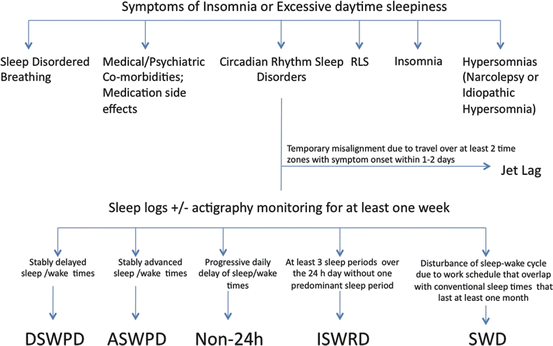
For a formal diagnosis, symptoms must persist for at least 3 months and cause clinically significant distress or impairment to work, school, or social functioning. CRSWD is not a single condition: it includes six distinct subtypes, each with a unique sleep timing pattern:
| Subtype | Key Pattern | Most Common Affected Group |
|---|---|---|
| Delayed Sleep-Wake Phase Disorder (DSWPD) | Sleep onset delayed by 2+ hours relative to desired schedule; difficulty waking in the morning | Adolescents and young adults |
| Advanced Sleep-Wake Phase Disorder (ASWPD) | Sleep onset 2+ hours earlier than desired; early morning awakening (3-5 a.m.) with inability to fall back asleep | Older adults |
| Irregular Sleep-Wake Rhythm Disorder (ISWRD) | Fragmented sleep pattern across 24 hours, with 3+ short sleep episodes per day | People with neurodivergence (autism, ADHD), dementia |
| Non-24-Hour Sleep-Wake Rhythm Disorder (Non-24) | Sleep cycle runs longer than 24 hours, so sleep onset shifts later each day | Totally blind people (no light input to the master clock) |
| Shift Work Disorder (SWD) | Insomnia and excessive daytime sleepiness caused by work schedules that conflict with the natural circadian rhythm | Shift workers, first responders, healthcare workers |
| Jet Lag Disorder | Acute sleep disruption and daytime sleepiness after rapid travel across 2+ time zones | Frequent international travelers |
This misalignment is distinct from occasional poor sleep caused by stress or caffeine: CRSWD is a persistent, physiological pattern that does not resolve on its own without targeted intervention.
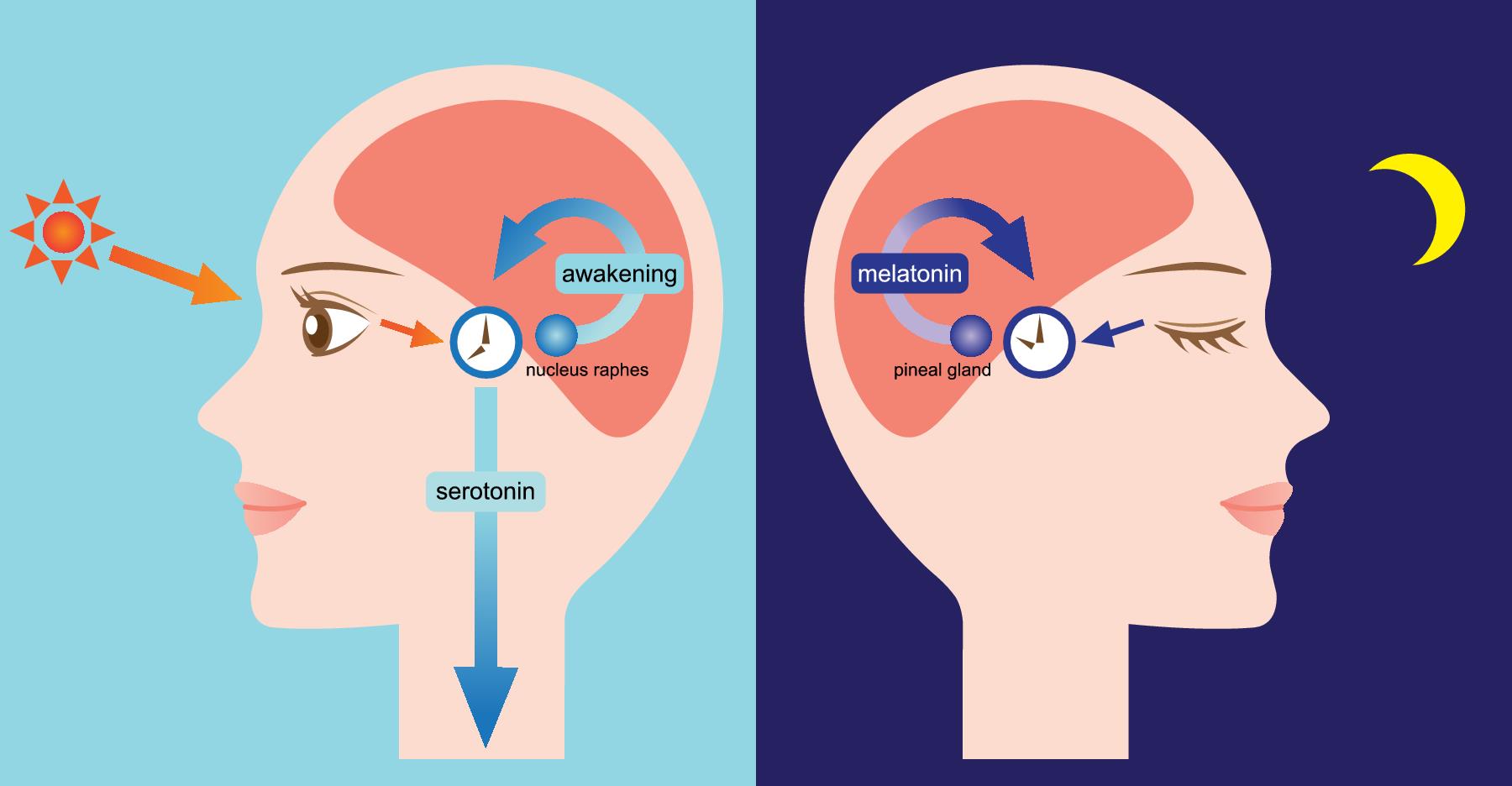 The suprachiasmatic nucleus (SCN) in the hypothalamus acts as the body's master circadian clock, responding to light and dark cues.
Source: pulmonarydocs
The suprachiasmatic nucleus (SCN) in the hypothalamus acts as the body's master circadian clock, responding to light and dark cues.
Source: pulmonarydocs
Core Symptoms and Daily Impact
Symptoms of CRSWD center entirely on sleep timing, rather than sleep quality or duration. People with the condition often can sleep normally if their schedule aligns with their natural circadian rhythm, but struggle to function on a standard 9-to-5 or school schedule. Common symptoms fall into three categories:
- Sleep timing symptoms: Persistent trouble falling asleep at your desired bedtime, difficulty waking up at your desired wake time, frequent nighttime awakenings at inconsistent times, or fragmented sleep across 24 hours
- Daytime functioning symptoms: Excessive daytime sleepiness, brain fog, impaired concentration, irritability, microsleeps (brief, uncontrollable episodes of sleep), or reduced performance at work or school
- Long-term health impacts: Increased risk of mood disorders (depression, anxiety), metabolic dysfunction (type 2 diabetes, obesity), cardiovascular disease, and impaired immune function, per 2024 guidance from the Sleep Research Society
Symptoms often worsen with schedule disruptions like jet lag, rotating shift work, or even weekend “social jet lag” (staying up later and sleeping in on weekends, which shifts your clock later and makes Monday morning wake-ups even harder). A common misconception is that CRSWD is just “insomnia” or “being a night owl,” but unlike occasional late nights, CRSWD causes persistent, unmanageable impairment to daily life.
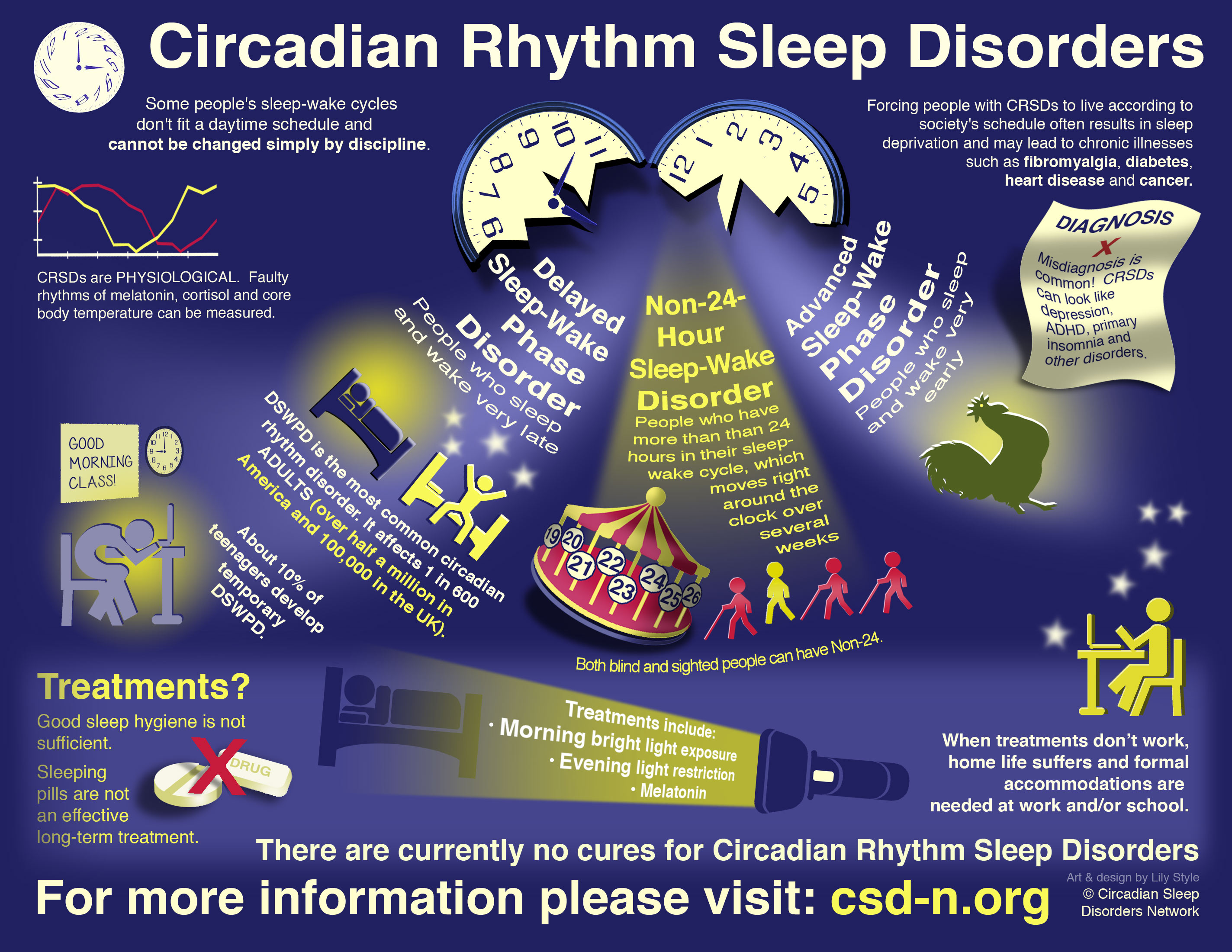 Symptoms of CRSWD center on misaligned sleep timing rather than general insomnia.
Source: circadiansleepdisorders
Symptoms of CRSWD center on misaligned sleep timing rather than general insomnia.
Source: circadiansleepdisorders
Root Causes and Key Risk Factors
CRSWD develops from a combination of endogenous (internal) and exogenous (external) factors that disrupt the SCN’s ability to align with the 24-hour day:
Endogenous Causes
- Genetic variants in clock genes (PER, CRY, CLOCK) that naturally shift your sleep timing earlier or later than average
- Age-related changes to the SCN, which is why advanced sleep phase is common in older adults and delayed sleep phase is common in adolescents
- Total blindness or severe visual impairment, which eliminates light input to the SCN and is the leading cause of Non-24-Hour Sleep-Wake Rhythm Disorder
- Neurodivergence (autism, ADHD) which is linked to irregular SCN function and higher risk of Irregular Sleep-Wake Rhythm Disorder
Exogenous Causes
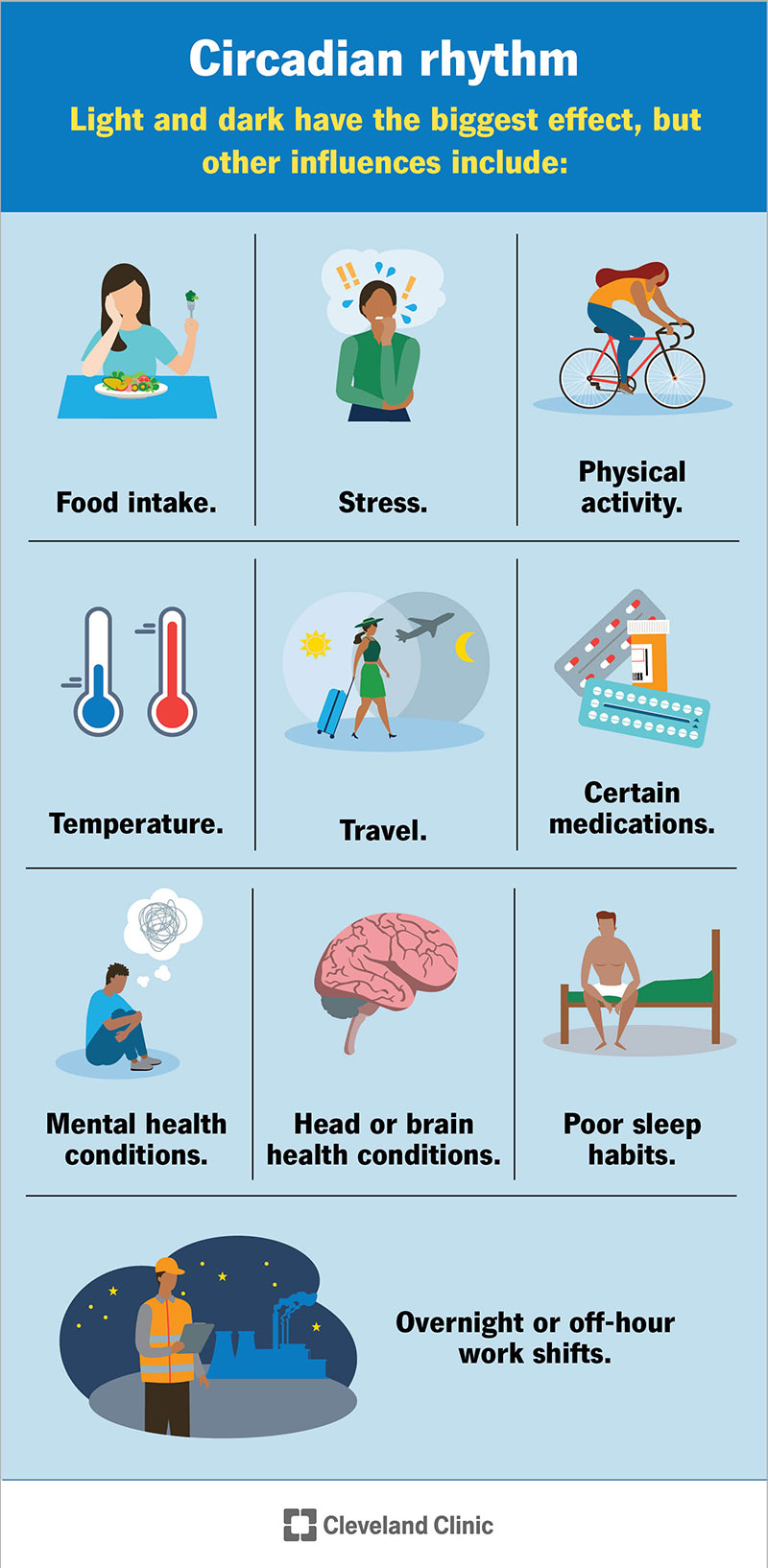
- Chronic exposure to bright light (especially blue light from phones, laptops, and LED bulbs) in the 1-2 hours before bed, which suppresses melatonin production and delays sleep onset
- Lack of morning bright light exposure, which fails to anchor the SCN to the day’s start
- Rotating or overnight shift work that forces sleep at times conflicting with your natural rhythm
- Frequent transmeridian travel that causes chronic jet lag
- Regular use of certain medications (SSRIs, beta-blockers, corticosteroids) that can alter circadian timing as a side effect
In clinical practice, many patients have a mix of internal predisposition and external triggers: for example, a teen with a genetic predisposition to delayed sleep phase may develop full DSWPD after years of late-night screen use and early school start times.
How Clinicians Diagnose Circadian Rhythm Sleep-Wake Disorders
Diagnosis of CRSWD is made by a board-certified sleep specialist, per the 2023 International Classification of Sleep Disorders, 3rd edition text revision (ICSD-3-TR), the global standard for sleep disorder diagnosis. The process is designed to rule out other conditions that can mimic CRSWD, such as insomnia disorder, sleep apnea, or mood-related sleep disruption. Steps include:
- Clinical interview and sleep history: The specialist will ask about your sleep patterns, work/school schedule, light exposure habits, and symptom duration (minimum 3 months for a formal diagnosis). A common mistake patients make is self-diagnosing based on a few nights of poor sleep, which can lead to incorrect treatment for an underlying condition.
- Sleep tracking: You will be asked to keep a detailed sleep diary for 7-14 days, or wear an actigraphy device (a wrist-worn tracker that measures movement to estimate sleep timing) for the same period. This objective data helps identify patterns in your sleep-wake timing.
- Standardized questionnaires: Tools like the Morningness-Eveningness Questionnaire and Epworth Sleepiness Scale measure your natural circadian preference and level of daytime impairment.
- Differential diagnosis: The specialist will rule out other sleep, medical, or mental health conditions that could be causing your symptoms.
- Optional advanced testing: For complex cases, a dim light melatonin onset (DLMO) test may be ordered, which measures when your body starts producing melatonin in low-light conditions to pinpoint your exact circadian timing. This is the gold standard for diagnosis but not required for most routine cases.
Accurate diagnosis is critical, as treatment for DSWPD (delayed sleep phase) is the opposite of treatment for ASWPD (advanced sleep phase): getting the timing wrong can make symptoms far worse.
 Diagnosis requires ruling out other sleep disorders to confirm a timing-based mismatch.
Source: researchgate
Diagnosis requires ruling out other sleep disorders to confirm a timing-based mismatch.
Source: researchgate
Evidence-Based Treatment Options
Treatment for CRSWD is personalized to your specific subtype, and most plans combine multiple interventions for the best results. Clinical guidelines from the American Academy of Sleep Medicine note that the following approaches are first-line for most patients:
- Timed light therapy: Bright light (10,000 lux) exposure at specific times to shift your circadian rhythm earlier or later. For delayed sleep phase, 30 minutes of bright light within 1 hour of your desired wake time advances your clock. For advanced sleep phase, 30 minutes of bright light in the late afternoon delays your clock. Avoid bright light (especially blue light) for 1-2 hours before bed, as it will counteract treatment.
- Timed melatonin supplementation: Low-dose (0.5-3mg) melatonin taken 1-2 hours before your desired bedtime for delayed sleep phase, or upon waking for advanced sleep phase. Over-the-counter melatonin is not FDA-regulated, so quality varies widely, and timing is critical: taking it at the wrong time can worsen your symptoms. Always consult a clinician before starting melatonin, especially if you take other medications.
- Chronotherapy: A supervised, gradual shift of your sleep time by 15-30 minutes per day until you reach your desired schedule. This is effective for severe cases but requires strict adherence, and is not recommended without clinical supervision due to risk of worsening dysregulation.
- Adapted CBT-I: Cognitive behavioral therapy for insomnia tailored to CRSWD, which addresses maladaptive beliefs about sleep and helps build consistent, sustainable routines.
- Schedule adjustments: For shift workers, consistent sleep schedules even on days off, scheduled 20-30 minute naps before shifts, and discussions with employers about schedule flexibility can reduce symptom severity.
Combining timed light exposure and melatonin is often more effective than either intervention used alone for most CRSWD subtypes. Most patients see measurable improvement in 2-4 weeks with consistent adherence to their treatment plan, though some (like people with Non-24) may need long-term management.
 Treatment plans are tailored to the specific subtype of CRSWD a patient has.
Source: news-medical
Treatment plans are tailored to the specific subtype of CRSWD a patient has.
Source: news-medical
Practical Daily Strategies You Can Start Tonight
You don’t need expensive gear or a specialist appointment to start realigning your circadian rhythm. These small, evidence-based steps can make a measurable difference in 1-2 weeks:
- Prioritize a consistent wake time above all else: Your wake time is the anchor for your entire circadian system. Even if you went to bed late, wake up at your target time every day (including weekends) and get 15 minutes of bright outdoor light within 30 minutes of waking.
- Adjust your light exposure: Avoid screens (phones, laptops, TVs) for 90 minutes before your desired bedtime. Use blue light filters on devices after 8 p.m. if you need to use them, and keep your bedroom completely dark with blackout curtains and no glowing electronics.
- Use timed melatonin only if recommended: If your clinician approves, take a low 0.5-1mg dose of melatonin 1.5 hours before your desired bedtime. Avoid higher doses, which can cause next-day grogginess and disrupt your rhythm further.
- Limit naps: If you experience daytime sleepiness, keep naps to 20 minutes or less and before 2 p.m. Longer or later naps can interfere with nighttime sleep.
- Avoid circadian disruptors: Cut off caffeine after 2 p.m., and avoid alcohol within 3 hours of bed, as both disrupt melatonin production and sleep timing.
- For shift workers: Wear blue light blocking glasses on your drive home from night shifts to prevent light from suppressing your melatonin, and use blackout curtains to block daylight for daytime sleep.
A common mistake people make is trying to shift their sleep schedule by more than 30 minutes per day, which often worsens dysregulation rather than fixing it. Small, steady adjustments are far more effective long-term. A consistent, comfortable sleep environment reinforces your body’s sleep cues; keep your sleep surface fresh and supportive fresh sleep surface by washing pillowcases and bedding regularly.
 Small, consistent adjustments to light exposure and schedule are the most impactful first steps.
Source: thevinemedicalcenter
Small, consistent adjustments to light exposure and schedule are the most impactful first steps.
Source: thevinemedicalcenter
When to See a Sleep Specialist
Home adjustments work for many people with mild CRSWD, but you should consult a board-certified sleep specialist if:
- Your symptoms persist for 3+ months despite consistent lifestyle adjustments
- Daytime sleepiness is severe enough to cause accidents, missed work/school, or impaired daily functioning
- You have a history of mood disorders (depression, anxiety) that coincide with changes to your sleep timing
- You are totally blind and experience shifting sleep schedules (high risk for Non-24)
- You are a frequent international traveler with chronic jet lag that does not resolve within a few days of returning home
During your appointment, the specialist will review your sleep tracking data, rule out other underlying conditions, create a personalized light and melatonin schedule, and discuss work or school accommodations if needed. Most insurance plans cover sleep specialist visits when a formal CRSWD diagnosis is confirmed.
 A sleep specialist can create a personalized treatment plan if home adjustments are not enough.
Source: com
A sleep specialist can create a personalized treatment plan if home adjustments are not enough.
Source: com
Living Well Long-Term With a Circadian Rhythm Disorder
For most people, CRSWD is a manageable chronic condition, not a lifelong sentence of poor sleep. With consistent routine and treatment, many patients report normal quality of life and no daytime impairment. Long-term management tips include:
- Track your sleep patterns regularly with a wearable tracker or free app to catch early shifts in your timing before symptoms worsen
- Communicate your needs to employers, teachers, or family members: for example, requesting a later start time for school if you have DSWPD, or a consistent, non-rotating shift schedule if you work non-standard hours
- Build buffer time for schedule changes: if you are traveling across time zones, adjust your sleep schedule 1-2 days before your trip to reduce jet lag severity
- Connect with support groups for people with circadian disorders to share tips, reduce feelings of isolation, and learn from others managing the same condition
- Maintain a clean, supportive sleep environment: if you use a mattress topper, follow care instructions to keep it in good condition supportive mattress topper to avoid unnecessary sleep disruptions.
In clinical practice, patients who commit to small, consistent adjustments to their routine almost always see meaningful improvement in their symptoms over time.
 Most people with CRSWD can achieve normal daily function with consistent routine adjustments.
Source: neupsykey
Most people with CRSWD can achieve normal daily function with consistent routine adjustments.
Source: neupsykey
Prevention and Maintaining a Stable Clock
While you can’t eliminate genetic risk for CRSWD, you can reduce your risk of developing symptoms or experiencing relapse by protecting your circadian rhythm daily:
- Keep a consistent sleep-wake schedule, even on weekends, to avoid social jet lag
- Get 15+ minutes of bright outdoor light within 1 hour of waking every day to anchor your SCN to the day’s start
- Limit bright light exposure 1-2 hours before bed, and use blue light filters on screens after 8 p.m.
- Avoid rotating shift work if possible; if you must work non-standard hours, prioritize consistent sleep timing on your days off
- Cut off caffeine after 2 p.m. and avoid alcohol within 3 hours of bed, as both disrupt circadian signaling
- Habits that disrupt sleep timing, such as sleeping with wet hair without proper protection, can worsen circadian misalignment; learn proper overnight hair care proper overnight hair care to avoid unnecessary sleep disruptions.
The most powerful tools for circadian health are simple, consistent light and timing cues — no expensive supplements or gadgets required.
 Each subtype has a distinct sleep timing pattern and tailored treatment approach.
Source: wikipedia
Each subtype has a distinct sleep timing pattern and tailored treatment approach.
Source: wikipedia
Frequently Asked Questions
Is circadian rhythm sleep-wake disorder the same as insomnia?
No. Insomnia is defined as difficulty falling or staying asleep regardless of timing, often caused by stress, anxiety, or poor sleep habits. CRSWD is specifically a mismatch between your natural circadian timing and your required sleep schedule: people with CRSWD can usually sleep normally if their schedule aligns with their internal clock.
Can you cure circadian rhythm sleep-wake disorder?
There is no permanent “cure” for most CRSWD subtypes, but symptoms can be fully managed with consistent treatment and routine. Many people with delayed sleep phase, for example, see their symptoms improve as they age and their circadian rhythm naturally shifts earlier.
Is blue light really that bad for your circadian rhythm?
Yes. Blue light (460-480nm wavelength) suppresses melatonin production by up to 50% when exposure occurs in the 2 hours before bed, per research from Harvard Health Publishing. Even small amounts of blue light from phones, laptops, or LED bulbs can shift your circadian rhythm later by 30-60 minutes with consistent nightly exposure.
Do I need a prescription for melatonin?
In the U.S., melatonin is available over the counter, but low-dose (0.5-3mg) timed melatonin is most effective for CRSWD. Higher doses (over 5mg) can cause next-day grogginess and disrupt your rhythm further. Always consult a clinician before starting melatonin, especially if you take other medications or have underlying health conditions.
Can children and teens develop circadian rhythm sleep-wake disorder?
Yes. Delayed Sleep-Wake Phase Disorder affects an estimated 7-16% of adolescents, per the American Academy of Sleep Medicine, and is often mistaken for “teenage laziness” or insomnia. Early school start times (before 8:30 a.m.) are a major exacerbating factor for teen CRSWD.
Will circadian rhythm sleep-wake disorder ever go away?
For many people, symptoms can be fully managed with consistent routine and treatment, but they may recur with major schedule changes (like starting a new shift work schedule, traveling across time zones, or changing school start times). Ongoing adherence to light and timing habits helps keep symptoms at bay long-term.
Can I self-treat CRSWD without seeing a doctor?
Mild cases may improve with consistent lifestyle adjustments like fixed wake times and light exposure, but it’s always best to get a formal diagnosis first to rule out other underlying conditions. If your symptoms persist for 3+ months despite home adjustments, consult a sleep specialist to avoid making symptoms worse with incorrect treatment.
Conclusion
Understanding what circadian rhythm sleep-wake disorder is the first step to taking control of your sleep. Unlike general insomnia, CRSWD is a physiological mismatch between your internal clock and your required schedule — not a personal failing, and not something you have to live with forever.
The most impactful first steps are simple: lock in a consistent wake time, get bright morning light within 30 minutes of waking, and avoid bright light 1-2 hours before bed. If symptoms persist after 2-3 weeks of consistent adjustments, schedule an appointment with a board-certified sleep specialist to get a personalized treatment plan.
For more tips on building a sleep-supportive routine, check out our guides to keeping your sleep surface fresh and core evidence-based sleep hygiene practices.

Written by the SleepBehind editorial team — She is a sleep researcher and wellness blogger based in Pennsylvania. Passionate about helping people optimize their sleep.