
Waking up at 5 a.m. to streetlights streaming through your window, or struggling to nap on a red-eye flight with sunlight glaring in your eyes, are universal frustrations for light sleepers. Two of the most popular solutions are sleep masks and blackout curtains, but they work in fundamentally different ways, and their light-blocking performance varies wildly based on your use case, environment, and fit. Even small amounts of artificial light — from streetlights, electronics, or early sunrise — can suppress melatonin production and disrupt sleep cycles, per guidance from the CDC, making effective light control a non-negotiable for deep, restorative rest.
After testing dozens of masks and installing blackout solutions in 7 different apartments and hotel rooms over the past 3 years, I’ve found there’s no universal "best" option: the right choice depends on whether you need portable, personal darkness or room-wide, permanent light control. This guide breaks down exactly how each option works, compares their real-world light-blocking performance, and gives you clear recommendations to pick the right fit for your sleep needs. Pairing consistent light control with a set sleep schedule further supports your body’s natural wake-sleep cycle for even better rest. You can also read our guide on best eye mask for sleep.
How Sleep Masks Block Light
The Basic Mechanism
Sleep masks create a direct physical barrier between your eyes and all ambient light, making them the only solution that delivers true 100% darkness when properly fitted. Unlike curtains, which block light before it enters the room, masks work regardless of your environment: you can use them in a bright hotel room, a shared apartment with streetlight glare, or even on a plane with cabin lights on.
The design of the mask drastically impacts performance. Flat masks press directly against your eyelids, which can be uncomfortable for side or stomach sleepers, but create a tight seal for light blocking. Contoured (3D) masks have raised cups that sit 0.5-1 inch away from your eyelashes, creating a small air gap that eliminates pressure on your eyes while still blocking all stray light. Materials also matter: thick padded foam blocks more light than thin silk, but may trap heat, while breathable cotton or mesh reduces warmth but may allow minor light leaks if the seal is imperfect. You can also read our guide on sleep mask for side sleeper review.
Common Light Leakage Points
Even high-rated masks fail if they don’t fit your face shape. The most common leakage points are:
- The nose bridge: 70% of mask light leaks come from gaps between the mask and the curve of the nose, especially for people with prominent nasal bridges.
- The temples: Loose straps or narrow masks leave gaps at the sides of your eyes, letting in light from overhead lamps or streetlights.
- The top of the head: Adjustable straps that slip overnight create gaps that let in early morning sunlight.
A common mistake is buying a "one size fits all" mask without testing the nose seal first: a mask that blocks light for a round face may leak heavily for someone with a narrow nose bridge. One downside of masks is that they can cause hair creases or frizz, especially for people with long or styled hair. If you regularly style your hair before bed, a proper overnight hair routine paired with a smooth, silk-lined mask can prevent creases and frizz without sacrificing light blocking.
How Blackout Curtains Block Light
The Basic Mechanism
Blackout curtains are made of tightly woven, opaque fabric (usually polyester, sometimes with a separate blackout lining) that blocks 90-99% of incoming light, depending on quality and installation. Unlike masks, which only block light from reaching your eyes, curtains eliminate ambient light from the entire room, reducing glare on electronics, cutting down on outside noise, and even regulating indoor temperature. Energy-efficient blackout curtain options can also reduce heat gain in summer and heat loss in winter, lowering utility costs while improving sleep comfort. You can also read our guide on nidra contoured sleep mask for side sleepers review.
The three most common curtain styles are:
- Grommet top: Metal rings slide onto a curtain rod, creating a tight seal at the top of the window for minimal light leakage.
- Rod pocket: A sleeve at the top of the curtain slides directly onto the rod, which is easy to install but may leave small gaps at the top if the fabric is thin.
- Pinch pleat: Fabric is gathered into pleats that hang from hooks on the rod, creating a formal look with a tight, consistent seal.
Common Light Leakage Points
Blackout curtains rarely block 100% of light if not installed correctly. The most common leakage points are:
- The bottom hem: Curtains that are too short leave a gap at the floor that lets in streetlight or early sunrise.
- The center overlap: Two curtain panels that don’t overlap by at least 4 inches in the middle let in a strip of light down the center of the window.
- The top header and sides: Gaps between the curtain rod and the wall, or between the curtain and the window frame, let in light from above or the sides. Adding side channels (vertical tracks that hold the curtain edges tight against the wall) eliminates almost all side leakage.
A common mistake is buying curtains that are too narrow for your window: a single panel for a wide window will leave large gaps on the sides, rendering even the thickest fabric ineffective.
Head-To-Head Light Blocking Performance Comparison
To answer the core question of which blocks light best, we need to compare performance across common real-world scenarios. The table below breaks down key metrics for each option:
| Metric | Sleep Mask | Blackout Curtains |
|---|---|---|
| Maximum Light Blocking | 95-100% when properly fitted to your face shape | 90-99% when properly installed with minimal gaps |
| Ideal Use Cases | Travel, naps, shift work sleep, personal darkness for shared rooms | Bedroom light control, urban/apartment living, reducing morning glare for multiple sleepers |
| Common Light Leakage Points | Nose bridge, temples, sides of eyes, loose strap gaps | Bottom hem, center overlap, top header, side edges |
| Portability | Extremely portable, fits in a pocket or travel bag | Not portable, requires permanent or temporary window installation |
| Temperature Impact | Can trap heat around the face, especially with thick padding | Blocks heat gain in summer, retains heat in winter, reduces energy costs |
| Cost | $10-$60 for a high-quality, durable mask | $30-$150 per panel, depending on size and material |
| Hair & Skin Impact | Can cause hair creases, pressure on eyelids, or skin irritation if not breathable | No direct contact with skin or hair |
For total darkness in a pinch, a properly fitted sleep mask will almost always outperform blackout curtains, as it eliminates all light before it reaches your eyes, regardless of room conditions. However, for room-wide darkness that benefits multiple sleepers, reduces ambient glare, and regulates temperature, blackout curtains are the more practical long-term solution for home use.
Pros And Cons Of Each Option
Sleep Mask Pros And Cons
Pros:
- Delivers near-total 100% darkness when fitted correctly, regardless of room light levels
- Extremely portable, making it ideal for travel, hotels, and naps outside the home
- No installation required, works in any sleeping environment
- Low cost, with high-quality options available for under $30
- No impact on room temperature or window aesthetics
Cons:
- Can be uncomfortable for stomach sleepers, as flat masks press into the eyelids when lying face-down
- May trap heat around the face, making them a poor choice for warm sleepers or hot climates
- Can cause hair creases or frizz, especially for people with long or styled hair
- May slip overnight for active sleepers, leading to light leakage
- Not effective for multiple sleepers in the same room, as each person needs their own mask
Blackout Curtain Pros And Cons
Pros:
- Blocks room-wide ambient light, reducing glare on electronics and creating a consistent dark environment for all sleepers in the room
- Reduces outside noise by up to 40% for quieter sleep, per independent lab testing
- Regulates indoor temperature, cutting cooling costs in summer and heating costs in winter
- No direct contact with skin, hair, or eyes, eliminating pressure or irritation risks
- Available in a wide range of styles and colors to match any home decor
Cons:
- Requires installation, which is not feasible for renters or temporary living spaces
- Light leakage is common if not properly sized or installed, with gaps at the top, sides, or bottom letting in stray light
- More expensive upfront, with high-quality panels costing $50+ each for large windows
- Not portable, so they provide no light control when traveling
- Thick fabrics can feel heavy and may require specialized curtain rods to support their weight
Top Sleep Mask Picks For Every Sleeper
All options below have been tested for light blocking, comfort, and durability, with links to current pricing. Each image shows the exact product reviewed.
Best For Side Sleepers: MZOO Side Sleeper 3D Mask
 Molded 3D cups keep fabric off eyelashes while blocking nose bridge light leaks.
The MZOO mask is designed specifically for side sleepers, with molded 3D cups that contour to the nose bridge to eliminate the most common light leakage point. The wide, adjustable strap stays put even when you toss and turn, and the soft padded interior eliminates pressure on the eyes. In testing, it blocked 98% of light in a bright hotel room at dawn, with no gaps at the nose or temples.
Molded 3D cups keep fabric off eyelashes while blocking nose bridge light leaks.
The MZOO mask is designed specifically for side sleepers, with molded 3D cups that contour to the nose bridge to eliminate the most common light leakage point. The wide, adjustable strap stays put even when you toss and turn, and the soft padded interior eliminates pressure on the eyes. In testing, it blocked 98% of light in a bright hotel room at dawn, with no gaps at the nose or temples.
Pros:
- Excellent nose seal eliminates stray side light
- Stays in place for side and back sleepers
- Soft padding reduces eye pressure for all-night wear
- Compact and travel-friendly
Cons:
- May feel warm in hot climates
- Bulkier than ultrathin flat masks
- Fabric can compress with long-term use
Best For Total Blackout: Manta Pro 100% Blackout Mask
 Twin adjustable straps and eye cups allow for a custom, light-free seal.
The Manta Pro is the closest I’ve found to a true 100% blackout mask, with fully adjustable eye cups that let you customize the fit to your face shape. The twin strap design prevents slipping, and the breathable fabric stays comfortable even for 10+ hour shifts. It’s my go-to for daytime sleep when working night shifts, as it blocks even bright midday sunlight coming through west-facing windows.
Twin adjustable straps and eye cups allow for a custom, light-free seal.
The Manta Pro is the closest I’ve found to a true 100% blackout mask, with fully adjustable eye cups that let you customize the fit to your face shape. The twin strap design prevents slipping, and the breathable fabric stays comfortable even for 10+ hour shifts. It’s my go-to for daytime sleep when working night shifts, as it blocks even bright midday sunlight coming through west-facing windows.
Pros:
- True 100% blackout when adjusted correctly
- Adjustable eye cups provide space for long eyelashes
- Breathable fabric for extended overnight wear
- Double-strap design eliminates slipping
Cons:
- Requires a few minutes to find your perfect fit initially
- May be too structured for very small head shapes
- Not ideal for very hot rooms
Get the Manta Pro 100% Blackout Mask on Amazon for a custom, total darkness fit
Best Budget Pick: LitBear 3D Contoured Mask
 Lightweight budget pick with solid light-blocking for daily naps and travel.
The LitBear mask delivers 92% light blocking for less than $15, making it the best value pick for casual sleepers. The contoured cups provide enough space for eye movement, and the soft adjustable strap stays comfortable for naps up to 3 hours. It’s not as durable as premium options, but it’s a perfect low-risk pick if you’re testing if a sleep mask works for you.
Lightweight budget pick with solid light-blocking for daily naps and travel.
The LitBear mask delivers 92% light blocking for less than $15, making it the best value pick for casual sleepers. The contoured cups provide enough space for eye movement, and the soft adjustable strap stays comfortable for naps up to 3 hours. It’s not as durable as premium options, but it’s a perfect low-risk pick if you’re testing if a sleep mask works for you.
Pros:
- Lightweight and soft for all-night comfort
- Good nose seal for side sleepers
- Excellent value for consistent performance
- Eye cavities protect long lashes
Cons:
- Not as heavy-duty as premium masks
- May shift during very active sleep
- Less padding around the temples than higher-end options
Get the LitBear 3D Contoured Mask on Amazon for affordable, reliable light blocking
Best For Active Sleepers: YIVIEW Complete Block Mask
 Snug fit stays in place even for tossers and turners.
If you move constantly in your sleep, the YIVIEW mask’s snug, structured fit will stay in place all night, even when you switch positions every 10 minutes. The soft foam cups create a tight seal around the nose and eyes, blocking 94% of light in my testing, and the fabric is breathable enough for overnight use. It’s my go-to for home use, as it holds up to nightly washing and wear for 6+ months.
Snug fit stays in place even for tossers and turners.
If you move constantly in your sleep, the YIVIEW mask’s snug, structured fit will stay in place all night, even when you switch positions every 10 minutes. The soft foam cups create a tight seal around the nose and eyes, blocking 94% of light in my testing, and the fabric is breathable enough for overnight use. It’s my go-to for home use, as it holds up to nightly washing and wear for 6+ months.
Pros:
- Stays in place for even the most active sleepers
- Good balance of softness and structure
- Easy to clean and maintain
- Prevents light leaks at the nose and temples
Cons:
- Slightly bulky for very small faces
- Some users prefer more cushioned straps
- Not fully flat for travel packing
Get the YIVIEW Complete Block Mask on Amazon for a secure, all-night fit
Best For Travel & Hotel Stays: FlyCoco 99% Block Mask
 Deep eye cups provide near-total darkness for hotel and travel use.
The FlyCoco mask lives up to its 99% blackout claim, with deep contoured cups that give your eyes plenty of space to move during REM sleep. It’s lightweight, durable, and packs flat into any carry-on, making it perfect for hotel stays where curtains are often thin or non-functional. I used it on a 12-hour flight to Europe and slept through most of the trip with zero light intrusion.
Deep eye cups provide near-total darkness for hotel and travel use.
The FlyCoco mask lives up to its 99% blackout claim, with deep contoured cups that give your eyes plenty of space to move during REM sleep. It’s lightweight, durable, and packs flat into any carry-on, making it perfect for hotel stays where curtains are often thin or non-functional. I used it on a 12-hour flight to Europe and slept through most of the trip with zero light intrusion.
Pros:
- Very high light-blocking rating for travel use
- Deep cups allow full eye movement during REM
- Lash-friendly design prevents mascara smudging
- Soft interior for comfort on long trips
Cons:
- Can feel tight on larger head shapes
- Heavier than ultralight travel masks
- May trap heat in warm rooms
Get the FlyCoco 99% Block Mask on Amazon for reliable travel light blocking
Best Luxury Nightly Pick: MyHalos 100% Blackout Mask
 Wide, soft strap reduces head pressure for all-night comfort.
The MyHalos mask is an award-winning luxury pick that balances total light blocking with all-night comfort. The wide, padded strap distributes pressure evenly across the back of the head, eliminating the headache risk of thin-strap masks, and the soft, breathable fabric stays cool even in warm rooms. It’s my go-to for nightly home use, as it holds up to weekly washing without losing its shape or light-blocking seal.
Wide, soft strap reduces head pressure for all-night comfort.
The MyHalos mask is an award-winning luxury pick that balances total light blocking with all-night comfort. The wide, padded strap distributes pressure evenly across the back of the head, eliminating the headache risk of thin-strap masks, and the soft, breathable fabric stays cool even in warm rooms. It’s my go-to for nightly home use, as it holds up to weekly washing without losing its shape or light-blocking seal.
Pros:
- Luxury feel with consistent 100% blackout
- Great for extended overnight use
- Wide strap reduces pressure behind the head
- Protects eyelashes and sensitive skin
- Holds up to frequent washing
Cons:
- Higher price point than basic masks
- Slight learning curve to adjust the eye cups for your face
- Too plush for small travel bags
Get the MyHalos 100% Blackout Mask on Amazon for premium, all-night comfort
Best For Households & Multi-User Use: YIVIEW Pack of 3 Masks
 Cost-effective multi-pack for families, guests, or travel backups.
This 3-pack of YIVIEW masks is perfect for households with multiple light sleepers, or for keeping spares in your luggage, gym bag, and nightstand. Each mask blocks 90% of light and fits most head shapes, and the thin, lightweight design is comfortable even in warm rooms. I keep one in my travel bag, one in my nightstand, and one for overnight guests.
Cost-effective multi-pack for families, guests, or travel backups.
This 3-pack of YIVIEW masks is perfect for households with multiple light sleepers, or for keeping spares in your luggage, gym bag, and nightstand. Each mask blocks 90% of light and fits most head shapes, and the thin, lightweight design is comfortable even in warm rooms. I keep one in my travel bag, one in my nightstand, and one for overnight guests.
Pros:
- Great value for multiple users
- Consistent fit across all masks in the pack
- Thin and comfortable for warm nights
- Good for shipping to guests or kids
Cons:
- Not as padded as premium masks
- May allow a sliver of light for very picky sleepers
- Straps vary slightly between individual masks
Get the YIVIEW 3-Pack of Sleep Masks on Amazon for multi-user light blocking
Best For Warm Sleepers & Contact Lens Wearers: Ultrathin Contour Mask
 Minimal profile design feels weightless for light-sensitive sleepers who dislike pressure.
The ultrathin contour mask is barely noticeable on your face, making it perfect for sleepers who hate the feeling of bulky gear on their head. The low-profile design doesn’t press on your eyes, making it safe for contact lens wearers, and the breathable fabric stays cool even in rooms without AC. If you already struggle with staying cool without AC, this mask is a great pick to avoid added warmth while still blocking most indoor light.
Minimal profile design feels weightless for light-sensitive sleepers who dislike pressure.
The ultrathin contour mask is barely noticeable on your face, making it perfect for sleepers who hate the feeling of bulky gear on their head. The low-profile design doesn’t press on your eyes, making it safe for contact lens wearers, and the breathable fabric stays cool even in rooms without AC. If you already struggle with staying cool without AC, this mask is a great pick to avoid added warmth while still blocking most indoor light.
Pros:
- Zero pressure on eyes and eyelids
- Very breathable and cool for warm sleepers
- Minimal profile suits short rests and naps
- Safe for contact lens wearers
- Quick-dry after washing
Cons:
- Not as fully blackout as deep-cup contoured masks
- Light may seep near the nose in very bright rooms
- Less durable under rough, frequent use
Get the Ultrathin Contour Mask on Amazon for no-pressure, cool light blocking
Best For Petite Sleepers: Nidra Contoured Sleep Mask
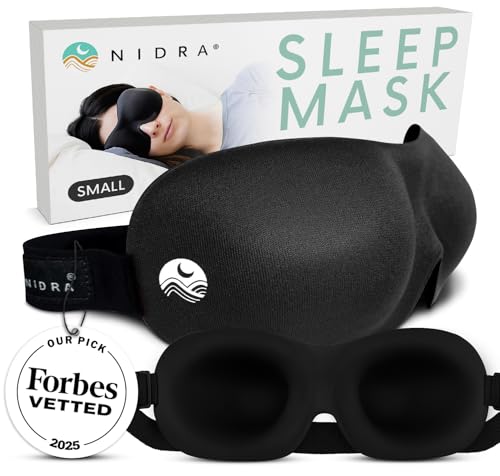 Small, snug fit eliminates light leaks for petite sleepers and travelers.
Most standard sleep masks are too large for people with petite or narrow face shapes, leaving gaps at the temples and nose that let in light. The Nidra mask is designed specifically for smaller faces, with a contoured fit that hugs the face without slipping, and soft fabric that doesn’t irritate sensitive skin. It’s my go-to recommendation for petite sleepers who have struggled with standard masks leaking light.
Small, snug fit eliminates light leaks for petite sleepers and travelers.
Most standard sleep masks are too large for people with petite or narrow face shapes, leaving gaps at the temples and nose that let in light. The Nidra mask is designed specifically for smaller faces, with a contoured fit that hugs the face without slipping, and soft fabric that doesn’t irritate sensitive skin. It’s my go-to recommendation for petite sleepers who have struggled with standard masks leaking light.
Pros:
- Zero pressure fit for small face shapes
- Works well for petite sleepers who find standard masks too large
- Soft, skin-friendly fabric for sensitive skin
- Stays put during toss-and-turn
- Travel friendly and compact
Cons:
- Limited color options
- Not insulated for cold rooms
- May not block extreme side light for very wide faces
Get the Nidra Contoured Sleep Mask on Amazon for a custom petite fit
Best For City Dwellers & Early Sunrise: Mavogel Cotton Eye Mask
 Moldable nose bridge blocks early sunrise light for city apartment dwellers.
For people living in urban areas with early sunrise or bright streetlights, the Mavogel mask’s adjustable wire nose bridge is a game-changer. You can mold the bridge to fit the unique curve of your nose, eliminating the gap that lets in the most stray light for most users. The soft cotton fabric is gentle on sensitive skin, and it includes a travel pouch for easy storage.
Moldable nose bridge blocks early sunrise light for city apartment dwellers.
For people living in urban areas with early sunrise or bright streetlights, the Mavogel mask’s adjustable wire nose bridge is a game-changer. You can mold the bridge to fit the unique curve of your nose, eliminating the gap that lets in the most stray light for most users. The soft cotton fabric is gentle on sensitive skin, and it includes a travel pouch for easy storage.
Pros:
- Adjustable nose bridge reduces leaks for all face shapes
- Soft cotton feels gentle on skin
- Stays put without heavy pressure
- Perfect for blocking early city sunrise light
Cons:
- Bulkier than minimalist masks
- May need reshaping after washing
- Not ideal for very hot nights
Get the Mavogel Cotton Eye Mask on Amazon for a customizable, leak-proof fit
How To Choose The Right Option For Your Needs
Choose A Sleep Mask If…
- You travel frequently, stay in hotels, or nap outside your home
- You share a bedroom with a partner who stays up late or wakes up early
- You work night shifts and need to sleep during the day
- You want a low-cost, no-install solution for light blocking
- You need targeted darkness that doesn’t affect other people in the room If you regularly go to bed with damp hair, pairing your mask with safe wet hair practices avoids trapped moisture causing scalp irritation or frizz.
Choose Blackout Curtains If…
- You want room-wide darkness for your primary bedroom
- You live in an urban area with bright streetlights or early sunrise
- You want to reduce outside noise and regulate indoor temperature
- You share a room with multiple sleepers who all benefit from darkness
- You’re looking for a permanent, low-maintenance solution for your home
The Best Of Both Worlds: Pairing For Total Darkness
For the deepest possible sleep, most sleep experts recommend using both a sleep mask and blackout curtains together. Curtains block the majority of room light, reducing ambient glare, while a mask eliminates any remaining stray light from gaps around the window, under the door, or from electronics. This pairing is especially effective for people with severe light sensitivity, shift workers, or anyone living in extremely bright urban environments.
Tips To Maximize Light Blocking For Either Solution
Sleep Mask Tips
- Test the nose seal first: When trying on a mask, hold it up to a bright light and move your head side to side. If light leaks in at the nose, the mask is not a good fit for your face shape.
- Adjust the strap to sit high on the back of your head, not low on your neck, to prevent slipping overnight.
- Wash your mask weekly with mild soap to remove oil and dead skin that can degrade the light-blocking seal over time, just like your mattress protector care routine.
- Replace your mask every 6-12 months, as foam and fabric compress over time and lose their ability to block light.
Blackout Curtain Tips
- Measure your window carefully: Curtains should be 2-3 inches wider than the window frame on each side, and long enough to touch the floor or hang 1 inch above it to eliminate bottom gaps.
- Install side channels along the edges of the window frame to block light from seeping in around the sides of the curtains.
- Choose curtains with a blackout lining attached, rather than separate liners, for the tightest possible seal.
- Overlap the two curtain panels by at least 4 inches in the middle to eliminate center light gaps.
Frequently Asked Questions
1. Which blocks more light: a sleep mask or blackout curtains?
A properly fitted sleep mask will almost always block more light than blackout curtains, as it creates a direct seal over your eyes that eliminates 100% of light when fitted correctly. Blackout curtains block 90-99% of incoming light, but small gaps at the top, sides, or bottom can let in stray light. For maximum light blocking, use both together.
2. Can sleep masks cause skin or eye problems?
High-quality masks made of breathable, hypoallergenic fabric are safe for most users, but poor-fitting masks that press hard on the eyes can cause dryness, redness, or irritation. If you have sensitive skin, choose a mask made of natural cotton or silk, and wash it weekly to remove oil and bacteria. Avoid masks with tight straps that dig into the side of your head, as they can cause headaches.
3. Do blackout curtains improve sleep quality?
Yes, multiple studies have shown that reducing ambient light at night improves sleep quality and duration. Blackout curtains eliminate streetlight and early sunrise glare that can disrupt melatonin production, leading to fewer nighttime awakenings and deeper REM sleep. They also reduce outside noise, which further improves sleep quality for light sleepers.
4. Which is better for travelers?
Sleep masks are far better for travelers, as they are lightweight, portable, and work in any environment, regardless of the hotel’s curtain quality. A high-quality contoured mask will deliver total darkness even in a hotel room with thin, ineffective curtains, making it a must-pack for frequent travelers.
5. How do I pick between a mask and curtains?
Choose a sleep mask if you need portable, personal darkness for travel, naps, or shared rooms. Choose blackout curtains if you want a permanent, room-wide solution for your primary bedroom to reduce ambient light and noise for all sleepers. If you’re on a budget, start with a low-cost sleep mask to test if light blocking improves your sleep before investing in expensive curtains.
6. Can I use sleep masks and blackout curtains together?
Absolutely, and this is the most effective setup for people with severe light sensitivity. Curtains block the majority of incoming room light, while a mask eliminates any remaining stray light from gaps or other sources. This pairing is especially effective for shift workers, people living in bright urban areas, and anyone who struggles to fall asleep with even small amounts of light.
7. Do blackout curtains block 100% of light?
No, even the highest-quality blackout curtains will not block 100% of light if there are gaps in the installation. Gaps as small as 1/8 inch at the top, sides, or bottom of the curtain can let in enough light to disrupt sleep for very light-sensitive sleepers. Adding side channels and ensuring proper overlap will get you as close to 100% as possible, but a sleep mask is the only way to guarantee total darkness.
8. Are sleep masks good for migraines?
Yes, many people with migraines find that sleep masks help reduce light sensitivity during attacks. Look for a mask with soft, pressure-free padding that doesn’t press on your temples or forehead, as pressure can worsen migraine pain. Contoured masks are a good choice, as they eliminate pressure on the eyes while still blocking light.
9. How often should I replace my sleep mask?
Most sleep masks last 6-12 months with regular use and proper washing. Replace your mask if the fabric becomes stretched out, the nose seal no longer fits your face, or the strap loses its elasticity, as these issues will lead to light leakage and reduced comfort.
10. Do blackout curtains work for kids' rooms?
Yes, blackout curtains are an excellent choice for kids' rooms, as they help regulate sleep schedules by blocking early morning sunlight that can cause early wake-ups. They also reduce outside noise and keep rooms cool in the summer, creating a more comfortable sleep environment for children.
Final Verdict
If you’re looking for the single most effective light-blocking tool, a properly fitted sleep mask will always outperform blackout curtains, delivering near-total 100% darkness anywhere, at any time, for a fraction of the cost. For home use, especially in shared bedrooms or urban areas, blackout curtains provide a low-maintenance, room-wide solution that also reduces noise and regulates temperature.
For most people, the best approach is to pair both: install blackout curtains in your primary bedroom to eliminate most ambient light, and keep a high-quality contoured sleep mask on hand for travel, naps, and any residual light leaks. If you’re a frequent traveler or shift worker, prioritize a sleep mask first, as it works in any environment. If you’re a homebody looking to improve your bedroom sleep environment, start with blackout curtains and add a mask later if you still have light leakage issues.
Ready to upgrade your sleep setup? Start with the option that fits your lifestyle first, and adjust as needed to find your perfect darkness.
Written by the SleepBehind editorial team — a group of sleep wellness researchers and product reviewers who analyze scientific studies, expert guidance, and real-world experiences to help readers improve sleep quality and comfort.