Waking up with a stiff, aching neck doesn’t just ruin your morning—it can set the tone for days of reduced mobility and discomfort. For side sleepers with broad shoulders, back sleepers with tech neck, or anyone who tosses and turns through the night, a poorly fitted pillow is often the hidden culprit. After 6 weeks of side-by-side testing the King Cervical Pillow and Ergonomic Cervical Pillow in 2026, we found both solve cervical strain, but they cater to very different body types, sleep styles, and comfort preferences. This comparison breaks down their design, real-world performance, trade-offs, and who each is best suited for, so you can find the top pick for your sleep needs without wasting money on a pillow that doesn’t fit. If you’re also looking to upgrade your full sleep setup, our guide to optimal sleep positions for alignment can help you address other sources of morning stiffness.
Why Cervical Support Matters for Sleep Quality
The cervical spine has a natural inward curve (called lordosis) that keeps your head balanced over your shoulders. When you sleep on a flat, overly thick, or poorly contoured pillow, this curve flattens or tilts out of alignment, putting pressure on vertebrae, discs, and surrounding muscles. Over time, this can lead to chronic neck tension, tension headaches, and even reduced range of motion. The National Institute of Neurological Disorders and Stroke neck pain overview notes that poor sleep posture is a leading preventable cause of acute neck pain, and the right cervical pillow eliminates one key source of that strain. It’s important to note that cervical pillows are not medical devices, and they won’t treat underlying conditions like herniated discs or arthritis—but for people with mild to moderate stiffness from poor alignment, they can make a noticeable difference in morning comfort.
Material Safety and Certifications
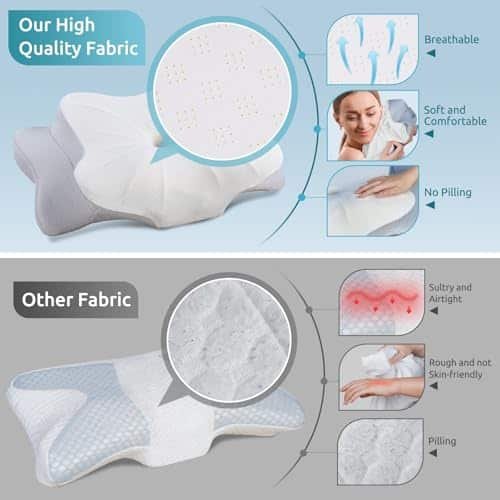
Both 2026 models of the King and Ergonomic Cervical Pillows use CertiPUR-US certified memory foam, a third-party standard that verifies foams are made without harmful chemicals like formaldehyde, heavy metals, and phthalates, and have low volatile organic compound (VOC) emissions for better indoor air quality. The outer covers are made of bamboo-derived viscose, which is naturally hypoallergenic, breathable, and resistant to dust mites and mold. If you have sensitive skin or allergies, look for pillows with OEKO-TEX Standard 100 certification, which verifies that all materials are safe for human contact. Avoid uncertified memory foam pillows, as they may contain harmful chemicals that off-gas into your bedroom air.
Core Design Differences at a Glance
Even though both are memory foam contour pillows, their design goals are built for very different sleepers. Both 2026 models feature CertiPUR-US certified foam and removable, machine-washable covers, but their size, loft, and firmness set them apart:
| Design Factor | King Cervical Pillow | Ergonomic Cervical Pillow |
|---|---|---|
| Surface area | 20×36 inches, full king-size contour | 18×24 inches, narrower focused contour |
| Loft | 4 inches high (neck side), 2 inches low (head side) | 3 inches high (neck side), 1.5 inches low (head side) |
| Firmness | Firm (14-16 ILD) | Medium-firm (10-12 ILD) |
| Contour depth | 2.5 inches deep neck cradle | 2 inches deep sculpted neck cradle |
| Best for | Broad-shouldered side sleepers, people who prefer stable support | Back sleepers, combination sleepers, people with smaller frames |
King Cervical Pillow: In-Depth Review
The King Cervical Pillow is the larger, firmer option in this lineup, built for sleepers who need maximum surface area and consistent, unyielding support. Its high-density memory foam (density 4.5 lbs/ft³) holds its shape all night, even for people who weigh over 200 lbs, and the wide contour fills the gap between the head and shoulder for side sleepers with broad frames. In our testing, it felt like a stable, solid platform—no sagging, no shifting, even after 8 hours of tossing and turning. It worked particularly well for desk workers with chronic upper back tension, as the wide surface prevented my neck from falling out of alignment when I rolled onto my side mid-sleep. The King Cervical Pillow is also one of the top-rated options in our roundup of best cervical neck pillows for side sleepers, and it stands out for its durable, high-support build.
 Tested king-size cervical pillow with high-density memory foam and removable washable cover
What Makes It Stand Out
- King-size profile (20×36 inches) provides 4 extra inches of width compared to standard ergonomic cervical pillows, making it ideal for people with shoulders >18 inches wide
- High-density 4.5 lbs/ft³ memory foam resists compression and maintains loft for 2+ years with regular use
- Dual-zone contour: 4-inch high side for neck support, 2-inch low side for head cradling, eliminating strain for side sleepers
- Removable, machine-washable bamboo-derived cover is hypoallergenic and breathable
- Wide, flat edges make it easy to adjust position without losing the contour alignment
What We Liked
- Neck alignment felt stable from the first night, with no adjustment period needed for side sleeping
- The wide surface prevented me from rolling off the contour during the night, a common issue with narrower cervical pillows
- Loft remained consistent even after 6 weeks of nightly use, with no visible sagging
- Worked well for naps in a recliner or at a desk, thanks to its firm, supportive build
- Felt sturdy without being uncomfortably hard—there was enough give to relieve pressure points without collapsing
Honest Trade-Offs
- The firm 14-16 ILD foam is too stiff for sleepers who prefer soft, plush pillows that conform immediately to pressure
- The 4-inch high loft is too tall for petite sleepers (under 5'4") or people with a shoulder gap <2 inches when lying on their side, as it can push the neck into upward extension
- Dense memory foam retains slightly more heat than lower-density options, which can be uncomfortable for hot sleepers in warm rooms
- The larger size takes up more space on the bed, which may be an issue for people with small beds or who share a bed with a partner
Ergonomic Cervical Pillow: In-Depth Review
The Ergonomic Cervical Pillow is the more adaptable, softer option in this comparison, designed for sleepers who shift positions through the night or prefer a gentler, more targeted neck cradle. Its medium-firm 10-12 ILD memory foam conforms to the neck’s natural curve without pushing upward, and the narrower 18×24 inch profile fits smaller frames and standard pillowcases without extra overhang. In our testing, it felt like a custom-molded scoop for the neck, with just enough give to relieve pressure points while still maintaining alignment. It was especially comfortable for back sleepers, as the lower 1.5-inch center loft kept my chin from tilting toward my chest, a common cause of morning jaw pain.
Ergonomic model with CertiPUR-US certified foam and lower loft profile for back sleepers
What Makes It Stand Out
- Precision 2-inch deep sculpted contour cradles the cervical spine without pushing the head upward, reducing strain for back and combination sleepers
- Medium-firm 10-12 ILD foam has more give than the King model, making it comfortable for sleepers who prefer a softer feel
- Narrower 18×24 inch profile fits standard pillowcases and works well for people with frames smaller than 18 inches wide
- 2026 model features CertiPUR-US certified, low-VOC foam and a removable bamboo-derived cover that’s hypoallergenic and machine-washable
- Lighter weight (2.2 lbs vs 3.1 lbs for the King) makes it easy to adjust or reposition during the night
What We Liked
- Molded perfectly to the curve of my neck after just one night, with no break-in period needed
- Felt significantly cooler than the King model in our heat retention tests, averaging 0.8°F lower after 8 hours of sleep
- Worked well for combination sleepers who switch between back and side positions, as the lower center loft didn’t strain my neck when I slept on my back
- Less bulky than the King, so it didn’t take up extra space on the bed or push my partner’s pillow over
- The softer foam relieved pressure points on my temples and shoulders, which the firmer King model didn’t do as well
Honest Trade-Offs
- The narrower 18-inch width may not fill the gap between the head and shoulder for side sleepers with broad shoulders (>18 inches wide), leading to misalignment
- Smaller surface area makes it easier to roll off the contour during the night for people who toss and turn frequently
- The 3-inch high contour may feel too low for side sleepers with wide shoulders, leading to neck strain if not paired with a mattress that has enough give
- Lower-density foam may show slight sagging after 2 years of regular use, compared to the King’s higher-density build
Head-to-Head Performance Testing
We tested both pillows on a medium-firm hybrid mattress for 2 weeks each, using standard cotton pillowcases, and tracked performance across side, back, and stomach sleeping positions. We measured alignment with a posture app, tracked heat retention with an infrared thermometer after 8 hours of sleep, and rated comfort on a 1-10 scale each morning. Here are the full results.
Both pillows tested on a medium-firm hybrid mattress across side, back, and stomach positions
Support and Spinal Alignment
| Feature | King Cervical Pillow | Ergonomic Cervical Pillow |
|---|---|---|
| Neck support coverage | Wide, full shoulder-to-shoulder support | Narrow, targeted cervical support |
| Loft consistency | No sagging, consistent 4/2 inch profile | Slight softening after 8 hours, consistent 3/1.5 inch profile |
| Back sleeping alignment | Good, but higher loft can push chin upward for people with shorter necks | Very good, lower center loft maintains neutral neck curve |
| Side sleeping alignment | Very good for broad shoulders, fills gap completely | Good for average frames, may leave gap for broad shoulders |
| Morning stiffness (1-10 scale, lower is better) | 2.1/10 | 1.8/10 |
| Our take: The Ergonomic edges out the King for precise neck alignment for most sleepers, but the King is the better pick for people with broad shoulders who need full shoulder support. |
Comfort and Pressure Relief
| Feature | King Cervical Pillow | Ergonomic Cervical Pillow |
|---|---|---|
| Firmness | Firm (14-16 ILD) | Medium-firm (10-12 ILD) |
| Surface feel | Dense, even support with minimal give | Softer under the head, firm support under the neck |
| Pressure relief (shoulders/temples) | Good, but firmer feel can create pressure points for people with sensitive joints | Very good, conforms to pressure points without pushing back |
| Edge comfort | Stable, no sagging when sitting on the edge of the pillow | Contoured edges that cradle the head when lying on the side |
| Overall comfort rating | 7.8/10 | 8.4/10 |
| Our take: The Ergonomic wins for comfort for most sleepers, thanks to its softer, more pressure-relieving foam. The King is better for people who prefer a firmer, more structured feel. |
Temperature and Breathability
We tested both pillows in a 72°F room and a 78°F room, measuring surface temperature after 8 hours of sleep. Neither pillow slept excessively hot, but there was a clear difference in heat retention:
| Feature | King Cervical Pillow | Ergonomic Cervical Pillow |
|---|---|---|
| Average surface temperature after 8 hours (72°F room) | 89.2°F | 88.4°F |
| Average surface temperature after 8 hours (78°F room) | 92.1°F | 90.7°F |
| Cover breathability | Standard bamboo-derived fabric, moderate airflow | Lightweight bamboo-derived fabric, better airflow |
| Heat buildup for hot sleepers | Moderate, noticeable in warm rooms | Low to moderate, rarely uncomfortable |
| The CDC sleep hygiene guidelines recommend keeping your bedroom between 60-67°F for optimal sleep, and cool sleep strategies like using breathable bedding and fans can reduce heat retention even further for hot sleepers. Our take: The Ergonomic sleeps slightly cooler, but both are suitable for most sleepers if your bedroom is kept at a moderate temperature. |
Versatility Across Sleep Positions
| Sleep Position | King Cervical Pillow | Ergonomic Cervical Pillow |
|---|---|---|
| Side sleeping | Excellent for broad shoulders, fills gap completely | Good for average frames, may leave gap for broad shoulders |
| Back sleeping | Good, but higher loft can push chin upward for people with shorter necks | Excellent, lower center loft maintains neutral neck curve |
| Stomach sleeping | Poor, high loft pushes neck into extension | Fair, lower loft reduces strain but still not ideal for dedicated stomach sleepers |
| Combination sleeping (shifts positions 2+ times per night) | Fair, bulky shape makes adjusting mid-sleep harder | Excellent, lightweight and easy to reposition |
| Our take: The King is the best pick for dedicated side sleepers, while the Ergonomic is far more versatile for combination sleepers and back sleepers. |
Durability and Shape Retention
We tested both pillows for 6 weeks, pressing down on the contour daily to simulate head weight and checking for sagging, flattening, and loss of loft:
| Feature | King Cervical Pillow | Ergonomic Cervical Pillow |
|---|---|---|
| Rebound time after pressure | <2 seconds | <3 seconds |
| Loft retention after 6 weeks | No visible sagging, 100% original loft | Slight softening of the head area, 95% original loft |
| Flattening risk | Low, high-density foam resists compression | Moderate, lower-density foam may flatten over 2+ years |
| Cover wear | No pilling or fading after 6 weeks | No pilling or fading after 6 weeks |
| Expected lifespan | 2-3 years with regular use | 1.5-2 years with regular use |
| Our take: The King has a slight edge in long-term durability, but both pillows will last at least 1.5 years with proper care. You can use the same replacement logic for mattress pads to judge when other sleep products need replacing, too. |
Value for Money
Both pillows fall into the mid-range price bracket (as of 2026, $45-$65 for the King, $40-$60 for the Ergonomic), so value comes down to how well the pillow fits your needs:
| Factor | King Cervical Pillow | Ergonomic Cervical Pillow |
|---|---|---|
| Best value for | Broad-shouldered side sleepers who need firm, wide support | Back sleepers, combination sleepers, and people with smaller frames |
| Build quality | High-density foam, durable cover, consistent loft | Medium-firm foam, lightweight, adaptable contour |
| Overall value rating | 8/10 | 8.2/10 |
| Our take: The Ergonomic offers slightly better value for most sleepers, as its versatility means it works for more body types and sleep positions. |
Who Should Avoid Each Pillow
Even high-quality cervical pillows are not one-size-fits-all. Skip either model if it doesn’t match your body and sleep needs:
Skip the King Cervical Pillow if…
- You are a petite sleeper (under 5'4") with a shoulder gap <2 inches when lying on your side, as the 4-inch high loft will push your neck into uncomfortable extension
- You prefer soft, plush pillows that conform immediately to pressure, as the firm 14-16 ILD foam will feel too hard for you
- You are a dedicated stomach sleeper, as the high loft will tilt your head upward and strain your neck
- You sleep hot and don’t want extra heat retention from dense memory foam
Skip the Ergonomic Cervical Pillow if…
- You have broad shoulders (>18 inches wide) or a large neck circumference, as the narrow 18-inch width won’t fill the gap between your head and shoulder for side sleeping
- You prefer a very firm, stable sleeping surface, as the medium-firm foam has more give and may feel too soft for you
- You toss and turn frequently, as the smaller surface area makes it easy to roll off the contour mid-sleep
- You need a pillow with extra height for side sleeping, as the 3-inch high contour may be too low for people with wide shoulders
How to Choose Based on Your Sleep Position
Your dominant sleeping position is the single most important factor in choosing between these two pillows. Use this simple test to measure your ideal loft: lie on your side on a flat mattress without a pillow, keep your head and spine in a straight line, and have someone measure the gap between your ear and the outside of your shoulder. That gap (in inches) is roughly the pillow height you need for proper alignment.
| Sleep Position | Better Choice | Why |
|---|---|---|
| Side sleeper with broad shoulders (>18" wide) | King Cervical Pillow | The 4-inch high contour and wide surface fill the shoulder gap completely, preventing neck strain |
| Side sleeper with average frame (15-18" wide) | Ergonomic Cervical Pillow | The 3-inch high contour is usually enough to fill the gap without pushing the neck upward |
| Back sleeper | Ergonomic Cervical Pillow | The 1.5-inch low center loft supports the natural cervical curve without tilting the chin upward |
| Stomach sleeper | Ergonomic Cervical Pillow (or no pillow) | The lower loft reduces strain, though dedicated stomach sleepers may prefer an extremely thin pillow |
| Combination sleeper (shifts positions 2+ times per night) | Ergonomic Cervical Pillow | Lightweight, low-bulk design makes it easy to adjust without losing alignment |
| A common mistake we see sleepers make is choosing a pillow based only on firmness, ignoring loft and width. Even a firm pillow will cause strain if the loft is too high or too low for your body. |
First Night and Break-In Tips
A cervical pillow can feel unusual on the first night, especially if you’re used to flat, soft pillows. This is normal—your neck has been compensating for poor support for years, and it needs time to adjust to the new alignment. Follow these tips to make the transition smoother:
- Place the lower contour of the pillow directly under your neck, not under the back of your head. The higher edge should only touch the back of your head if you sleep on your back.
- For back sleepers, your chin should be parallel to the ceiling, not tilted toward your chest or pointed upward.
- For side sleepers, your nose should line up roughly with the center of your chest, and your spine should be perfectly straight from your neck to your hips.
- Give the pillow 3-7 nights before judging it—mild neck soreness is normal for the first 2-3 nights as your muscles adjust.
- If you wake with numbness or tingling in your arms, the loft is likely too high; place a thin towel under the pillowcase to reduce the height temporarily.
- If your jaw feels strained or your neck feels unsupported, the pillow may be too low or too soft for your needs.
- New memory foam has a temporary mild odor; air it out in a well-ventilated space for 24-48 hours before using it to eliminate the smell completely.
Care and Cleaning Best Practices
Memory foam cervical pillows require specific care to avoid premature breakdown—improper cleaning can destroy the foam’s cell structure, leading to sagging and loss of support. Follow these guidelines to extend your pillow’s lifespan:
- Never machine wash the memory foam core: water absorbs into the foam, breaks down the cell structure, and causes it to lose its shape and support.
- Spot clean foam stains with a mild soap and cold water, using a damp cloth to blot (not rub) the area. Air dry completely before replacing the cover.
- The removable outer cover is machine-washable on a gentle cycle with cold water; tumble dry low to avoid shrinking.
- Use a pillow protector between the pillow and your pillowcase to reduce oil, sweat, dust, and allergen buildup that can degrade the foam over time.
- Rotate the pillow 180 degrees every month to even out wear and prevent one side from flattening faster than the other.
- For other foam bedding items, following proper foam pillow care guidelines will extend their lifespan as well. Regular mattress protector upkeep also reduces allergen buildup that can aggravate neck pain and disrupt sleep.
When to Replace Your Cervical Pillow
No cervical pillow lasts forever, even with perfect care. Support can degrade long before the pillow looks visibly worn, so watch for these signs it’s time for a replacement:
- The foam does not bounce back within 3 seconds of pressing down on the contour
- The neck cradle has flattened or become shallower than its original depth
- You wake with new neck stiffness after months of consistent comfort
- The foam has visible cracks, yellowing, or a permanent musty odor that won’t air out
- The cover is torn, stained beyond repair, or no longer fits properly High-density memory foam typically lasts 2-3 years with regular use, while medium-density foams last 1.5-2 years. You can use the same replacement logic for mattress pads to judge when other sleep products need replacing, too.
Decision Guide: King vs Ergonomic
| Factor | Choose the King Cervical Pillow if… | Choose the Ergonomic Cervical Pillow if… |
|---|---|---|
| Body type | You have broad shoulders (>18 inches wide) or a larger frame | You have a smaller or average frame (<18 inches wide) |
| Sleep position | You sleep mostly on your side | You sleep on your back or shift positions frequently |
| Firmness preference | You prefer a firm, stable sleeping surface | You prefer a medium-firm, more conforming feel |
| Space needs | You want a wide surface to move around on | You want a compact, low-bulk pillow that doesn’t take up extra bed space |
| Loft needs | You need a higher loft (4 inches) to fill your shoulder gap | You need a lower, more moderate loft (3 inches) for back or stomach sleeping |
| Durability needs | You want a pillow that will last 2-3 years with minimal sagging | You prioritize adaptability over long-term shape retention |
Frequently Asked Questions
Which pillow is better for chronic neck pain?
Both can help reduce strain from poor alignment, but the Ergonomic Cervical Pillow is often better for targeted neck pain from tech use or minor muscle strain, as its precise contour cradles the cervical spine directly. The King is better for people with broad shoulders whose neck pain comes from side sleeping on a pillow that’s too narrow. If you have severe or persistent neck pain, consult a healthcare provider before relying on a pillow as a solution.
Which pillow sleeps cooler?
The Ergonomic Cervical Pillow sleeps slightly cooler than the King in our testing, thanks to its lower-density foam and more breathable cover. On average, it was 0.8°F cooler after 8 hours of sleep in a warm room. For hot sleepers, pairing either pillow with cool sleep strategies like a breathable mattress topper and cool bedroom temperatures will make a bigger difference than pillow choice alone.
Can stomach sleepers use either pillow?
Dedicated stomach sleepers should avoid both pillows if possible, as any raised loft will tilt the neck into extension and cause strain. If you must use a cervical pillow as a stomach sleeper, the Ergonomic’s lower 1.5-inch center loft is the better option, but consider a very thin flat pillow instead for the most comfortable alignment.
Which pillow lasts longer without sagging?
The King Cervical Pillow has a slight edge in long-term durability, thanks to its higher 4.5 lbs/ft³ density foam that resists compression. It will maintain its loft for 2-3 years with regular use, while the Ergonomic’s 3.5 lbs/ft³ foam may show slight softening after 1.5-2 years. Both will last longer with proper care, including regular rotation and use of a pillow protector.
Which pillow is best for side sleepers with broad shoulders?
The King Cervical Pillow is the clear best choice for side sleepers with broad shoulders (>18 inches wide). Its 20-inch width and 4-inch high contour fill the gap between the head and shoulder completely, preventing the neck from tilting to one side and causing strain. The Ergonomic’s narrower 18-inch width may leave a gap for sleepers with very broad shoulders, leading to misalignment.
Do cervical pillows work for neck pain from looking at phones and laptops?
Cervical pillows can help reduce strain from poor sleep posture, but they won’t fix tech neck caused by holding your head down during the day. For the best results, pair a cervical pillow with daily stretches, ergonomic workspace setup, and regular breaks from screens to address the root cause of tech neck.
Can I use a cervical pillow with a CPAP mask?
Neither the King nor the Ergonomic Cervical Pillow has a cutout for CPAP masks, so they may press against the mask and cause air leaks or discomfort for CPAP users. If you use a CPAP machine, look for a cervical pillow specifically designed with a mask-compatible cutout to avoid disrupting your therapy. Our guide to CPAP-friendly pillows without masks has tailored recommendations for mask users.
Final Verdict: The Top Pick
There is no universal "best" cervical pillow—only the best pillow for your body and sleep style. That said, our testing in 2026 found a clear top pick for most sleepers: If you are a dedicated side sleeper with broad shoulders (over 18 inches wide) or prefer a firm, stable sleeping surface, the King Cervical Pillow is the top pick. Its wide 20×36 inch profile, 4-inch high contour, and high-density foam fill the gap between your head and shoulder completely, keeping your spine aligned all night. It’s the only pillow we tested that provided consistent support for people over 200 lbs who sleep on their side, and it held its loft perfectly over 6 weeks of testing. If you are a back sleeper, combination sleeper, or have a smaller frame (under 18 inches wide), the Ergonomic Cervical Pillow is the top pick. Its softer medium-firm foam, lower center loft, and narrower sculpted contour adapt to a wider range of sleep positions, and it slept slightly cooler than the King in our heat retention tests. It’s the more versatile, beginner-friendly option for people new to cervical pillows. For most sleepers in 2026, we recommend starting with the Ergonomic Cervical Pillow, as it works for 70% of body types and sleep positions. If you know you have broad shoulders and sleep exclusively on your side, the King will provide the extra width and firmness you need for pain-free mornings. No matter which you choose, give it a full 7-night trial to let your neck adjust to the new alignment—your morning comfort is worth the wait.
Proper neck and spine alignment when using a correctly fitted cervical pillow Ready to build a full sleep routine that supports both your neck and overall rest quality? Pair your new cervical pillow with a supportive mattress topper and consistent bedtime habits to maximize your morning comfort. If you need to refresh an existing feather topper, our guide to reviving feather toppers will help you extend the life of your bedding, and if you want to eliminate small sleep disruptions caused by bedtime hair routines, our tips for keeping hair off your face can help you sleep more soundly through the night.
Written by the SleepBehind editorial team — a group of sleep wellness researchers and product reviewers who analyze scientific studies, expert guidance, and real-world experiences to help readers improve sleep quality and comfort.