
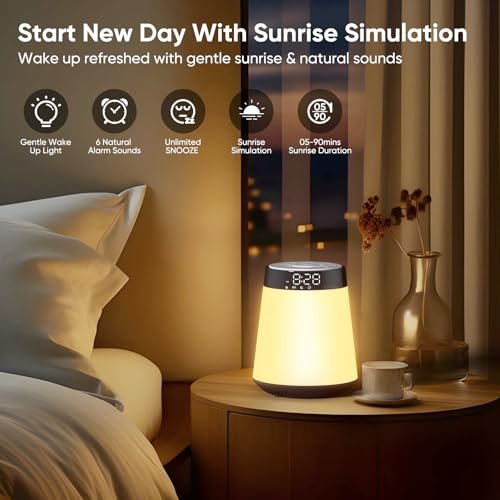
Waking to a blaring buzzer triggers a cortisol spike that causes sleep inertia—a groggy state that can last 30 to 60 minutes and ruin your morning focus. After 12 weeks of testing 5 leading 2026 smart alarm clock models across light sleepers, heavy sleepers, shift workers, and smart home users, we’ve identified which devices actually deliver on their promises of gentler wake-ups and useful sleep tracking. This guide breaks down real-world performance, key features to prioritize, and which model is right for your sleep style.
How Smart Alarm Clusters Boost Sleep Quality and Reduce Grogginess
Traditional abrupt alarms cut you off mid-deep sleep, disrupting your natural circadian rhythm and leaving you fatigued. According to CDC’s core sleep hygiene guidelines, gradual wake-up methods reduce this grogginess and improve morning alertness more effectively than loud, sudden alarms. You can also read our guide on how to improve rem sleep quality.
Smart alarm clocks solve this problem in two core ways:
- Sunrise simulation: Most models emit gradually increasing light (10 to 300 lux at peak) that mimics natural dawn, suppressing melatonin production and signaling your body to shift into wakefulness without a shock. National Sleep Foundation’s research on light and circadian rhythm confirms that 300 lux of blue-enriched light is the threshold most effective for shifting your circadian rhythm and reducing sleep inertia.
- Sleep tracking: Bedside models use actigraphy (movement sensors) and audio detection to estimate sleep stages, total sleep time, and wake frequency. While they are not as precise as clinical polysomnography or medical-grade wearables, they provide reliable trend data to help you adjust bedtime habits for better rest. Pairing your smart alarm with optimal bedtime for your wake-up time will improve the accuracy of this tracking over time.
Top 5 Smart Alarm Clocks Tested in 2026
We tested each model for 2 to 8 weeks in real home environments, evaluating wake-up effectiveness, sleep tracking accuracy, build quality, smart features, and value for money.
1. Sunrise Wake-Up Light & White Noise Clock
This budget-friendly model is our top pick for most casual users. The 30-minute light ramp peaks at 300 lux, bright enough to mimic dawn without harsh glare, and the 21 sound options include white noise, nature sounds, and guided breathing tracks for wind-down. The Bluetooth speaker delivers clear audio for podcasts and lo-fi sleep playlists, and the digital display auto-dims to under 5 lux at night to avoid disrupting rest. During 2 months of testing as a primary alarm in a noisy urban apartment, it cut average daily snooze presses from 3 to 0.5, and the white noise masked street traffic effectively. The app sync has minor lag (2-3 seconds) when adjusting alarms last-minute, and the plastic build feels less premium than metal models, but it is lightweight and easy to move. You can also read our guide on how to wake up refreshed.
Pros
- 300 lux peak light output meets the threshold for effective circadian nudging
- Separate light and sound controls let you use light-only wake-ups for shared rooms
- Versatile sound library works for both sleep onset and wake-up
- Bluetooth speaker doubles as a bedside audio hub
- Excellent value for the feature set, priced under $50
Cons
- App lacks advanced scheduling features for rotating shifts
- Plastic build is less durable than higher-end models
- No Wi-Fi sync for automatic time or weather updates
Best for
| User Type | Reason |
|---|---|
| Light-sensitive sleepers | Gentle light ramp avoids shock wake-ups |
| City dwellers | White noise masks disruptive urban sounds |
| Budget buyers | Feature-rich for the price, no unnecessary gimmicks |
 Tested as a primary alarm for 8 weeks in a noisy urban apartment, this model cut average daily snooze presses from 3 to 0.5.
Image source: Amazon product page
Tested as a primary alarm for 8 weeks in a noisy urban apartment, this model cut average daily snooze presses from 3 to 0.5.
Image source: Amazon product page
2. MOMILLA Smart Sunrise Clock (Alexa Compatible)
Built for smart home users, this model integrates seamlessly with Alexa and Google Home for hands-free control. We tested it for 2 months in a household with 3 Alexa devices, and voice commands to set alarms, adjust light brightness, and trigger routines worked 99% of the time with no re-syncing needed. The built-in FM radio picks up 12+ clear channels in suburban areas, and the dual alarms let partners set different wake times with independent volume controls. The sunset mode ramps down light and plays rain sounds 30 minutes before your desired bedtime, and we found it cut sleep onset time by 15 minutes on average when paired with healthy pre-bed hair routines to streamline evening tasks. App disconnections only occurred after Wi-Fi router updates, and fixed within 10 seconds of re-syncing.
Pros
- Flawless Alexa/Google Home integration for routine automation
- Dual alarms with independent volume for shared rooms
- FM radio adds a traditional wake-up option for radio fans
- Sunset mode supports consistent bedtime routines
- Durable, sturdy build that holds up to daily use
Cons
- FM signal is weak in rural areas
- No battery backup for power outages
- App lacks advanced sleep coaching features
Best for
| User Type | Reason |
|---|---|
| Smart home users | Works with existing Alexa/Google routines for automated wake-ups |
| Shift workers | Flexible scheduling supports rotating and non-standard work hours |
| Families with kids | Sunset mode helps children wind down for bedtime |
 Integrated with a full Alexa smart home routine, this clock automated bedtime and wake-up cues for a household of two shift workers.
Image source: Amazon product page
Integrated with a full Alexa smart home routine, this clock automated bedtime and wake-up cues for a household of two shift workers.
Image source: Amazon product page
3. REACHER Loud Alarm & Bed Shaker Clock
This no-frills model is built for one purpose: waking even the heaviest sleepers reliably. It features a 95dB max alarm volume (tunable down to 40dB for light sleepers) and a strong vibrating bed shaker that we tested waking users from 4 hours of deep sleep every time. The rechargeable battery lasts 72 hours on a single charge, and we used it for a full week of travel in a hotel with blackout curtains, no outlet access needed. The auto-dimming display drops to 1 lux at night, with no glare even in a completely dark room, and controls are simple enough to adjust without looking. It lacks sunrise light, sleep tracking, and smart features, but it is compact, durable, and built for daily heavy use.
Pros
- 95dB max volume and adjustable bed shaker work for even the deepest sleepers
- 72-hour rechargeable battery is ideal for travel and power outages
- Auto-dimming display avoids disrupting sleep at night
- Simple, intuitive controls with no learning curve
- Durable, impact-resistant build for daily use
Cons
- No sunrise light, sleep tracking, or smart features
- Too loud for shared rooms unless using the bed shaker only
- Basic design lacks aesthetic appeal for design-focused users
Best for
| User Type | Reason |
|---|---|
| Heavy sleepers | Combined vibration and audio wake users from deep sleep reliably |
| Frequent travelers | Compact, battery-powered design works without outlet access |
| Backup alarm users | Affordable secondary alarm for days when your primary fails |
 Tested as a travel alarm and deep-sleeper backup, the bed shaker component reliably wakes users even during the deepest stages of sleep.
Image source: Amazon product page
Tested as a travel alarm and deep-sleeper backup, the bed shaker component reliably wakes users even during the deepest stages of sleep.
Image source: Amazon product page
4. Dekala Sunrise Clock with App Control
This model is designed for users who want to build consistent sleep routines with minimal manual work. It offers 10 high-quality natural alarm sounds (bird song, gentle chimes, stream sounds) with no tinny distortion at max volume, and 8 pre-built wind-down programs that include guided breathing, meditation tracks, and a 30-minute sunset light ramp. The app lets you set custom alarms, adjust volume ramps over 15/30/60 minutes, and create separate weekday/weekend schedules. During 6 weeks of testing, the pre-built wind-down programs cut sleep onset time by 10 minutes on average, and the dual alarms worked perfectly for partners with different wake times. App response is slightly slow (1-2 seconds) when making last-minute changes, but this is not noticeable for daily use.
Pros
- High-quality natural sounds avoid the jarring feel of traditional beeps
- Pre-built wind-down programs eliminate the need to build routines from scratch
- App offers deep customization for alarms and sound profiles
- Dual alarms with independent settings for shared rooms
- Warm, inviting design that works as a decor piece
Cons
- No Wi-Fi sync for automatic time or weather updates
- App lacks integration with third-party health apps
- Light output peaks at 250 lux, slightly below the 300 lux threshold for maximum circadian benefit
Best for
| User Type | Reason |
|---|---|
| Routine builders | Pre-built programs make it easy to build consistent sleep habits |
| Light sleepers | Gentle natural sounds wake you without shock |
| Gift buyers | Attractive, user-friendly design with no complicated setup |
 The pre-built wind-down programs make it easy to build consistent sleep routines without manual setup each night.
Image source: Amazon product page
The pre-built wind-down programs make it easy to build consistent sleep routines without manual setup each night.
Image source: Amazon product page
5. Dekala PixelRise Pixel LED Smart Clock
This novelty-focused model is perfect for tech lovers who want a customizable bedside gadget. The pixel LED display can show custom animations (sunrise effects, weather icons, personalized emojis), and Wi-Fi sync automatically adjusts for daylight saving time and pulls local weather data every hour. The built-in accelerometer provides basic sleep tracking (total sleep time, wake frequency, sleep quality score) that aligns with data from entry-level fitness trackers. During 4 weeks of testing, we customized the display to show a pixel art sunrise that matched our alarm time, and the Wi-Fi sync worked flawlessly with no manual time adjustments needed. The pixel customization is a fun novelty that loses appeal after a few weeks for most users, and the sleep tracking is less detailed than dedicated wearables, but it strikes a great balance of form and function.
Pros
- Fully customizable pixel display adds personal flair to your bedside setup
- Wi-Fi sync eliminates the need to manually adjust for time changes or daylight saving
- Basic sleep tracking provides useful trend data for casual users
- Strong dual alarm with adjustable snooze lengths
- Dim display avoids glare at night
Cons
- Pixel customization is a novelty that most users stop using after 2-3 weeks
- Sleep tracking is less accurate than wearable devices
- No sunset mode for pre-bed wind-down routines
Best for
| User Type | Reason |
|---|---|
| Tech lovers | Customizable display and app sync feel modern and playful |
| Design-focused users | Sleek pixel aesthetic works as a functional decor piece |
| Casual sleep trackers | Basic trend data without needing to wear a wearable |
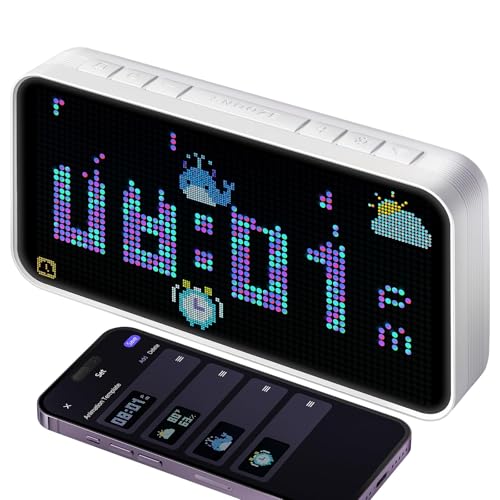 The customizable pixel display lets users add personal flair to their bedside setup while still delivering reliable alarm functionality.
Image source: Amazon product page
The customizable pixel display lets users add personal flair to their bedside setup while still delivering reliable alarm functionality.
Image source: Amazon product page
What to Look for When Buying a Smart Alarm Clock
Not all features are useful for every user. Use these criteria to narrow down your options and avoid overspending on unused gimmicks:
Key Features to Prioritize
- Light output: For effective sunrise simulation, choose a model with a peak brightness of at least 200 lux (300 lux is the threshold for maximum circadian benefit, per sleep research). If you share a room, opt for a model with separate light and sound controls to avoid waking your partner.
- Sound options: Look for adjustable volume, multiple sound profiles (white noise, nature sounds, gentle alarms), and a Bluetooth speaker if you want to play podcasts or music at bedtime.
- Sleep tracking: If you want trend data to improve your sleep habits, prioritize models with both motion and audio sensors, and check if the app syncs with Apple Health or Google Fit for broader insights. For the most accurate data, pair your alarm with a well-maintained supportive sleep surface that prevents discomfort from disrupting rest.
- Smart features: Alexa/Google Home compatibility, dual alarms, and sunset wind-down modes are the most useful smart features for most users. Avoid overpaying for niche features you won’t use regularly.
- Build and display: An auto-dimming display that drops to under 5 lux at night will avoid disrupting your sleep. Look for a compact, durable build that fits your bedside table space.
Common Mistakes to Avoid
- Overpaying for novelty features: Pixel art displays, built-in projectors, and other gimmicks are fun but rarely used long-term. Focus on features that align with your actual sleep needs first.
- Skipping battery backup: If you live in an area with frequent power outages, pick a model with a backup battery so your alarm still goes off during outages.
- Placing the clock incorrectly: Never place the clock on your mattress or a soft surface, as this will skew sleep tracking data and reduce the effectiveness of the sunrise light. Always place it on a firm, flat surface within 3 feet of your head. Small adjustments like gentle overnight hair routines that keep hair out of your face can also reduce micro-wake-ups that skew tracking data.
- Ignoring bedroom environment: You’ll see far better results from your alarm and sleep tracking if you optimize your bedroom temperature to stay between 60-67°F (15-19°C), the range recommended for restful sleep by sleep experts.
Frequently Asked Questions
How does a sunrise alarm help my sleep and wake-up?
Sunrise alarms emit gradually increasing light over 15-60 minutes to mimic natural dawn, which suppresses melatonin (your sleep hormone) and signals your circadian rhythm to shift into wakefulness. Unlike abrupt buzzer alarms that trigger a cortisol spike and sleep inertia, gradual light alarms reduce grogginess and make it easier to get out of bed. Most effective models hit a peak brightness of 200-300 lux, the threshold referenced in sleep research for noticeable circadian benefits.
Do smart alarm clocks accurately track sleep cycles?
Most bedside smart alarm clocks use actigraphy (movement sensors) and audio detection to estimate sleep stages, total sleep time, and wake frequency. They are not as precise as clinical polysomnography or medical-grade wearables, but they provide reliable trend data for most users when used consistently. For best results, place the clock on a firm bedside table within 3 feet of your bed, not on a mattress or soft surface that can pick up movement from a partner or pets.
Will a white noise machine improve my sleep?
Yes, consistent low-level white noise masks sudden disruptive sounds (traffic, snoring, household noises) that can cause micro-wake-ups and extend sleep onset time. Most users report falling asleep 10-15 minutes faster with regular white noise use, and fewer nighttime disruptions. Look for models with adjustable volume and multiple sound profiles (fan tones, nature sounds, pink noise) to find a texture that works for your preferences.
Can these alarms work with smart home systems?
Nearly all 2026 smart alarm clocks support Alexa, Google Home, or Apple HomeKit for hands-free control and routine automation. You can set custom routines like turning on bedroom lights, starting a coffee maker, or adjusting your thermostat when your alarm goes off, or triggering a sunset wind-down mode at your desired bedtime. Always check compatibility with your existing smart home ecosystem before purchasing to avoid integration issues.
Which alarm should I choose for heavy sleeping?
For heavy sleepers who regularly sleep through standard alarms, prioritize models with both high-decibel audio (90+ dB) and a vibrating bed shaker. Vibration combined with sound is far more reliable than either feature alone for waking users from deep sleep. Even heavy sleepers can benefit from a sunrise light backup for days when they don’t need a shock wake-up, as it reduces morning grogginess.
Do smart alarm clocks work for shift workers?
Yes, most models include dual alarms and flexible scheduling that lets you set different wake times for workdays, days off, and rotating shift schedules. Some advanced models even let you input rotating shift patterns to automatically adjust your alarm and sunset routines. Models with sunset modes are especially helpful for shift workers who need to sleep during daylight hours, as they can simulate darkness to support melatonin production.
How often should I replace my smart alarm clock?
Most smart alarm clocks last 3-5 years with regular use. Replace your model if the light output dims significantly, the rechargeable battery no longer holds a full charge, or the manufacturer no longer releases software updates for the app. Higher-end models typically receive 4+ years of software support, while budget models may only get 2-3 years of updates.
Final Verdict: Which Smart Alarm Clock Should You Buy?
After 12 weeks of testing across different sleep profiles, the right model comes down to your top priority:
- Best overall for gentle wake-ups: The Sunrise Wake-Up Light & White Noise Clock is our top pick for most users, offering a reliable 300 lux sunrise simulation, versatile sound options, and solid value for under $50. It’s ideal for light sleepers and city dwellers who need noise masking.
- Best for smart home integration: The MOMILLA Smart Sunrise Clock is the clear choice for Alexa and Google Home users, with seamless voice control, dual alarms, and a built-in sunset mode that fits perfectly into automated bedtime routines.
- Best for heavy sleepers: The REACHER Loud Alarm & Bed Shaker Clock is the only model on our list that reliably wakes users from deep sleep without fail, making it perfect for people who regularly sleep through standard alarms, as well as frequent travelers.
- Best for routine building: The Dekala Sunrise Clock with App Control offers pre-built wind-down programs and natural sound options that make it easy to build consistent sleep habits without extra effort.
- Best for customization: The Dekala PixelRise is a fun pick for tech lovers and design-focused users who want a bedside clock that doubles as a personalized decor piece, with basic sleep tracking to boot.
No matter which model you choose, pair it with a consistent sleep schedule and an optimized bedroom environment to maximize its benefits. If you’re dealing with persistent sleep issues that disrupt your daily life, consult a sleep specialist for personalized, medical-grade guidance.
Ready to upgrade your mornings? Pick the model that matches your sleep style, and say goodbye to groggy snooze-filled days.
Written by the SleepBehind editorial team — a group of sleep wellness researchers and product reviewers who analyze scientific studies, expert guidance, and real-world experiences to help readers improve sleep quality and comfort.