Pillow use is a relatively modern sleep habit — for most of human history, people rested on flat surfaces without head support. Today, many people experiment with ditching their pillow to relieve chronic neck pain, reduce overheating, or improve spinal alignment. But pillow-free sleep is not a one-size-fits-all solution: people with pre-existing neck conditions, sleep apnea, or specific sleep positions may experience worse discomfort if they switch too quickly. This guide covers evidence-based benefits, clear risks, a gradual transition plan, position-specific tips, and troubleshooting advice to help you decide if pillow-free sleep fits your needs, and how to try it safely.
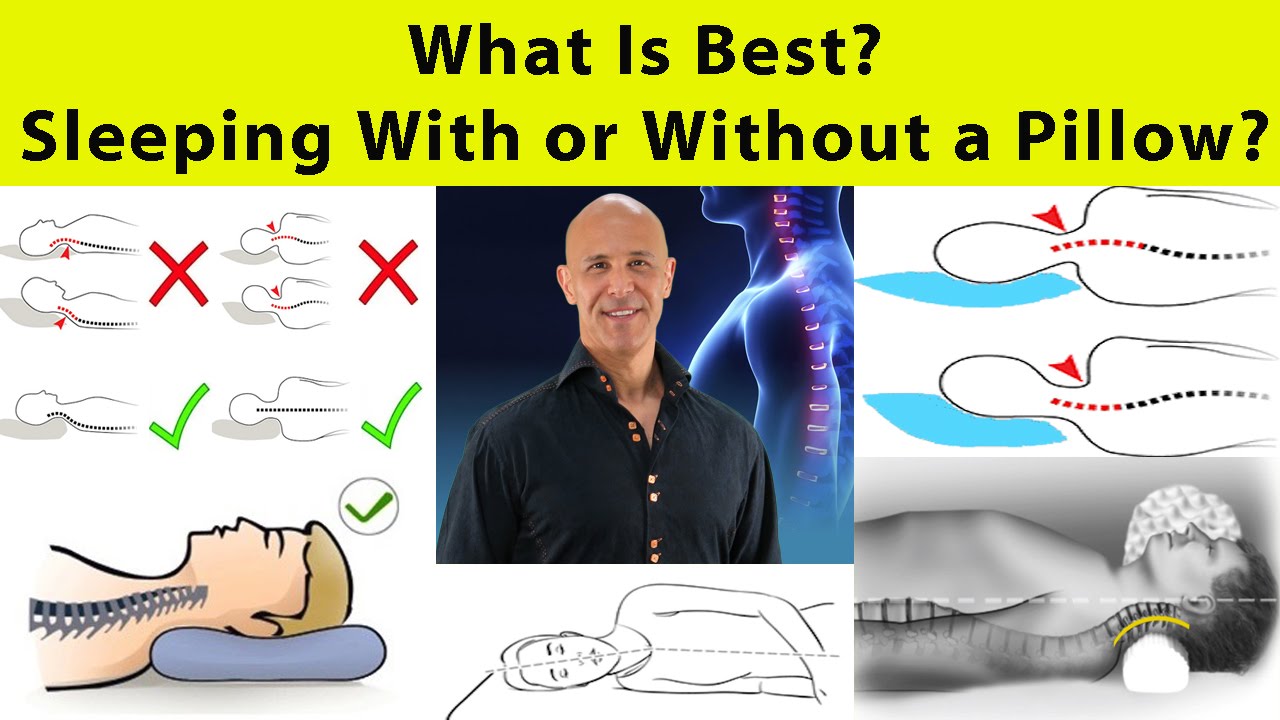 Source: YouTube
Who Benefits From Ditching Their Pillow?
The most common reasons people experiment with pillow-free sleep are related to alignment, comfort, and temperature regulation. In practice, the people who see the most consistent benefits fall into three core groups:
- Stomach sleepers: Standard pillows force the neck into an extreme upward tilt when sleeping on your stomach, leading to chronic neck strain and forward head posture over time. Removing the pillow allows the head to rest in a neutral position aligned with the spine, per expert pillow guidance from leading sleep health nonprofits.
- People with mild pillow-induced neck pain: Overly thick or thin pillows that misalign the cervical spine are a top cause of morning neck stiffness and tension headaches. For people whose pain stems directly from poor pillow height, ditching the pillow entirely can eliminate the root cause.
- People who sleep hot: Pillows, especially memory foam and down varieties, trap body heat around the head and neck. Removing the pillow reduces heat retention, making it easier to stay cool overnight for people who struggle with night sweats or overheating.
- Side sleepers with contouring mattresses: If your mattress has a plush, contouring top layer that cradles your shoulders, a standard pillow can push your head too high, misaligning the cervical spine and putting extra pressure on the rotator cuff of the shoulder you’re lying on.
If you’re concerned about preserving your hairstyle overnight, pillow-free sleep can also reduce friction-related breakage and frizz caused by rubbing against rough pillowcases.
Key Benefits Of Pillow-Free Sleep
Benefits vary based on your body, mattress, and sleep style, but most people who successfully transition to pillow-free sleep report the following improvements:
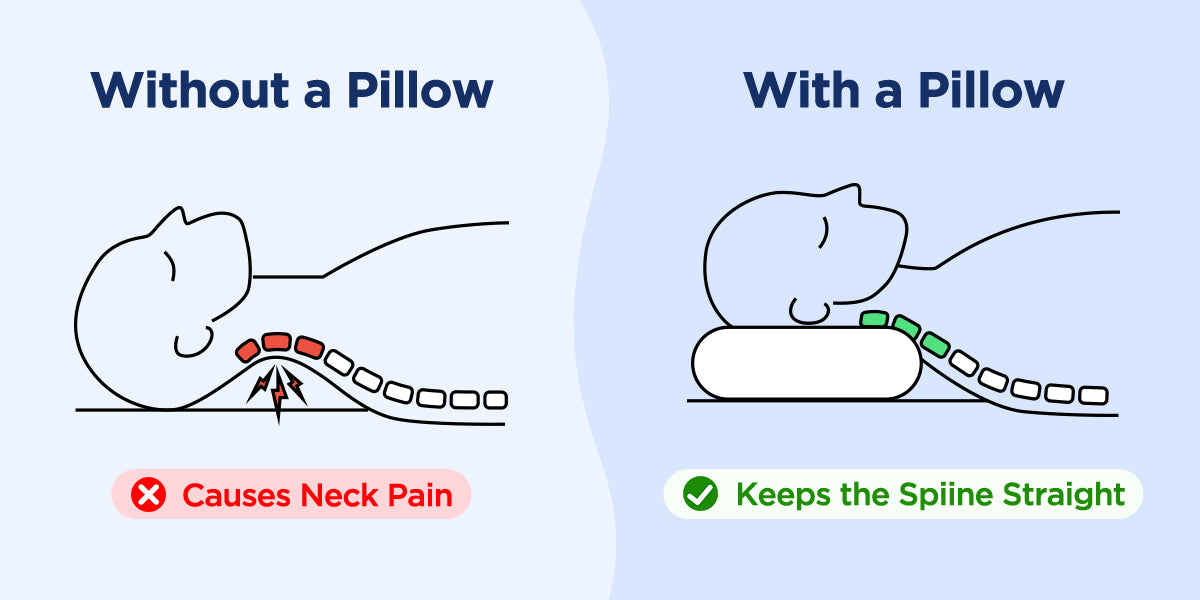
- Improved cervical spine alignment: For stomach sleepers especially, removing a standard pillow eliminates the forced upward tilt of the neck, allowing the cervical spine to rest in a neutral position aligned with the thoracic and lumbar spine. Over time, this reduces morning stiffness and tension headaches caused by strained neck muscles.
- Reduced overheating: Pillows add extra insulation around the head and neck. Removing them lowers the local temperature around your face for most sleepers, which can reduce night sweats and improve sleep continuity.
- Less hair damage: Standard pillowcases create friction against hair as you move overnight, leading to split ends, frizz, and broken strands, especially for curly, wavy, or chemically treated hair. Sleeping without a pillow reduces this friction, and pairing it with a satin pillowcase on your mattress can cut down on damage even more.
- Reduced shoulder pain for side sleepers with contouring mattresses: A plush, contouring mattress cradles your shoulders, so your head can rest level with your spine without a pillow, eliminating pressure on the rotator cuff.
- Simpler bedding routine: Fewer pillows to fluff, adjust, and wash means less time on maintenance, and one less item to displace if you share a bed with a partner or pet.
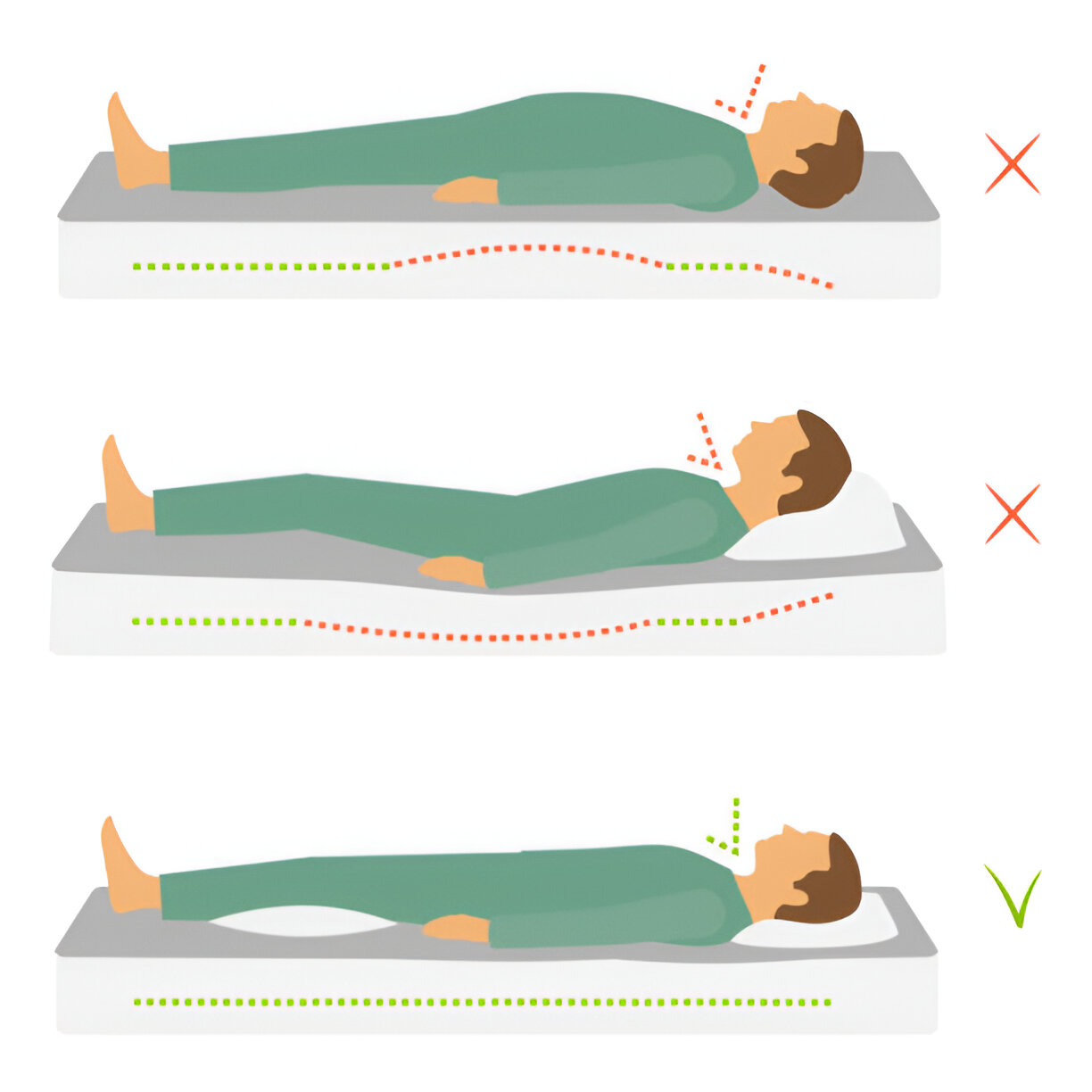 Comparing head and neck positioning with and without a pillow
Source: Eli & Elm
Comparing head and neck positioning with and without a pillow
Source: Eli & Elm
Risks And Who Should Avoid Pillow-Free Sleep
Pillow-free sleep is not safe or comfortable for everyone. The following groups should avoid trying it, or consult a doctor before making the switch:
- People with diagnosed cervical spine conditions: If you have herniated discs, cervical spondylosis, or chronic neck arthritis, the lack of support from a pillow can exacerbate pain and inflammation. Always consult your physical therapist or doctor before ditching your pillow if you have a pre-existing neck condition.
- People with moderate to severe sleep apnea: For many people with sleep apnea, slight head elevation helps keep the airway open by preventing the tongue and soft tissues from collapsing backward during sleep. Removing the pillow entirely can worsen breathing pauses, leading to poorer sleep quality and increased health risks, per sleep apnea guidance from leading medical providers.
- People with TMJ (temporomandibular joint) disorders: Sleeping without a pillow can cause the jaw to rest in an awkward, open position overnight, leading to jaw pain, clicking, and stiffness for people with existing TMJ issues.
Even for healthy people, a rushed transition can cause short-term side effects, including:
- Acute neck stiffness and muscle soreness during the first 1-2 weeks, as your neck muscles adjust to a new position
- Increased pressure on the ears and face for side sleepers, especially on firm mattresses that don’t contour to the head
- Worsened snoring for people who rely on slight head elevation to keep their airway open
- Temporary disruption to sleep quality as you adjust to a new position
If you experience increased pain, breathing issues, or poor sleep for more than 3 nights in a row during your transition, stop immediately and consult a healthcare provider.
 Diagram showing cervical spine alignment with incorrect pillow loft
Source: Sleep Foundation
Diagram showing cervical spine alignment with incorrect pillow loft
Source: Sleep Foundation
Step-By-Step Transition Plan To Sleep Without A Pillow
A gradual transition is critical to avoiding injury and discomfort. Rushing into full pillow-free sleep cold turkey leads to most of the common negative side effects. Follow this 4-6 week plan to adapt safely:
- Week 1: Test with short naps only Start with 15-20 minute naps on a medium-firm mattress, without a pillow, on your back or stomach (avoid side sleeping for naps during this phase). Note how your neck, shoulders, and jaw feel when you wake up. If you feel any sharp pain, stop and try a folded towel under your neck for 1-2 inches of support. If you often nap with damp hair, you can find more safe wet hair tips to avoid hair damage during your tests.
- Weeks 2-3: Add 1-2 full nights per week Choose 1-2 nights per week (e.g., Tuesday and Thursday) to sleep fully without a pillow. Stick to your usual sleep position, but avoid side sleeping for these nights if possible, as side sleepers typically need more support. Keep a simple sleep journal: note any neck stiffness, jaw pain, snoring (if you have a partner who can observe this), and how rested you feel in the morning. If you feel discomfort, use a thin, folded towel (no more than 1 inch thick) placed only under your neck, not your head, to provide minimal support.
- Weeks 4-6: Increase frequency gradually If you feel no pain or disrupted sleep after 2 weeks of 1-2 pillow-free nights, add a third night per week. By week 6, you can try sleeping without a pillow every night if you feel comfortable. If at any point you experience persistent pain, snoring, or poor sleep, revert to using a low-profile pillow for a few nights before resuming the transition.
Key Checkpoints For Success
- If you have neck pain that lasts more than 30 minutes after waking, pause the transition and consult a physical therapist.
- If your partner notices louder snoring, or you wake up gasping, stop immediately and resume using a slightly elevated pillow.
- Give your body at least 4 weeks to adjust before deciding if pillow-free sleep works for you — most people see the full benefits after the 4-week mark, once muscles have adapted to the new position.
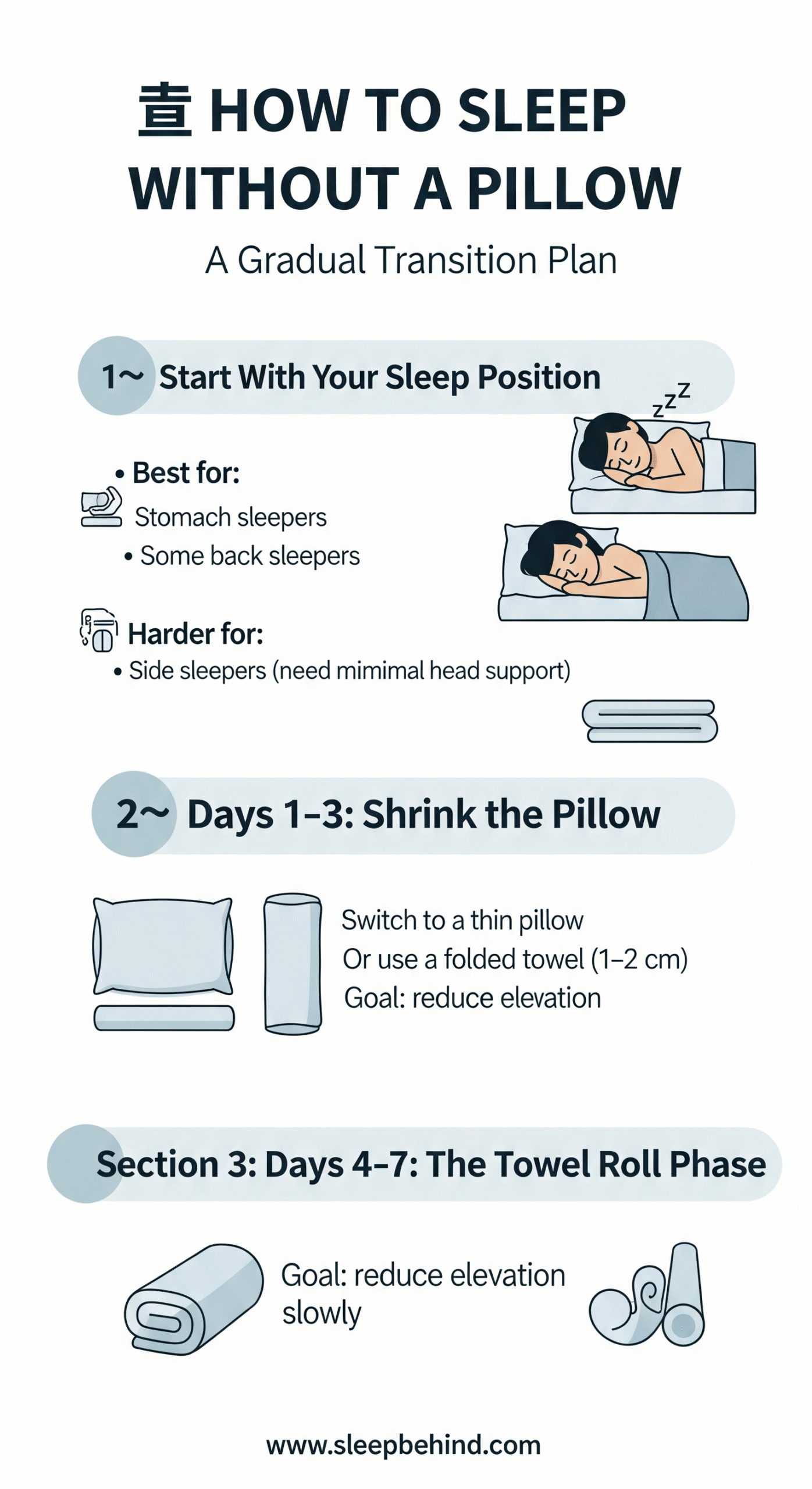 Visual guide to gradual pillow-free sleep adaptation
Position-Specific Tips For Pillow-Free Sleep
Your sleep position is the biggest factor in how comfortable pillow-free sleep will be for you. Use these tips to optimize alignment and reduce discomfort:
Back Sleepers
Back sleepers are the second-best candidates for pillow-free sleep after stomach sleepers, as the position naturally supports a neutral spine when the head is flat. To optimize comfort:
- Keep your hips and shoulders aligned by placing a thin pillow under your knees if you feel lower back pressure.
- Avoid tucking your chin to your chest, which can strain the neck — keep your head in a neutral position, as if you’re standing upright.
- If you have long or styled hair, avoid tight hairstyles that pull on your scalp overnight. For more tips on protecting straightened hair while you sleep, check out our dedicated guide.
Stomach Sleepers
Stomach sleepers are the ideal candidates for pillow-free sleep, as standard pillows force the neck into an extreme upward bend that causes chronic strain. To make the transition comfortable:
- Place a very thin cushion (1 inch or less) under your pelvis if you feel lower back pressure, which helps keep your spine aligned.
- Keep your arms at your sides or under your head (if you use a very thin support) to avoid shoulder strain.
- Avoid twisting your head to the side to breathe, which can cause neck pain — instead, turn your entire upper body slightly if needed, or experiment with a small hole cut in your mattress for your face (a common trick for stomach sleepers who struggle to breathe face-down).
Side Sleepers
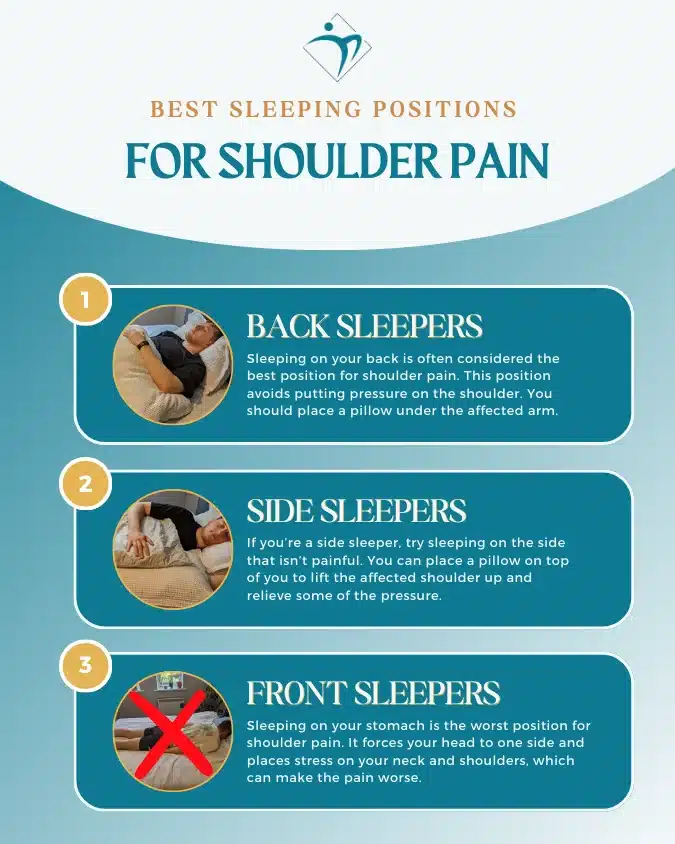
Side sleepers are the least likely to benefit from fully pillow-free sleep, as the position requires support to keep the cervical spine aligned with the rest of the spine. If you want to try reducing your pillow use:
- Use a low-profile, firm neck roll (no more than 2 inches thick) placed directly under your neck, not your head, to support the natural curve of the cervical spine without lifting your head too high.
- Place a standard pillow between your knees to keep your hips aligned and reduce lower back pressure.
- If you find full pillow-free sleep too uncomfortable, try a 2-inch thick memory foam pillow instead of a standard 4-5 inch thick one to reduce loft while still providing support.
Combination Sleepers
If you switch positions multiple times per night, fully ditching your pillow is likely to cause discomfort when you roll onto your side. Instead:
- Use a low-profile pillow for side sleeping phases, and tuck it under your arm or remove it entirely when you roll onto your back or stomach.
- Consider an adjustable pillow that you can reshape to different heights for different positions, or a body pillow that you can hug to keep your shoulders aligned when sleeping on your side.
 Low-profile neck support option for side sleepers trying pillow-free rest
Source: Casper
Low-profile neck support option for side sleepers trying pillow-free rest
Source: Casper
Bedding And Support Alternatives For Pillow-Free Nights
Your mattress and bedding play a huge role in how comfortable pillow-free sleep is — an unsupportive mattress will make even the best transition plan fail. Use these tips to set yourself up for success:
- Choose the right mattress Medium-firm mattresses (rated 5-7 on a 10-point firmness scale) are ideal for pillow-free sleep, as they provide enough support to keep your spine aligned without being so firm that they cause pressure points on your shoulders and hips. If you’re a side sleeper, opt for a plush, contouring mattress top layer that cradles your shoulders, so your head can rest level with your spine without a pillow. If your current mattress is too soft or sagging, consider adding a firm mattress topper to improve support. If you have a feather topper that’s lost its loft, you can learn how to revive a worn feather topper to extend its life.
- Use low-profile support alternatives if needed If you need minimal support during your transition, use a folded bath towel (1 inch thick or less) placed only under your neck, not your head, to provide gentle lift without misaligning your spine. Cervical rolls (small, cylindrical foam supports) are designed to fit the natural curve of the neck, providing support without lifting the head. If you prefer a reusable option, a low-profile bamboo pillow can provide minimal support without the bulk of a standard pillow. You can learn how to clean a bamboo pillow to keep it fresh between uses.
- Optimize your bedding for temperature Since you’ll have less fabric around your head, you may not need as many blankets on your upper body. Use breathable, moisture-wicking sheets (cotton, linen, or bamboo) to reduce heat retention, and keep your bedroom temperature between 15-19°C (60-67°F) for optimal sleep.
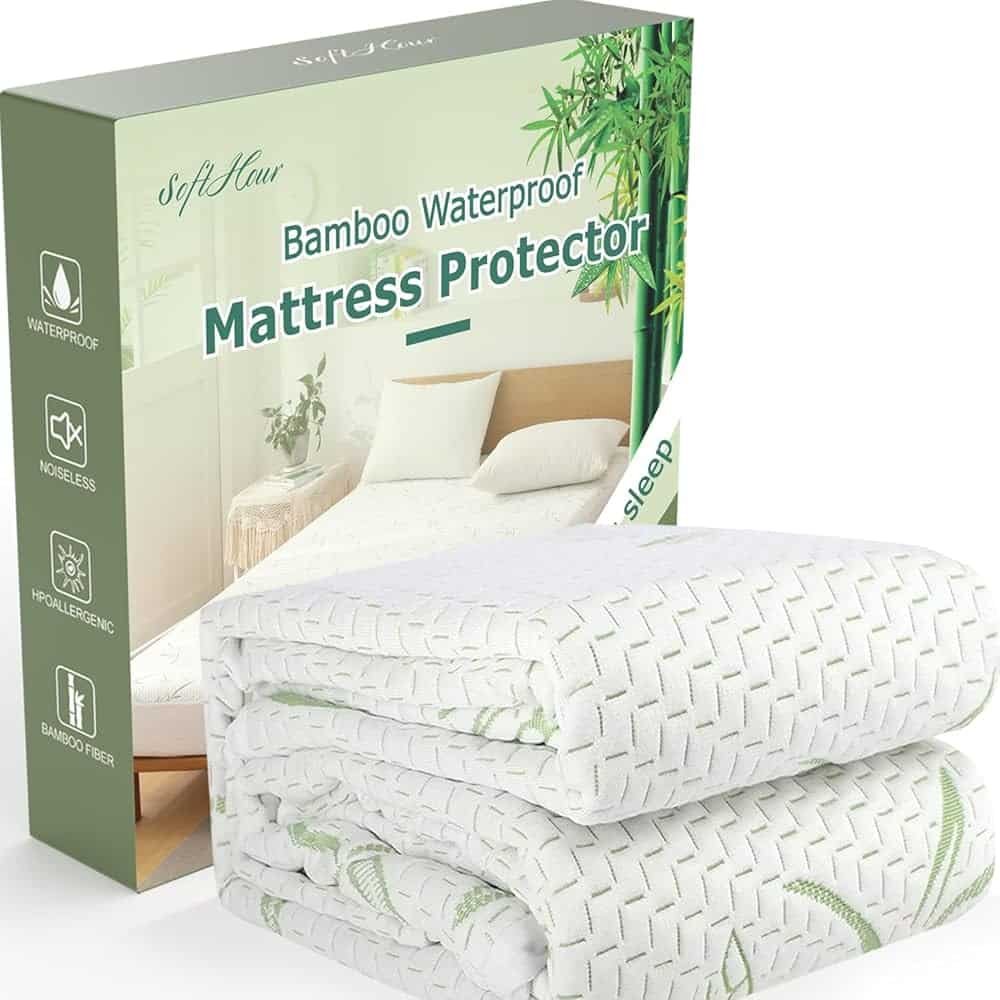
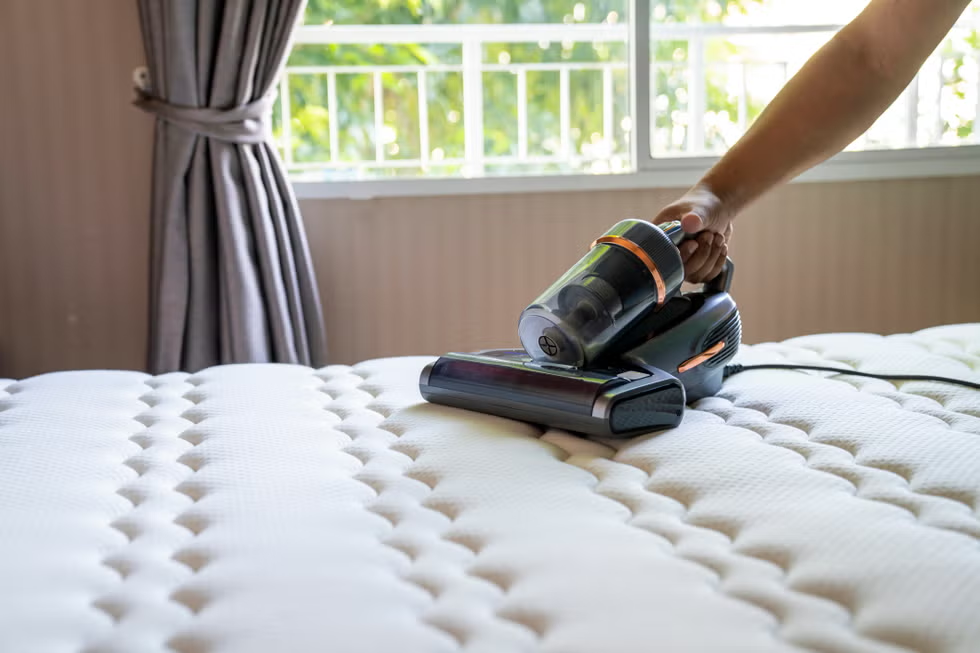
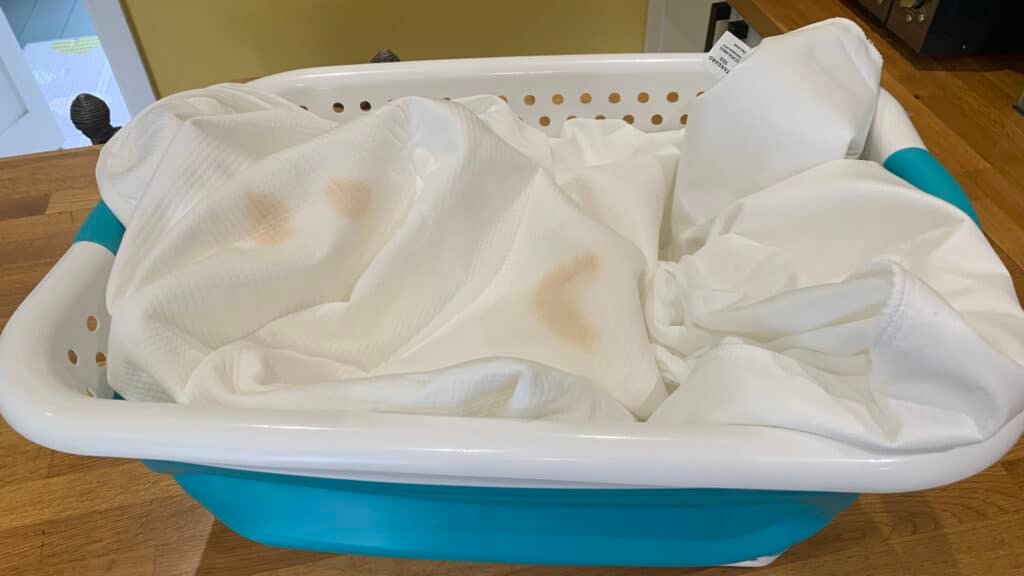
- Keep your sleep surface clean Without a pillow, your face will be pressed directly into your mattress or topper more often, so using a waterproof, breathable mattress protector is key to avoiding exposure to dust mites, dead skin, and spills. You can learn how to keep your mattress protector fresh with easy cleaning tips.
 Contoured mattress toppers and thin supports as pillow substitutes
Source: Zamathome
Contoured mattress toppers and thin supports as pillow substitutes
Source: Zamathome
Troubleshooting Common Transition Issues
Most people face at least one minor issue during the first 2 weeks of transitioning to pillow-free sleep. Use these fixes to resolve common problems without giving up:
- Neck stiffness or soreness in the first week This is the most common issue, as your neck muscles adjust to a new position. Fix: Use a 1-inch thick folded towel under your neck for the first 3-5 nights, then gradually reduce the thickness by half each week until you’re sleeping with no support. Do 5 minutes of gentle neck stretches before bed each night: tilt your head side to side, forward and back, and roll your shoulders to loosen tight muscles.
- Jaw pain or TMJ discomfort Sleeping without a pillow can cause your jaw to hang open or clench overnight, leading to pain. Fix: Use a soft sleep mask to gently support your jaw in a closed position, or try a bite guard if you grind your teeth at night. Avoid caffeine and chewing gum before bed, as these can exacerbate jaw clenching.
- Worsened snoring or breathing issues If you notice louder snoring or wake up gasping, you likely need slight head elevation to keep your airway open. Fix: Try placing a 1-inch thick book under the head of your mattress to raise your upper body slightly, or use a low-profile wedge pillow instead of going fully pillow-free.
- Face or ear pressure from side sleeping Side sleepers often experience pressure on the ear and side of the face when sleeping without a pillow. Fix: Use a soft, contoured mattress topper to reduce pressure points, or use a thin neck roll for support when sleeping on your side.
- Hair mess or breakage If you’re used to sleeping with wet hair or styled hair, a pillow can help keep your hair off your face. Fix: Use a loose silk scrunchie to tie your hair back in a low ponytail, or a satin bonnet to reduce friction. For more tips on sleeping with wet or styled hair, check out our guide to safe wet hair habits.
 Optimal pillow-free positioning for stomach sleepers
Source: Casper
Optimal pillow-free positioning for stomach sleepers
Source: Casper
Frequently Asked Questions
Is it safe to sleep without a pillow every night?
For most healthy people without pre-existing neck or breathing conditions, yes. However, people with cervical spine issues, moderate to severe sleep apnea, or TMJ disorders should consult a doctor or physical therapist before making the switch, as pillow-free sleep may worsen their symptoms.
How long does it take to adjust to sleeping without a pillow?
Most people adjust fully within 4-6 weeks with a gradual transition plan. Some people feel comfortable after 1-2 weeks, while others may take up to 8 weeks if they have chronic neck stiffness. Rushing the process increases the risk of injury and discomfort.
Will sleeping without a pillow reduce neck pain?
For people whose neck pain is caused by overly thick or thin pillows that misalign the cervical spine, yes — pillow-free sleep can reduce or eliminate pain over time. However, if your neck pain is caused by a pre-existing condition, poor posture during the day, or an unsupportive mattress, ditching your pillow may not help, and could make pain worse.
Can side sleepers sleep without a pillow?
Fully pillow-free sleep is not recommended for most side sleepers, as the position requires support to keep the cervical spine aligned with the rest of the spine. Side sleepers can try using a very low-profile neck roll (1-2 inches thick) to reduce pillow loft while still getting enough support to avoid neck strain.
Will sleeping without a pillow damage my hair?
No, in fact, many people find that sleeping without a pillow reduces hair breakage and frizz, as there is less friction between their hair and a pillowcase. If you’re worried about your hair getting messy, use a silk pillowcase on your mattress or a satin bonnet to reduce friction and keep your style intact overnight.
Do I need a special mattress to sleep without a pillow?
You don’t need a special mattress, but a medium-firm, supportive mattress will make the transition much more comfortable. Very soft, sagging mattresses will not provide enough support for your spine when you’re not using a pillow, leading to pain and poor alignment.
Can children sleep without a pillow?
Infants under 12 months old should never sleep with a pillow due to SIDS risk, and they don’t need one. Older children can try pillow-free sleep if they want, but it’s best to consult their pediatrician first to make sure it’s safe for their developing spine.
 FAQ graphic addressing pillow-free sleep concerns
Source: Saatva
FAQ graphic addressing pillow-free sleep concerns
Source: Saatva
Final Takeaway
Sleeping without a pillow can be a game-changer for stomach sleepers, people with mild pillow-induced neck pain, and anyone who struggles with overheating at night — but it’s not a one-size-fits-all solution. The key to success is a slow, gradual transition, listening to your body’s signals, and adjusting your bedding to support your spine without a standard pillow.
If you’re ready to try pillow-free sleep, start with a 20-minute nap today and track how your neck feels when you wake up. If you’re concerned about preserving your hair while sleeping without a pillow, check out our guide to maintaining straight hair for simple, low-effort tips. If you’re looking for more ways to improve your sleep quality without overhauling your routine, our deep sleep tips can help you fall asleep faster and stay asleep longer. If you do choose to keep using a pillow, you can find more guidance on waking up refreshed with the right bedding in our dedicated guide.
Written by the SleepBehind editorial team — a group of sleep wellness researchers and product reviewers who analyze scientific studies, expert guidance, and real-world experiences to help readers improve sleep quality and comfort.