
You set your 6:00 AM alarm determined to start the day energized, only to hit snooze three times and drag yourself out of bed feeling like you haven’t slept at all—even though you were in bed for a full 8 hours. If this sounds familiar, the problem isn’t the amount of sleep you’re getting. It’s that you’re waking up at the wrong point in your sleep cycle.
Sleep doesn’t happen in one continuous block. Your brain cycles through 4 distinct sleep stages roughly every 90 minutes all night long, with a brief natural window of light sleep at the end of each cycle. If your alarm goes off during that window, you’ll wake up feeling alert and refreshed. If it goes off mid-cycle—even after 8 hours of rest—you’ll be hit with sleep inertia: that thick, disoriented grogginess that can last up to an hour. You can also read our guide on sleep deprivation symptoms.
The exact bedtimes for a 6:00 AM wake-up aren’t arbitrary. They’re calculated to align your alarm with the end of a full 90-minute sleep cycle, with a built-in buffer for the average time it takes adults to fall asleep. In this guide, you’ll get precise, cycle-aligned bedtimes, the science behind why they work, and actionable steps to make your 6am mornings feel effortless starting tonight.
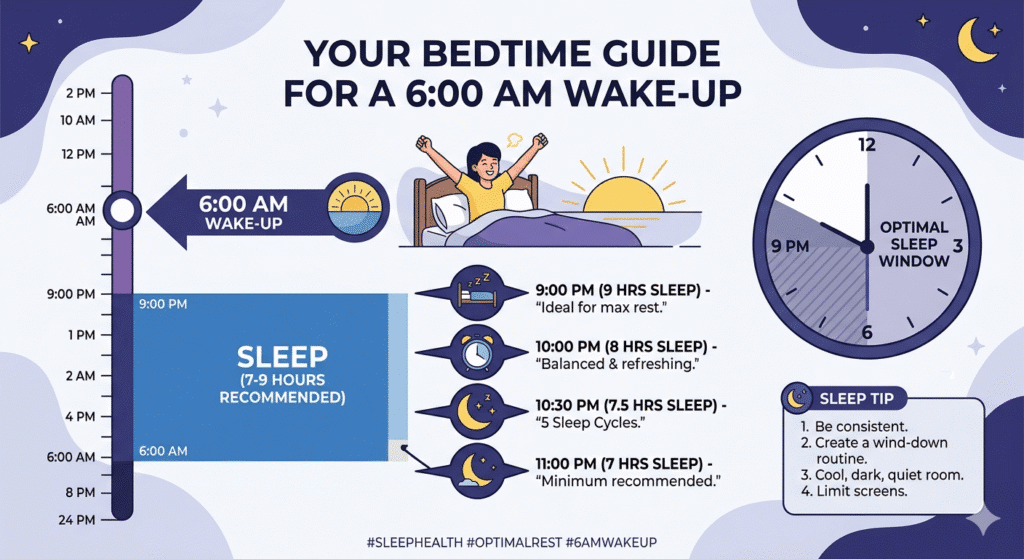 Exact bedtimes calculated to align with 90-minute sleep cycles for a 6:00 AM wake-up.
Exact Bedtimes for a 6:00 AM Wake-Up
All bedtimes below are built on two core pieces of sleep science: the average 90-minute sleep cycle length, and the 14-minute average sleep onset latency (the time it takes most adults to fall asleep after getting into bed). Most generic sleep calculators ignore this buffer, which is why their recommended times often leave you waking up groggy. You can also read our guide on how to wake up refreshed.
The table below outlines cycle-aligned bedtimes for a 6:00 AM alarm, including the time you’ll fall asleep, total sleep duration, and best use cases for each option:
| Target Bedtime | Expected Fall Asleep Time | Total Sleep | Number of 90-Min Cycles | Best For |
|---|---|---|---|---|
| 8:46 PM | 9:00 PM | 9 hours | 6 cycles | Teens (14–17), illness recovery, paying down severe sleep debt |
| 10:16 PM | 10:30 PM | 7.5 hours | 5 cycles | Most adults (18–64), ideal for consistent 6am wake-ups |
| 11:46 PM | 12:00 AM | 6 hours | 4 cycles | Occasional late nights only, not sustainable long-term |
| 1:16 AM | 1:30 AM | 4.5 hours | 3 cycles | Emergency use only, not recommended for regular use |
For the majority of working adults with a 6:00 AM alarm, 10:16 PM is your target bedtime. This is not the time you start your wind-down routine—it’s the time your head should be on the pillow, lights out, ready to sleep. Build your evening around being fully ready for bed by 10:00 PM, so you can drift off by 10:30 PM and wake up at the natural end of your 5th sleep cycle at 6:00 AM.
Why does 10:16 PM beat the commonly recommended 10:00 PM bedtime? A 10:00 PM to 6:00 AM window is 8 hours, but 8 hours does not divide evenly into 90-minute cycles. You’ll wake up roughly 30 minutes into your 6th sleep cycle, pulled from moderately deep N2 sleep and hit with strong sleep inertia. The 14 extra minutes of sleep you get from a 10:16 PM bedtime make all the difference in waking up feeling refreshed. You can also read our guide on bedtime routine for better sleep.
The Science Behind 90-Minute Sleep Cycles
Your brain doesn’t power down for 8 hours straight. It moves through a repeating 4-stage cycle roughly every 90 minutes, with each stage serving a unique purpose for your physical and mental health. These guidelines align with CDC adult sleep recommendations, which advise 7–9 hours of nightly rest for adults to support overall health:
- N1 (Light Sleep): The 5-minute transition phase where you’re drifting off. You’re easily woken here, and may experience the sensation of "falling" as your muscles relax.
- N2 (True Sleep): The 20-minute stage where your heart rate slows, body temperature drops, and your brain processes short-term memories. You spend ~45% of your total sleep time in N2.
- N3 (Deep Sleep): The 40-minute stage where your body repairs tissue, releases growth hormone, and strengthens your immune system. Deep sleep dominates the first half of the night, and is the hardest stage to wake from without significant grogginess.
- REM Sleep: The 25-minute stage where your brain consolidates memories, processes emotions, and clears metabolic waste. REM cycles get progressively longer as the night goes on, which is why cutting sleep short by even 90 minutes can eliminate nearly half of your total REM rest.
At the end of every full cycle, you briefly return to light N1 sleep—almost waking up—before the next cycle begins. This is the natural window your alarm should target. Waking here feels effortless, as your brain is already primed for consciousness. Waking mid-cycle, especially during N3 deep sleep or early N2, triggers sleep inertia: a transitional state of impaired alertness, disorientation, and the urge to fall back asleep that can last 15 to 60 minutes.
The 14-minute sleep onset buffer accounts for the time it takes to move from being in bed to actually entering N1 sleep. In practice, many people overestimate how quickly they fall asleep, especially if they’re scrolling or ruminating on stressful thoughts before bed. If you know you take 20+ minutes to drift off, shift your bedtime 10–15 minutes earlier than the 10:16 PM target to stay aligned with cycle endpoints. You can also read our guide on how to improve rem sleep naturally.
Why 8 Hours of Sleep Can Still Leave You Tired at 6am
The frustration of waking up groggy after 8 hours of rest is one of the most common sleep complaints, and it almost always comes down to cycle misalignment. Let’s break down the math:
- 5 full cycles = 7.5 hours of sleep ✓ (perfect alignment with 6am wake-up)
- 5.33 cycles = 8 hours of sleep ✗ (you wake up 30 minutes into your 6th cycle, mid-N2 sleep)
- 6 full cycles = 9 hours of sleep ✓ (perfect alignment, best for teens and recovery)
That extra 30 minutes beyond 7.5 hours may actually make you feel worse, not better. Your brain has already completed 5 cycles and was preparing to enter a 6th cycle it expected to finish in full. When your alarm interrupts that cycle 30 minutes in, you’re pulled from a moderately deep sleep stage, triggering stronger sleep inertia than if you’d woken up between cycles.
The snooze button makes this problem drastically worse. When you hit snooze at 6:00 AM, your brain immediately starts a new 90-minute sleep cycle. Nine minutes later, when the snooze alarm fires, you’re being yanked out of the earliest, deepest part of that new cycle—stage N2, where your brain is least ready to transition to wakefulness. You’ll feel far more disoriented than if you’d just gotten up on the first alarm.
The solution is counterintuitive but effective: when your bedtime is set to 10:16 PM, waking up at 6:00 AM on the first alarm will feel dramatically easier, because your brain is already at the natural end of a cycle, not stuck in the middle of one.
How to Calculate Your Exact Personal Bedtime (Not Just the Average)
The 10:16 PM bedtime is a perfect starting point for most adults, but your ideal time may shift slightly based on your individual sleep patterns:
- Adjust for your personal sleep onset time: The 14-minute buffer is an average. If you know you take 20 minutes to fall asleep after getting into bed, subtract 6 extra minutes from your bedtime (10:10 PM) to ensure you still drift off by 10:30 PM. If you fall asleep in 10 minutes or less, you can shift to 10:20 PM.
- Account for cycle length variation: While 90 minutes is the average sleep cycle length, individual cycles can range from 80 to 100 minutes depending on age, sleep debt, and alcohol consumption. If you notice you consistently wake up groggy at 6am even with a 10:16 PM bedtime, try shifting 10 minutes earlier or later for a few nights to find your personal sweet spot.
- Shift gradually if you’re a night owl: If you’re used to going to bed at 1:00 AM, jumping straight to 10:16 PM will be unsustainable. Shift your bedtime earlier by 15 minutes every 2–3 days until you reach your target, and keep your 6:00 AM wake time consistent even on weekends to anchor your circadian rhythm.
Common Mistakes That Derail Your 6am Wake-Up Routine
Even with the perfect bedtime calculated, a few consistent habits can throw off your cycle alignment and leave you groggy:
1. Assuming 10:00 PM or 11:00 PM is "close enough"
Many people default to a round 10:00 PM or 11:00 PM bedtime, assuming the small difference won’t matter. But 10:00 PM to 6:00 AM is 8 hours, which doesn’t align with 90-minute cycles—you’ll wake up mid-cycle, just as you would with a misaligned 10:16 PM bedtime. The extra 16 minutes of sleep you get from a properly timed 10:16 PM bedtime are the difference between waking up refreshed and dragging yourself through the morning.
2. Sleeping in on weekends to "catch up"
This practice, called social jet lag, actively disrupts your circadian rhythm. Waking up at 6:00 AM on weekdays but 9:00 AM on Saturday shifts your internal clock three hours in two days, then forces it to reset abruptly on Monday. That’s why Monday morning 6am alarms feel so brutal. Your circadian rhythm is anchored by consistent wake times, not consistent bedtimes—keep your 6:00 AM wake time within 30 minutes even on weekends, even if you go to bed an hour later the night before.
3. Scrolling your phone until the last minute
Blue light from phones, tablets, and laptops suppresses melatonin production (the hormone that signals sleepiness) by up to 90 minutes, per sleep research. Even 10 minutes of scrolling in bed can delay your sleep onset by 15–20 minutes, pushing your actual fall-asleep time past 10:30 PM and throwing off your cycle alignment. Turn off all devices at least 30 minutes before bed, and keep your phone out of the bedroom if possible to avoid late-night temptations. If you regularly wash your hair at night, understanding how wet hair impacts sleep can help you adjust your routine to avoid dampness and discomfort that delay sleep onset.
4. Overdoing caffeine in the afternoon
Caffeine has a half-life of 5–6 hours, meaning a 3:00 PM coffee still has 50% of its stimulant effect in your system at 9:30 PM, right when your brain needs to be preparing for sleep. Cut off all caffeine (including soda, energy drinks, and even decaf, which has small amounts) by 2:00 PM to ensure it’s fully out of your system by your 10:16 PM bedtime.
5. Skipping your wind-down routine
Your brain can’t switch from work, stress, or high stimulation to sleep instantly. A 30–60 minute wind-down routine—low light, quiet activities, no work emails—signals to your body that it’s time to sleep. Starting your wind-down at 10:00 PM when you need to be asleep by 10:30 PM leaves no buffer for your brain to transition, leading to 30+ minutes of lying awake before you drift off.
5 Actionable Steps to Hit Your 10:16 PM Bedtime Tonight
Knowing your target bedtime is only half the battle. These simple, actionable steps will help you make the 10:16 PM routine stick starting tonight:
- Set two strategic alarms: Set a first alarm for 9:45 PM labelled "Start wind-down" to signal it’s time to wrap up work, turn off screens, and start relaxing. Set a second alarm for 10:00 PM labelled "Get in bed, lights out by 10:16" to act as a hard stop for your evening. Place your phone across the room so you have to get out of bed to turn the alarm off, preventing late scrolling.
- Optimize your pre-sleep routine: If you wash your hair or do a full skincare routine before bed, follow safe pre-sleep hair routines to avoid dampness or heavy products making your pillow uncomfortable and delaying sleep onset. For those with long or straight hair, using comfortable sleep hairstyles prevents tangles and pulling that can rouse you during light sleep stages.
- Prepare your bedroom for sleep: Keep your bedroom cool (65–68°F / 18–20°C), pitch black, and quiet. A cool room supports the 1°C drop in core body temperature needed to initiate sleep. Regularly cleaning your mattress protector reduces dust mites and allergens that can cause congestion and disrupt sleep onset. If your mattress is uncomfortable, a high-quality mattress topper can reduce pressure points and help you fall asleep faster.
- Cut off caffeine and heavy meals early: Finish all caffeine intake by 2:00 PM, and avoid heavy, spicy meals 2–3 hours before bed. A large meal raises your core body temperature and activates digestion, both of which delay sleep onset. If you’re hungry before bed, opt for a small, protein-rich snack like a banana or handful of almonds.
- Avoid the snooze button at all costs: When your 6:00 AM alarm goes off, get up immediately. Since you’re waking up at the end of a full sleep cycle, you won’t feel the need to snooze if your bedtime is consistent. If you do feel groggy, sit up in bed and get some natural light for 2–3 minutes—this signals your circadian rhythm to fully wake up, eliminating sleep inertia faster than hitting snooze.
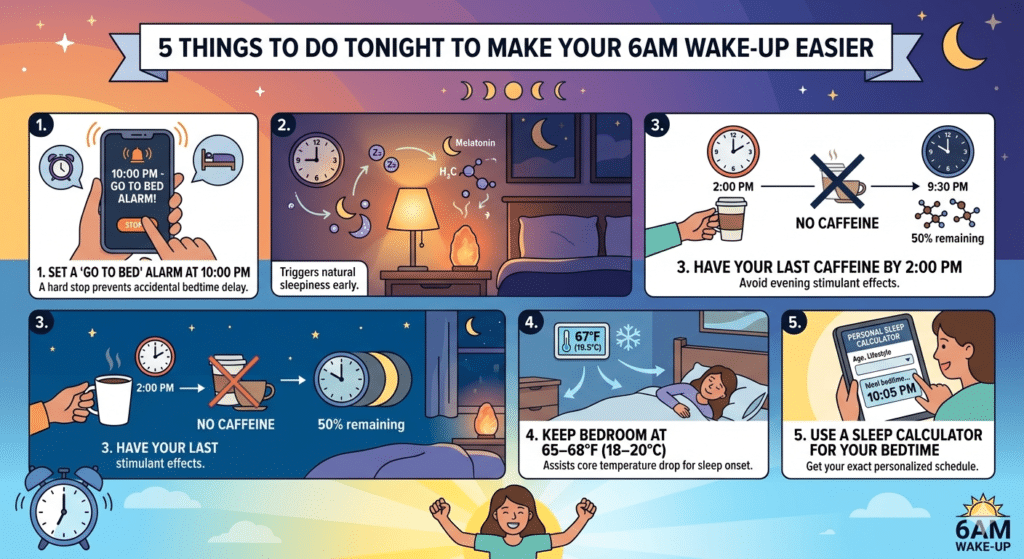 Simple, actionable steps to implement tonight to make waking at 6am feel effortless.
Get Your Exact Personalised Bedtime
Our free AI Sleep Calculator generates a cycle-aligned sleep schedule based on your exact fall-asleep time, age, and lifestyle. No sign-up, no data stored, results in 30 seconds. It will give you a precise bedtime for your 6:00 AM wake-up that accounts for your unique sleep patterns, so you never have to guess again.
Use the Free AI Sleep Calculator
Frequently Asked Questions
What time should I go to bed if I wake up at 6am?
For most adults aged 18–64, the ideal bedtime is 10:16 PM. This gives you 5 full 90-minute sleep cycles (7.5 hours of total sleep, accounting for the 14-minute average fall-asleep time) and aligns your 6:00 AM alarm with the natural light sleep window at the end of your 5th cycle, so you wake up feeling refreshed. If you’re a teen, recovering from illness, or paying down severe sleep debt, aim for 8:46 PM to get 6 full cycles and 9 hours of sleep.
Is 10pm to 6am enough sleep?
Yes, 8 hours of sleep is within the 7–9 hour range recommended by the CDC for adults. However, 10:00 PM to 6:00 AM does not align with 90-minute sleep cycles—if you take the average 14 minutes to fall asleep, you’ll only get 7 hours 46 minutes of rest, which is just short of 5 full cycles. Shifting your bedtime to 10:16 PM to hit 7.5 hours of cycle-aligned sleep will leave you feeling far more refreshed than 8 hours of misaligned rest.
Why am I still tired after 8 hours of sleep if I wake at 6am?
Eight hours of sleep (from 10:00 PM or 11:00 PM to 6:00 AM) does not divide evenly into 90-minute sleep cycles, so your alarm will pull you out of the middle of your 6th cycle, triggering sleep inertia. That groggy, disoriented feeling is not a sign you need more sleep—it’s a sign you woke up at the wrong point in your cycle. Shifting to a 10:16 PM bedtime for 7.5 hours of cycle-aligned sleep will eliminate most of that grogginess.
What time should a teenager go to bed to wake up at 6am?
Teens aged 14–17 need 8–10 hours of sleep per night to support growth, academic performance, and emotional regulation. For a 6:00 AM wake-up, teens should aim for a bedtime between 8:46 PM (9 hours, 6 cycles) and 10:16 PM (7.5 hours, 5 cycles, the minimum recommended for this age group). Adolescent circadian rhythms naturally shift later, so if an 8:46 PM bedtime feels impossible, shift earlier by 15 minutes every few days until you reach the target.
Is 6 hours of sleep enough if I wake up at 6am?
Six hours of sleep (bedtime 11:46 PM, 4 full cycles) is below the 7–9 hour recommendation for adults, and chronic 6-hour sleep is linked to impaired cognitive function, weakened immunity, and increased long-term health risks. The 11:46 PM bedtime is only appropriate for occasional late nights, not regular use. If you regularly can’t get to bed earlier than 11:46 PM, consider adjusting your 6:00 AM wake-up time to allow for more full sleep cycles.
Does the snooze button help when waking at 6am?
No, snoozing makes morning grogginess significantly worse. When you hit snooze, your brain starts a new 90-minute sleep cycle, so the next alarm 9 minutes later pulls you out of the deepest part of that new cycle, triggering stronger sleep inertia than waking up on the first alarm. If you set your bedtime to 10:16 PM, waking up at 6:00 AM on the first alarm will feel much easier, as you’ll be waking at the end of a full cycle.
What if I can’t fall asleep by 10:30pm even if I get in bed at 10:16pm?
First, check if you’re doing too much screen time or intense activity before bed—blue light and stimulation can delay sleep onset by 30 minutes or more. If you’ve already cut out those triggers and still lie awake for more than 20 minutes, get out of bed and do a quiet, low-stimulation activity (like reading a physical book or folding laundry) in dim light until you feel sleepy. If this is a regular issue, you may have insomnia or another sleep disorder, and should consult a healthcare provider for personalized advice.
Conclusion
Waking up at 6:00 AM feeling refreshed doesn’t require more sleep—it requires the right bedtime aligned to your body’s natural 90-minute sleep cycles. For most adults, that means getting into bed at 10:16 PM, falling asleep by 10:30 PM, and completing 5 full cycles for 7.5 hours of uninterrupted rest.
The core principle is simple: prioritize cycle alignment over hitting a random total hour count. Adjust the 14-minute fall-asleep buffer up or down based on your personal sleep onset time, and avoid the common mistakes of sleeping in on weekends, scrolling before bed, or relying on the snooze button.
Your one clear next step: set a 10:00 PM alarm on your phone tonight to start your wind-down routine, and aim for the 10:16 PM lights-out time for 7 consecutive days. Track how your 6:00 AM wake-up feels by the end of the week—you’ll likely notice a dramatic drop in grogginess.
For a fully personalized bedtime recommendation that accounts for your age, sleep habits, and any existing sleep issues, use our free AI Sleep Calculator to get your exact schedule in 30 seconds, no sign-up required.
This article is for educational purposes only and does not constitute medical advice. If you experience persistent sleep difficulties, consult a licensed healthcare professional or sleep specialist.
Get Your Exact Personalised Bedtime
Our free AI Sleep Calculator generates a cycle-aligned sleep schedule based on your exact fall-asleep time, age, and lifestyle. No sign-up, no data stored, results in 30 seconds. It will give you a precise bedtime for your 6:00 AM wake-up that accounts for your unique sleep patterns, so you never have to guess again.
Use the Free AI Sleep Calculator
Frequently Asked Questions
What time should I go to bed if I wake up at 6am?
For most adults aged 18–64, the ideal bedtime is 10:16 PM. This gives you 5 full 90-minute sleep cycles (7.5 hours of total sleep, accounting for the 14-minute average fall-asleep time) and aligns your 6:00 AM alarm with the natural light sleep window at the end of your 5th cycle, so you wake up feeling refreshed. If you’re a teen, recovering from illness, or paying down severe sleep debt, aim for 8:46 PM to get 6 full cycles and 9 hours of sleep.
Is 10pm to 6am enough sleep?
Yes, 8 hours of sleep is within the 7–9 hour range recommended by the National Sleep Foundation for adults. However, 10:00 PM to 6:00 AM does not align with 90-minute sleep cycles—if you take the average 14 minutes to fall asleep, you’ll only get 7 hours 46 minutes of rest, which is just short of 5 full cycles. Shifting your bedtime to 10:16 PM to hit 7.5 hours of cycle-aligned sleep will leave you feeling far more refreshed than 8 hours of misaligned rest.
Why am I still tired after 8 hours of sleep if I wake at 6am?
Eight hours of sleep (from 10:00 PM or 11:00 PM to 6:00 AM) does not divide evenly into 90-minute sleep cycles, so your alarm will pull you out of the middle of your 6th cycle, triggering sleep inertia. That groggy, disoriented feeling is not a sign you need more sleep—it’s a sign you woke up at the wrong point in your cycle. Shifting to a 10:16 PM bedtime for 7.5 hours of cycle-aligned sleep will eliminate most of that grogginess.
What time should a teenager go to bed to wake up at 6am?
Teens aged 14–17 need 8–10 hours of sleep per night to support growth, academic performance, and emotional regulation. For a 6:00 AM wake-up, teens should aim for a bedtime between 8:46 PM (9 hours, 6 cycles) and 10:16 PM (7.5 hours, 5 cycles, the minimum recommended for this age group). Adolescent circadian rhythms naturally shift later, so if an 8:46 PM bedtime feels impossible, shift earlier by 15 minutes every few days until you reach the target.
Is 6 hours of sleep enough if I wake up at 6am?
Six hours of sleep (bedtime 11:46 PM, 4 full cycles) is below the 7–9 hour recommendation for adults, and chronic 6-hour sleep is linked to impaired cognitive function, weakened immunity, and increased long-term health risks. The 11:46 PM bedtime is only appropriate for occasional late nights, not regular use. If you regularly can’t get to bed earlier than 11:46 PM, consider adjusting your 6:00 AM wake-up time to allow for more full sleep cycles.
Does the snooze button help when waking at 6am?
No, snoozing makes morning grogginess significantly worse. When you hit snooze, your brain starts a new 90-minute sleep cycle, so the next alarm 9 minutes later pulls you out of the deepest part of that new cycle, triggering stronger sleep inertia than waking up on the first alarm. If you set your bedtime to 10:16 PM, waking up at 6:00 AM on the first alarm will feel much easier, as you’ll be waking at the end of a full cycle.
What if I can’t fall asleep by 10:30pm even if I get in bed at 10:16pm?
First, check if you’re doing too much screen time or intense activity before bed—blue light and stimulation can delay sleep onset by 30 minutes or more. If you’ve already cut out those triggers and still lie awake for more than 20 minutes, get out of bed and do a quiet, low-stimulation activity (like reading a physical book or folding laundry) in dim light until you feel sleepy. If this is a regular issue, you may have insomnia or another sleep disorder, and should consult a healthcare provider for personalized advice.
Conclusion
Waking up at 6:00 AM feeling refreshed doesn’t require more sleep—it requires the right bedtime aligned to your body’s natural 90-minute sleep cycles. For most adults, that means getting into bed at 10:16 PM, falling asleep by 10:30 PM, and completing 5 full cycles for 7.5 hours of uninterrupted rest.
The core principle is simple: prioritize cycle alignment over hitting a random total hour count. Adjust the 14-minute fall-asleep buffer up or down based on your personal sleep onset time, and avoid the common mistakes of sleeping in on weekends, scrolling before bed, or relying on the snooze button.
Your one clear next step: set a 10:00 PM alarm on your phone tonight to start your wind-down routine, and aim for the 10:16 PM lights-out time for 7 consecutive nights. Track how your 6:00 AM wake-up feels by the end of the week—you’ll likely notice a dramatic drop in grogginess.
For a fully personalized bedtime recommendation that accounts for your age, sleep habits, and any existing sleep issues, use our free AI Sleep Calculator to get your exact schedule in 30 seconds, no sign-up required.
This article is for educational purposes only and does not constitute medical advice. If you experience persistent sleep difficulties, consult a licensed healthcare professional or sleep specialist.
If you consistently struggle to fall asleep at your target bedtime or wake up feeling unrefreshed after 2 weeks of following this guide, consider requesting a referral for a sleep study to rule out underlying conditions like insomnia, sleep apnea, or delayed sleep phase disorder, which require targeted medical intervention to resolve.

Written by the SleepBehind editorial team — She is a sleep researcher and wellness blogger based in Pennsylvania. Passionate about helping people optimize their sleep.